The use of drones has become widespread not only for military purposes but also for civilian tasks. They are used for aerial reconnaissance, fire adjustment, photography and videography, mapping, agriculture, search-and-rescue operations, and more. The effectiveness of a drone's operation largely depends on its technical components, among which the motor plays a key role.
The motor is the basis of a drone's power system, its "heart," which directly determines flight characteristics. Lift, climb rate, maneuverability, and stability in the air depend on the motor's efficiency.
The Flash Army team prepared this material for everyone who uses drones across various fields. In this article, we will examine the role motors play in drone design, their main characteristics, types, and features.
What is a drone motor
A drone motor is an electric motor that converts electrical energy from the battery into mechanical energy and drives the propellers. It is thanks to the motors' operation that altitude is maintained, movement in different directions occurs, and maneuvers are performed.
Properly selected drone motors ensure proper operation. If the motor's characteristics are incompatible with the frame size, propeller type, or power supply voltage, it can lead to overheating, increased power consumption, reduced thrust, and accelerated wear on parts. In critical cases, speed controllers may overload, or the motor may fail.
Main motor characteristics
The motor's technical parameters directly affect its compatibility with different types of drones. Among the main characteristics, it is worth highlighting power, motor type, operating voltage, and dimensions. Let's consider each parameter in more detail.
Power and thrust
Power is determined by the size (stator), KV value (RPM/volt), and battery voltage. The higher the KV, the faster the motor spins, but the smaller the propeller it can turn. A high KV value (e.g., 2500KV+) is suitable for fast and light drones, while a low KV value (900–1300KV) is better for freestyle. It is worth noting that more maneuverable drones can more easily bypass drone detectors.
Drone motors are chosen based on the thrust-to-weight ratio, where the total thrust of the motors must exceed the drone's weight by at least two times (for racing, it’s 8–10:1). It is important to ensure that one motor produces thrust that is at least 50–60% of the drone's total weight.
Let's consider how the "thrust-to-weight" rule works using an FPV motor as an example:
- 2:1 — drone barely flies (for filming);
- 4:1 — comfortable flight and good control (standard);
- 10:1 — high speed.
Motor type (brushless or brushed)
Drone motors are divided into two types: brushed and brushless.
Brushed motors have a simple design that includes brushes and a commutator. In such a motor, electric current is transmitted to the rotor windings through special brushes (graphite or metal) that contact the commutator. This element is responsible for changing the direction of the current and ensuring rotor rotation.
The operating principle is quite simple, but they have a limited lifespan. Due to constant friction, the brushes wear out over time, leading to the need for motor replacement. Brushed motors are mostly installed in compact drones, training models, and budget devices.
Brushless motors are a more modern and common option. They are used for FPV drones, aerial photography, and industrial UAVs. The design lacks brushes and a mechanical commutator. Instead, phase switching occurs electronically via an electronic speed controller (ESC), which provides more precise control and higher operating efficiency.
In such motors, permanent magnets are located on the rotor, and the windings are on the stator. The speed controller sequentially supplies current to the windings, forming a rotating magnetic field that drives the rotor. This reduces mechanical losses, heating, and wear, which positively affects the motor's lifespan.
Operating voltage and current
Voltage is usually measured in the number of lithium-polymer batteries (S). Most often, this value is 4S–6S. For small drones, 2S–4S are used, and for large ones, 6S–8S. Thus, the higher the voltage, the greater the power the motor can develop, but at the same time, the requirements for compatibility with the ESC and other drone components increase.
Weight and dimensions
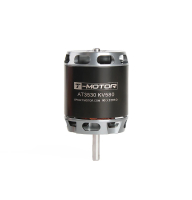
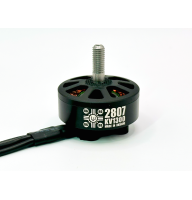
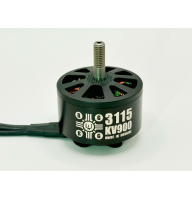
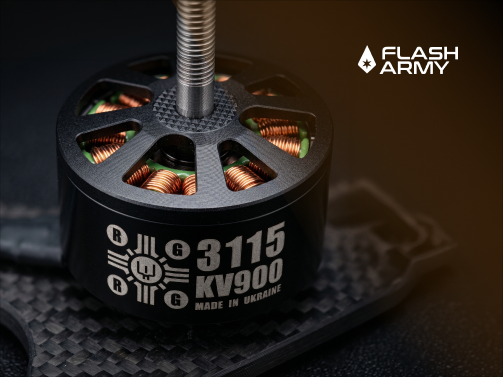
Motor dimensions (usually indicated in the format 2207, etc.) indicate the stator diameter and height. The larger the motor, the more windings and magnets it can have, which affects its power. For 5-inch FPV drones, options 2207–2306 weighing 30–34 g are chosen, and for heavier ones, powerful 2807–3115 models weighing 70–120 g or more are suitable.
Types of motors
Drone motors are divided into categories corresponding to the types of drones. Let's consider some of them.
For racing drones
High-speed motors with high KV ratings and stators are used in racing and freestyle. They provide high acceleration, instant response to control inputs, and high maneuverability. However, such options consume more energy and have a shorter operating time.
For quadcopters and multirotors
Universal motors for quadcopters are mid-class and used on most multirotors. They are easy to control and efficient for reconnaissance and filming.
For cargo and professional drones
For heavy UAVs, powerful motors with a low KV value are used, as they are capable of working with large propellers and lifting loads.
Selection criteria
An incorrectly selected power unit often leads to accelerated wear of components. Therefore, before purchasing, we recommend checking compatibility with the drone, flight style, and possible maintenance options.
Compatibility with the drone
The motor must match the parameters of the drone's frame, propellers, battery, and speed controller. Manufacturers often provide a table with characteristics that helps check the motor's compatibility with the drone against all necessary criteria.
Purpose and flight style
One of the main selection criteria is considering the type of drone, as different UAV types require appropriate motor characteristics.
Reliability and maintenance
It is worth paying attention to the quality of materials, the level of protection against dust and moisture, and the motor's lifespan. The screws that secure the motor to the frame can come loose due to vibration, so you should check them regularly. You can also periodically check the wire insulation for damage. Such simple maintenance steps significantly extend the motors' lifespan.
Conclusion
Motors are among the central elements of a drone, on which its flight characteristics, operational stability, and effectiveness under various conditions directly depend. They generate thrust, determine speed, maneuverability, and load-lifting capacity, and also affect power consumption and flight duration.
In this article, we examined the main technical parameters of drone motors: power, thrust, motor types, voltage, weight, and dimensions. Considering these features will help drone operators better navigate their devices' capabilities.
You can browse the available drone motor options in the Flash Army online store. The catalog presents various types of power units suitable for both military and civilian applications.