You watched
Catalog
1
0
0

Spotting Scopes for Military Use

There are no products to list in this category.

Continue
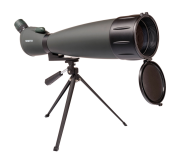
Spotting Scopes for Military Use

What are spotting scopes?

Spotting scopes for military use are powerful optical devices designed for precise observation of objects at long distances. A military spotting scope combines high optical quality, reliability, and resistance to external influences. It allows for detailed examination of targets, assessment of terrain situations, and decision-making with maximum accuracy. Such a scope is an important part of the equipment for military personnel, scouts, and snipers.

How spotting scopes work

A military spotting scope operates on the classic optical principle: light, passing through the objective lens and prism system, creates a magnified image of the object. Multi-coated lenses ensure clarity, contrast, and accurate color reproduction even in low light. Thanks to modern technologies, a spotting scope, like binoculars, can feature image stabilization, which is especially useful for prolonged observation or handheld use.

Functional features of spotting scopes

Modern spotting scopes for military use have a number of important advantages: powerful magnification, high objective lens light-gathering capability, a reliable focusing system, and protection against moisture, dust, and impacts. The optics are often made from high-quality glass, ensuring maximum image clarity. Some models are equipped with night vision mode, allowing for effective observation even in the dark. Thanks to ergonomic design and a precise optical system, a military spotting scope provides a stable image at long range.

How to choose spotting scopes?

Before buying a spotting scope, it is worth determining the main parameters: 

  • magnification power;
  • objective lens diameter;
  • presence of stabilization;
  • body protection level. 

For field conditions, it is better to choose models with rubberized coating, sealing, and the ability to mount on a tripod. It is important to consider the observation range and ease of focusing — these factors affect efficiency and comfort during use. For long periods of stationary observation, it is advisable to use tactical knee pads.

Where to buy spotting scopes?

You can buy spotting scopes for military use on the Flash Army website. Here you will find a wide range of models for various tasks — from field observations to professional use. Flash Army guarantees quality, proven optics, a favorable manufacturer's price, and fast delivery throughout Ukraine.

Frequently asked questions about products in this category Spotting Scopes for Military Use

A spotting scope is an optical instrument for long-distance observation with high magnification. Essentially, it's a format between binoculars and large optics: you look with one eye, but the image's range and detail are completely different. Most often, such models have variable magnification, such as 20-60x, and a large objective lens of 60, 65, 80, or 85 mm.
Spotting scopes are needed when binoculars no longer suffice in terms of range and detail. They are used to observe targets, landmarks, equipment, terrain sections, or shooting results at a distance. Spotting scopes are not for quick handheld viewing, but for longer observation from a tripod, when it's important to examine an object properly, rather than just noticing it.
In military applications, spotting scopes are used for observation, detection, and more precise target identification at a distance. They are designed as a tool for observation, adjustment, and operations where detail is critical.
For quick observation and handheld use, binoculars are more convenient. For range, detail, and longer work on a single point, a spotting scope is better. Binoculars typically come in formats like 8x42 or 10x42, while spotting scopes are 20-60x60, 20-60x65, 20-60x80, or 20-60x85. Therefore, binoculars are more about mobility, while a spotting scope is about longer distances and clear image resolution.
A spotting scope consists of an objective lens, an eyepiece or zoom eyepiece, a body, a focusing mechanism, and a tripod mount. Many models feature a changeable or adjustable eyepiece, and manufacturers' descriptions often separately mention the magnification adjustment ring, focus control, and tripod legs. More expensive models also include HD glass, fully multi-coated optics, gas purging, and sealing.
Most often, this is a variable magnification of 20-60x. This format is found in many popular models. That is, at the lower magnification, the scope provides a wider field of view and a more stable image, while at the upper magnification, you can examine the object in more detail, but this works much better with a tripod.
The light-gathering power of a spotting scope depends on two things: objective lens diameter and magnification. Simply put, a 20-60x80 or 20-60x85 will be brighter than a 20-60x60 because a larger lens gathers more light, but as magnification increases, the image becomes darker. For this reason, large 80–85 mm scopes excel in low light, while 60–65 mm scopes are more about compactness and weight.
The price depends on magnification, objective lens diameter, glass quality, coating, sealing, and overall optical performance. In other words, more compact and simpler models are cheaper, while large objective lenses, better optics, and tactical applications immediately increase the cost.
You can choose spotting scopes on the Flash Army website. Before making a choice, consider the magnification, objective lens diameter, body format — straight or angled — and the conditions in which the scope will be used, because a 20-60x65 for more compact work and a 20-60x85 for longer-range observation in dimmer light are already different models in feel.