Drone initiators are one of the most important elements in modern unmanned aviation, as they serve as the connecting link between the drone and the payload it carries. They ensure the activation of various systems on UAVs and act as coordinators, and the accuracy of their operation directly impacts the execution of tactical missions.
The precision provided by an initiator is a crucial factor for two important tasks: operator safety at launch and flawless timing upon target engagement. Timely activation of the mechanism eliminates the risk of erroneous activations due to human error, static electricity, or vibrations, ensuring the ideal moment for effective engagement without the risk of a wasted drone.
In this article, we will explore what drone initiators are, how they work, what types exist, how to choose them correctly, and what to pay attention to during use. This material is developed by the Flash Army team for beginner UAV operators, FPV assembly engineers, and suppliers who order drone parts.
What are Drone Initiators
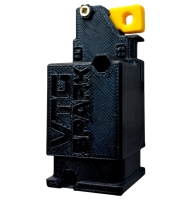
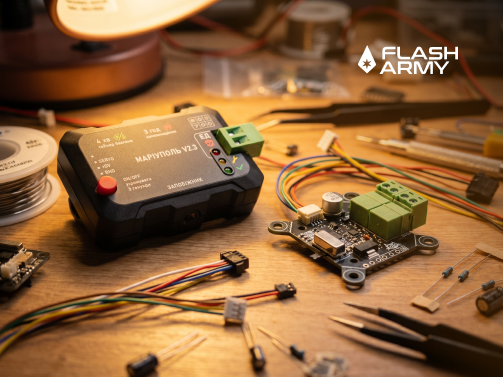
Drone initiators are electronic modules mounted on board that activate or control the payload installed on a UAV at a specified moment of flight or upon contact with a target. Their main function is to remotely close an electrical circuit and transmit current to a detonator for subsequent payload activation.
Each such device effectively functions as a detonation initiator, performing several important tasks:
- Detonation Control — ensures automatic detonation remotely (via a control panel) or upon collision (via contact whiskers, tapes, or sensors).
- Delayed Arming — a function responsible for operator safety. It guarantees that the board remains locked while the drone takes off and is near the pilot, and activation occurs only in the air and under specific conditions (operator command, reaching a certain speed, or after a certain time).
- Protection against Accidental Activation — using a multi-level architecture, the board components can block various types of threats: static electricity, EW jamming, flight controller malfunctions, or even human error.
Ensuring reliable and timely transmission of commands from the control system to the actuator makes initiators an extremely important aid for the operator and guarantees precise control of additional equipment during flight.
How Initiators Work in UAV Systems
The main principle of initiators is to convert a digital command into an electrical impulse, replacing mechanical levers or manual button presses with an automated electronic process.
The initiator's operation algorithm is as follows:
- Pre-flight Preparation: The powered-on drone is at the starting position, and the initiator is in a state of complete isolation. The board includes a safety pin (arming pin) that prevents current from reaching the detonator even in case of EW jamming or accidental button presses on the remote.
- Safe Departure: Before the drone takes off, the pilot pulls the arming pin, the timer starts counting, but the initiator remains locked, protecting against detonation in case of an accidental fall or impact of the drone.
- Arming: When the drone has flown a safe distance from the pilot, the safety timer has expired, or the operator has pressed a toggle switch on the remote — the board's transistors begin transitioning to a ready-to-open state.
- Activation: At the moment of approaching the target or by operator command, the board opens its electronic gates (MOSFET keys) in microseconds — current from the board's capacitors is supplied to the detonator wire. Payload activation occurs.
Although this process seems quite simple, it requires ideal configuration of the interaction between the drone's flight software and its hardware.
Main Types of Drone Initiators
Drone initiators are categorized by target sensor type, connection type, and number of boards. Let's examine the categories in more detail:
- By Target Sensor Type — the type of trigger for closing the circuit at the moment of approaching an object.
- Mechanical (Contact): The initiator connects to special sensors on the drone's nose in the form of intertwined wires (called "whiskers") or flexible intertwined tapes. Upon impact with the target, the wires close, forming a circuit, and current is supplied from the board. This type of initiator is typically used for FPV kamikaze drones and for engaging hard targets (armor, concrete).
- Electronic (Non-contact/Sensor): More modern variants that use electronic sensors instead of wires. These can be optical laser rangefinders (they detect the remaining distance to the target), magnetometers (trigger when the drone approaches a large mass of metal, reacting to changes in the magnetic field), or impact-accelerometer sensors (react to the drone's sudden deceleration upon impact). Due to their ability to activate the payload directly before collision or at a specified altitude, these initiators can effectively engage targets in trenches or above vehicle roofs.
- By Connection Interface — the method of communication with the flight controller (wire connection). This division is important for engineers who assemble the drone.
- Analog: connect to standard flight controller ports (like regular servos or LEDs) and operate via standard pulse channels (e.g., PWM).
- Digital: connect via digital ports (UART, etc.) and exchange encrypted data packets with the drone. They know the drone's exact speed, coordinates, and status, and offer the highest level of protection against EW.
- By architecture type (number of boards) — how the device is physically constructed.
- Single-component (monoboards): all electronics are assembled on a single printed circuit board. Such a light and compact FPV initiation board is an ideal solution for disposable kamikaze quadcopters, where every gram of weight counts.
- Two-component (split systems): consist of a separate control board, which is located in the drone's body and communicates with the flight controller, and a separate power activation module. These systems are more reliable and have a higher level of security.
The classification of initiators primarily depends on the task — simple analog platforms with mechanical "whiskers" are most often used for mass FPV drones, while digital ones — contactless systems with laser and magnetic sensors — are used for complex technological tasks.
Where drone initiators are used
Initiators are used for drone missions where it is necessary not just to drop a payload, but to ensure its precise and instantaneous activation. The main areas of use are as follows:
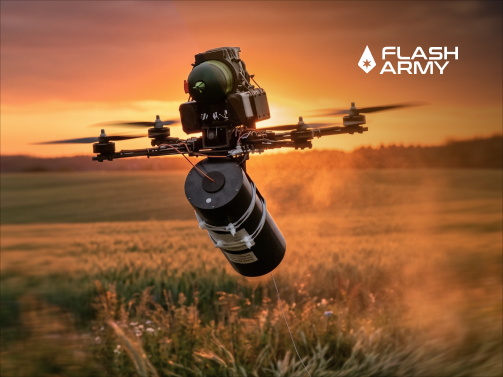
- FPV "kamikaze" drones — the widest area of use. Boards are used on mass-produced quadcopters to strike equipment, dugouts, or live targets by flying directly into the object.
- Remote mining — rapid deployment of mines or barriers in hard-to-reach areas. Initiators are necessary for safe arming of the mine after the drone has released it and flown away.
- High-precision aerial explosions — used on reusable drones or kamikazes with electronic (contactless) sensors. The board activates the payload detonation in the air at a height of 1–2 meters above a trench or the roof of armored vehicles, ensuring maximum damage area.
- Technology protection (self-destruction) — initiators are integrated into reconnaissance or expensive relay drones to destroy internal control boards in case the drone falls into enemy territory, to prevent the software from falling into enemy hands.
Initiators are most actively used for pinpoint strikes on moving or static targets, aerial detonations over objects, remote mining, and controlled self-destruction of equipment.
What to consider when choosing an initiator
The main factors to consider when choosing an initiator are technical compatibility and the conditions in which the drone will operate. Criteria to pay attention to:
- Compatibility with the flight controller: for analog assemblies, boards with PWM control are suitable, while for modern drones with interference protection, digital initiators operating via UART or other digital protocols are necessary.
- Activation current: different actuators require different current strengths to operate. The board must provide a sufficient pulse to activate a specific payload (can be checked in the output specifications).
- Safety system levels: a quality board should have a hardware safety pin, a delayed arming timer, dual electronic switches (MOSFETs), and protection against static voltage (TVS diodes).
- EW resistance: for operation in conditions of dense EW countermeasures, boards with galvanic isolation (optocouplers) and built-in interference filters are best suited.
- Dimensions: for small 7-inch or 10-inch FPV kamikazes, the lightest single-component monoboards are required, while for large reusable "wings" or heavy drones, two-component systems can be used.
A correctly chosen initiator is crucial: it ensures stable payload operation, increases mission effectiveness, and minimizes risks for the operator during task execution.
Advantages and limitations of using initiators in drones
Even the most reliable board requires careful handling in compliance with safety regulations, as it operates in extreme conditions. Before flight, it is important to check the integrity of the insulating varnish (compound), which provides protection against moisture — especially if the drone is to fly in fog, rain, or snow. Regular inspection of contacts is also necessary — due to vibration during flight, a poorly secured wire may come loose, so it is important to inspect solder joints and connectors.
One of the most important conditions for using initiators is strict safety pin timing. The physical safety pin is always removed last, when the drone is already in the starting position, and reconnected first (in case of drone return), before any manipulation of the device. This is key to preventing accidental activation, which can pose a threat to the operator's life and health.
A correctly selected initiation board not only ensures stable payload operation and improves mission accuracy, but also guarantees drone pilot safety through multi-level protection against EW jamming, static, software failures, and even common human error. The main function of this device is to minimize risks to the operator's life on the ground and guarantee equipment reliability in the air. You can choose and purchase reliable initiation boards for any tactical tasks at Flash Army.