

Laser Levels, Surveying Levels
There are no products to list in this category.
Continue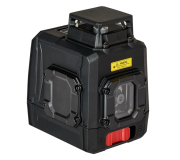
What is a laser level?
A laser level is a device for marking a straight line on a wall, floor, or ceiling. It is used when you need to install tiles, profiles, cabinets, shelves, cornices, or outlets without skewing. For a long wall, it is more convenient than a regular level because the beam immediately shows the entire line.
How a laser level works
The housing contains a laser diode, a prism, and pendulum self-leveling. After being set up on a tripod, floor, or magnetic base, the device projects a horizontal, vertical, or planar line. If the tilt exceeds the working range, usually around ±3–4°, the laser level blinks or emits a signal.
What is a laser level used for?
During renovation, the level helps lay the first row of tiles, mark a suspended ceiling, transfer outlet heights, set up a partition, or install kitchen cabinets. Room length, opening height, and distance between points are better measured by laser rangefinders, as the level provides direction, not size.
Types of laser levels
Dot models transfer marks between surfaces. Line models provide a single horizontal or vertical line. Cross-line models project two lines at 90°. 3D and 4D levels project 360° planes and are convenient for perimeter tiling, ceilings, and profiles. Rotary levels are used for large rooms and work with a receiver.
Features and advantages of laser levels
The line remains visible during drilling, cutting, or fastening. The craftsman sees the edge of the tile, a row of holes, or the profile guide without constant pencil marks. Near outlets, switches, and electrical panels, wire detectors are useful, as the cable in the wall may not run straight.
Laser level specifications
Specific parameters are important for selection:
- accuracy: often ±0.2–0.5 mm/m;
- indoor range: approximately 10–30 m, more with a receiver;
- number of planes: 1, 2, 3, or 4;
- beam: green is more visible in light, red consumes less power;
- power: batteries or rechargeable battery;
- mounting: 1/4 or 5/8 thread, magnetic base, tripod;
- housing protection: preferably against dust and splashes, often IP54 rated.
Recommendations for choosing laser levels
For shelves, cornices, and outlets, a cross-line model is sufficient. For tiles, ceilings, and partitions, it's better to choose a 3D level with circular scanning. Near underfloor heating, radiators, or cold corners, thermal detectors are useful: they will show heating, heat loss, and areas where drilling needs to be checked.
Where to buy a laser level?
For a one-time repair, an expensive rotary model is not needed. For regular installation, 360° projection, a green beam, a tripod, a rechargeable battery, and a decent range are already important. When planning to buy a laser level, it's best to immediately check the accuracy, planes, mounting, and complete set. Measuring tools and related marking products are among Flash Army's offerings.