

Vibration Saws
There are no products to list in this category.
Continue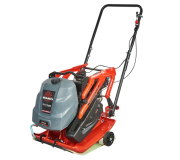
What is a vibratory plate compactor?
A vibratory plate compactor is a construction vibratory machine used for compacting sand, gravel, screenings, soil, and sub-bases for paving slabs. It consists of a steel base plate, an engine, a frame, a handle, and a vibration-generating unit.
Vibratory plate compactors are purchased for constructing paths, yards, parking spaces, preparing layers for paving stones, curbs, and small construction sites. Manual tampers are also used for sub-base compaction, but they work slower and do not provide uniform compaction across the entire surface. However, without concrete mixers, preparing the mix takes significantly more time, and sometimes it's impossible.
How a vibratory plate compactor works
The engine drives an eccentric, which transmits rapid vibrations to the metal plate. The base plate presses down on the sub-base with its own weight, causing sand or gravel to settle more densely, reducing voids between particles.
Gasoline vibratory plate compactors operate autonomously, making them more suitable for outdoor use, yards, and areas without access to an electrical outlet. Electric models are quieter but depend on nearby power and are better suited for lighter work.
What vibratory plate compactors are used for
The main tasks for which vibratory plate compactors are used:
- Compacting sand, screenings, and gravel before laying paving slabs;
- Preparing sub-bases for yards, paths, curbs, or platforms;
- Compacting layers for paving stones and paving slabs;
- Working on small areas where manual vibratory tamping takes too long;
- Preparing backfill for parking spaces or light construction.
For concrete mixtures, concrete vibrators are needed, not plate compactors. They work with concrete after pouring. If a small batch of mortar needs to be prepared before work, construction mixers are appropriate.
Vibratory plate compactor characteristics
Vibratory plate compactors have several important characteristics:
- Weight: 50-70 kg models are for paths and paving slabs; heavier models are for gravel and backfill under vehicles;
- Impact force: affects the compaction depth and layer density;
- Base plate size: a wide plate covers an area faster, a narrow one is more convenient near curbs and edges;
- Engine type: a gasoline model performs better in open areas;
- Pad: polyurethane is needed for paving stones to avoid damaging the face of the slab.
For professional work, not only mass is important. If the plate jumps, doesn't hold direction well, or has a weak frame, creating a level sub-base becomes more difficult.
Recommendations for choosing a vibratory plate compactor
It's best to buy a vibratory plate compactor after assessing the material and load. For sand, screenings, and paving slabs, an overly heavy machine is not needed. For parking lots, thick backfill, or gravel, greater mass, stronger vibration, and a stable base plate are required.
A vibratory plate compactor for paving stones should operate smoothly, without sudden jumps. Here, not only weight but also a soft pad, plate size, and impact force are important. When working near walls, curbs, or other obstacles, an overly wide base plate can be a hindrance.
Where to buy a vibratory plate compactor?
Different machines are needed for paths and car parking areas. A light plate works more precisely with paving slabs, while a heavier one compacts gravel and thick backfill better. If the wrong class is chosen, the sub-base will remain loose, or the paving stones will experience excessive stress.
Vibratory plate compactors are often purchased along with tools for site preparation, consumables, and related equipment, such as construction mixers. The Flash Army catalog allows you to purchase everything you need in one place and with a single order, so you won't have to search for everything separately before starting work.