

Concrete Mixers
There are no products to list in this category.
Continue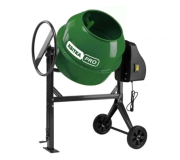
What are concrete mixers?
A concrete mixer is a construction machine with a drum, motor, and blades inside the bowl. It mixes concrete, screed, and cement mortar without lengthy manual labor. Cement, sand, and gravel are poured into the drum, water is added, and then the mixture is evenly stirred.
Concrete mixers are needed for pouring foundations, paths, floors, fence posts, supports, small slabs, and other construction work.
Types of concrete mixers
The main types of concrete mixers are:
- Gravity mixers - the most popular for homes, dachas, and small crews. The drum rotates, and the concrete tumbles inside under its own weight;
- Ring gear mixers - have a toothed ring gear on the outside of the drum. They are easier to repair, but the ring gear needs to be cleaned of dirt;
- Gearbox mixers - operate via a closed gearbox, are quieter, and better protected from dust;
- Compact mixers - suitable for repairs, room screeds, small paths, or supports.
For preparatory work on site, heat guns are often added: they are used to heat materials, remove coatings, and dry specific areas.
How concrete mixers work
The motor rotates the drum via a ring gear or gearbox. The blades pick up the mixture and tumble it inside the bowl, so cement, water, sand, and gravel combine more evenly than in a trough.
A commutator motor is cheaper and simpler but has brushes that wear out. An asynchronous motor is quieter, handles longer mixing times more calmly, and is better suited for frequent use.
Concrete mixer characteristics
Concrete mixers are chosen based on the following parameters:
- Drum volume: 120-160 L for minor repairs, 180-220 L for screeds, paths, and foundations;
- Actual output: less than the full liter capacity, as the drum is not filled to the brim;
- Power: often 500-1000 W in household and semi-professional models;
- Material: thicker steel better withstands gravel, dense concrete, and frequent tumbling;
- Drive: ring gear is easier to maintain, gearbox is better protected from dust;
- Brands: Forte, Werk, Limex, Agrimotor, Intertool are often compared.
For glue, plaster, and small portions, construction mixers are more convenient, but they do not replace concrete in large volumes.
Recommendations for choosing concrete mixers
It's best to buy a concrete mixer after assessing the scope of work. For one person, a 200 L drum is not always convenient, as the prepared mixture needs to be distributed quickly. For a crew, a larger mix, a strong frame, stable wheels, and a power reserve are important.
After pouring a foundation, slab, or reinforced area, concrete vibrators are often used. They expel air from the mixture and help make the concrete denser.
Where to buy concrete mixers?
You can choose a concrete mixer on Flash Army by liter capacity, drive type, motor, weight, steel thickness, and actual task. When choosing concrete mixers, the price of models depends on the drum volume, brand, power, gearbox, or ring gear. If it's difficult to understand which model will withstand heavy concrete, consultants will help you compare characteristics without unnecessary over-selection.