

Drill Press
There are no products to list in this category.
Continue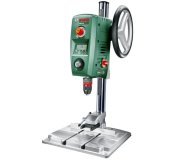
What is a drill press?
A drill press is a stationary or benchtop machine for drilling straight holes in metal, wood, plastic, and other materials. It holds the drill bit on its axis, prevents it from shifting sideways, and controls the depth of the hole more precisely than a hand drill.
Such a machine is essential in a garage, workshop, small-scale production, for equipment repair, manufacturing brackets, plates, furniture parts, and metal blanks.
What is a drill press used for?
Drill presses are used where holes need to be straight, repeatable, and without skew. They are used to drill profiles, sheet metal, wooden boards, plastic panels, housings, hinges, and fasteners.
In woodworking, sawing tables are often needed before drilling: first, the workpiece is cut straight, then fixed and drilled to the required diameter.
Types of drill presses
The main types of drill presses are:
- Benchtop - compact models for a garage, home, and small workshop;
- Floor-standing - heavier machines with a stable column for more frequent work;
- Radial drill presses - suitable for large parts that are inconvenient to move on the table;
- Magnetic - fixed on a metal surface and needed for beams, frames, and sheet metal.
Concrete vibrators work with a different material, but on construction sites, they often go hand-in-hand in terms of work logic: metal inserts are drilled separately, concrete is compacted separately after pouring.
Drill press characteristics
Drill presses are chosen based on several parameters:
- Power: 350-600 W is often sufficient for household models; for metal, it's better to have a reserve;
- Chuck: common clamping range is 1.5-13 mm or up to 16 mm;
- Drilling diameter: depends on the material, drill bit, and rigidity of the machine;
- Speed: several modes are needed for wood, plastic, and metal;
- Spindle travel: affects the depth of the hole without repositioning the part;
- Table: must hold the workpiece flat, without play or wobbling.
Recommendations for choosing a drill press
It's best to buy a drill press after understanding the material. For wood and plastic, a benchtop model with a decent table and a chuck without play is sufficient. For metal, a rigid column, the weight of the base, lower RPMs, and power reserve are important.
If you work with boards, planers are needed even before drilling to level the material by thickness. For serial holes, a stop, smooth handle travel, and stable workpiece fixation are important.
Where to buy a drill press?
For metal, a weak benchtop machine will quickly show play: the hole will go sideways, the drill bit will start to wobble, and the edge will be ragged. It's better to choose a model with a rigid column, a heavier base, a chuck without looseness, and lower speeds. For wood, other things are key: a flat table, smooth drill bit feed, and convenient workpiece fixation.
You can choose a drill press at Flash Army for your garage, workshop, or small-scale production. If you are unsure between a benchtop and a floor-standing model, consultants will suggest an option based on the material, hole diameter, and frequency of work.