Catalog
0
0

Acoustic Sensors

There are no products to list in this category.

Continue
Acoustic Sensors

What are acoustic sensors?

An acoustic sensor is a device that detects drones and other devices by the characteristic sound of their engines. When a UAV approaches, its propellers create a specific noise that is easily distinguishable from other sounds. An acoustic drone detection system detects and measures sound vibrations, converting them into electrical signals. This way, they listen to the environment and detect the presence of objects or measure noise levels. Such systems use special microphones and analysis software. 

Purpose of acoustic sensors

The main task of such systems is early threat detection. An acoustic UAV detection system allows a drone to be spotted even before it is visually seen. 

This is especially important against devices that do not use radio signals. For example, a fiber-optic drone detector helps identify a drone controlled via a cable.

In position defense systems, drone detectors of other types are also used in conjunction with such solutions.

Principle of operation of acoustic sensors

The system's operation is based on sound analysis. Microphones record ambient noise, after which software compares it with a database of known signals. When the algorithm recognizes the characteristic sound of propellers, the acoustic sensor transmits a signal to the operator. This allows for a quicker response to the appearance of a UAV.

How do "Shypovnyk" countermeasure systems work?

"Shypovnyk" systems combine several technologies. The system uses acoustic sensors that determine the direction of sound and the approximate distance to the drone.

After detection, the system can transmit coordinates to other countermeasure assets, initiating EW jammers as the most popular method of protection against UAVs. Net guns or other interception methods may also be used.

The systems are also equipped with special nozzles for winding and breaking fiber-optic cables. In most models, the coverage perimeter is stated as 500-600 meters, which helps actively counter fiber-optic drones. Minimal kits use timer-based launch, but extended versions already have a built-in acoustic sensor that automatically initiates device operation upon drone detection.

Recommendations for choosing acoustic sensors

Before choosing an acoustic sensor, it is worth paying attention to the operating range and the accuracy of sound direction determination. The capabilities of the signal processing system are no less important. A good acoustic drone detection system should distinguish UAV noise from ordinary sounds of machinery or transport.

In position security systems, tactical first-aid kits are often used with such solutions for basic medical support for each soldier. First-aid kits are an important component of military equipment.

Where to buy acoustic sensors?

When you need to choose an acoustic sensor or a fiber-optic drone detector, it is more convenient to compare several models by characteristics and operating range.

The FlashArmy catalog presents over 13,000 products for technical tasks, field conditions, and household needs. Here you can choose drone detection equipment and other gear.

If you have questions about system capabilities or setup, specialists will help you choose the equipment. Orders are shipped throughout Ukraine by postal operators.

Frequently asked questions about products in this category Acoustic Sensors

Acoustic sensors are devices that detect objects by their characteristic sound. In drone countermeasure systems, they analyze the noise of UAV motors, propellers, and movement in the air. Such a sensor does not replace an RF detector or optical observation, but it complements them well where it is important to obtain an additional detection channel.
In the military domain, acoustic sensors are designed for early drone detection, airspace monitoring, and warning units about potential threats. They are useful near positions, command posts, warehouses, equipment, or routes where a drone might appear without a noticeable radio signal. The sensor detects sound and helps to quickly understand that a UAV is operating nearby.
An acoustic sensor operates via microphones, sound processing, and recognition algorithms. It listens to the environment, separates drone noise from the background, and compares it with characteristic acoustic signatures. Wind, terrain, traffic, gunfire, generators, and other noise sources affect the result, so acoustic detection works best as part of a comprehensive system.
Acoustic sensors can be autonomous, networked, stationary, mobile, directional, and multi-channel. An autonomous sensor can operate as a standalone observation point, while networked models are combined into a system of several posts. Multi-channel solutions more accurately determine the direction to the sound source, and compact sensors are more convenient for rapid deployment at a specific position.
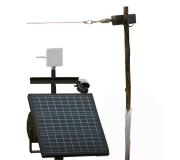
An acoustic sensor typically consists of a microphone module, a signal processing board, a housing, power supply, connection interfaces, and mounting elements. Housings use plastic, metal, seals, and dust and moisture protection, while electronics include microphones, controllers, cables, connectors, and communication modules. For field conditions, not only sensitivity but also housing protection, stable power supply, and normal operation in rain, dust, and temperature fluctuations are important.
Fiber-optic drones are harder to detect with conventional radio-frequency means because control and data transmission may not go through a typical radio channel. In such cases, acoustic sensors become a particularly useful additional tool: they react not to the control signal, but to the physical sound of flight. That is why, in a comprehensive detection system, acoustics can cover some tasks where a radio detector does not see everything.
Military acoustic sensors feature a ruggedized enclosure, operation in complex noise environments, network integration capabilities, and focus on small UAV detection. Civilian acoustic sensors are more commonly used for industrial control, security, noise monitoring, or research tasks. For military applications, rapid deployment, weather resistance, autonomy, and clear operator alerts are crucial.
Modern acoustic sensors use microphone arrays, digital signal processing, noise filtering, sound profile recognition algorithms, network data transmission, and connectivity via Ethernet or cellular. Some systems can work in conjunction with other detection channels: RF detectors, cameras, thermal imagers, or observation posts. The best results are achieved not by a single sensor, but by a system where multiple sources confirm a threat.
Acoustic sensors in Ukraine cost approximately from UAH 33,000. More expensive models feature different connection interfaces, a wider set of accessories, network operation, a better housing, greater integration capabilities, or a more complex signal processing system. The price is influenced by the sensor type, communication method, power supply, protection, brand, accessories, and the scale of the system it is intended to be part of.
The acoustic sensor in Flash Army should be considered not as a standalone gadget, but as part of a detection system. If the task is to control a position or object, it is important to think in advance about where the sensor will be placed, how it will be powered, whether network connection is needed, and which detectors it will work with. For detecting low-noise or non-standard UAVs, acoustics makes sense precisely when it is not placed randomly, but integrated into the overall observation logic.