You watched
Catalog
1
0
0

Telescopes for Military Use

There are no products to list in this category.

Continue
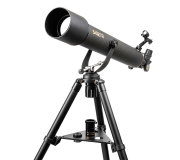
Telescopes for Military Use

What is a telescope?

A military telescope is an optical device designed for precise long-distance observation. It is widely used in reconnaissance, navigation, and combat observation, helping to determine the position of objects and plan actions. Modern military telescopes combine magnification, image stabilization, and integration with other devices, such as rangefinders or laser systems, making them a versatile tool in the field.

How a telescope works

The basic principle of military telescopes is based on a system of lenses and objectives that focus light onto the eyepiece, creating a clear, magnified image. Modern models, like thermal imagers, are often equipped with stabilization to reduce shaking, a laser for precise distance measurement, and a focusing mechanism for quick targeting. This allows for effective observation even in difficult conditions.

Types and varieties of telescopes

Military telescopes differ in magnification power, objective lens diameter, weight, and field of view. There are compact monoculars for mobile use, large stationary devices for long-distance observation, and models with integrated rangefinders or laser targeting. The choice depends on the specific task: reconnaissance, navigation, or terrain observation.

How to choose a telescope?

When choosing a military telescope, it is important to consider optical characteristics – magnification, objective lens diameter, field of view, as well as the presence of stabilization and additional functions. It is important to evaluate the weight and ergonomics to ensure the device is comfortable to use in the field and during prolonged observation. It is equally important to analyze the tasks for which the device is being chosen, as for some tasks, for example, rangefinders may be more suitable.

Where to buy a telescope?

Flash Army offers high-quality military telescopes. We guarantee equipment reliability, affordable manufacturer prices, and fast delivery across Ukraine. Flash Army provides modern devices for observation, reconnaissance, and navigation, enhancing operational efficiency in all conditions.

Frequently asked questions about products in this category Telescopes for Military Use

Telescopes are optical instruments for long-distance observation with high detail. They work using a large objective lens or mirror that collects light, and an optical system that forms the image. Basic specifications always include the objective diameter and focal length, such as 70/700 or 90/900 — this already provides an understanding of the instrument's class.
In military applications, telescopes are used for observing and identifying objects at a distance when conventional optics are insufficient. This is not fast-moving optics, but rather a tool for detailed observation from a stationary position: equipment, fortifications, landmarks, terrain sections. In terms of function, it is closer to a spotting scope, but with greater potential for magnification and detail.
For compact models, this can be 50–90 mm; for larger ones, 100, 130, 150 mm, and more. For example, 70 mm is a basic level, 90–102 mm already provides better detail, and 130–150 mm offers even more light and a better image. The larger the diameter, the more light the telescope gathers and the higher its resolution potential.
The magnification of telescopes is not fixed; it depends on the eyepiece. For example, a 700mm telescope with a 10mm eyepiece provides 70x magnification, and with a 20mm eyepiece, it provides 35x. In practice, the working range often lies within 20–150x for basic models. Theoretically, more is possible, but excessively high magnification quickly "kills" the image if the objective lens diameter is insufficient.
The main types are refractors, reflectors, and catadioptric systems. A refractor is a lens telescope (the classic "tubular" format). A reflector is a mirror telescope, most often a Newtonian system. Catadioptric systems are combined (Mak, Schmidt-Cassegrain). The difference between them lies in the method of image formation, dimensions, and light handling.
Resolution depends on the objective lens diameter. The larger the diameter, the finer the details that can be distinguished. Simply put, a 100mm telescope will show more details than a 70mm one. This is a basic rule directly related to the amount of light collected by the optics.
Focal length is a key parameter that, along with the eyepiece, determines magnification. For example, a 900mm telescope with a 10mm eyepiece provides 90x. A short focal length (400–700mm) offers a wider field of view, while a long one (900–1500mm and more) provides greater magnification and better detail resolution.
The price depends on the objective lens diameter, optical design, glass quality, and комплектації. Basic models with a 70–90 mm diameter are cheaper. Telescopes with a larger objective lens, better optics, and a stable mount cost significantly more. The difference here is noticeable in the detail and quality of the image.
You can choose telescopes on the Flash Army website. Before choosing, you should pay attention to the objective lens diameter, focal length, and type of construction, because a compact 70/700 and a larger 130/900 are already devices with different capabilities.