You watched
Catalog
3
0
0

Power Banks for Military Personnel (AFU)
Sort By:
Power Banks for Military Personnel (AFU)

What are power banks?

A power bank is a compact external battery that stores energy and charges devices without access to an electrical outlet. In military conditions, a power bank for the Armed Forces of Ukraine is not a luxury, but a necessity. It allows you to maintain communication, charge phones, two-way radios, or tablets even far from civilization.

A modern power bank can have different capacities, power outputs, and numbers of ports. Some models are capable of powering even drones or laptops. A robust casing and dust protection make them suitable for field use.

Purpose of power banks

The main function of a power bank is to provide backup power where a regular outlet is unavailable. This is relevant for military personnel, tourists, travelers, or during prolonged power outages.

Thanks to their mobility and autonomy, external batteries have become an essential part of military equipment. One charge — and you're back in touch.

How to choose a power bank?

First of all, determine your needs. If maximum autonomy is required, look for models with a large battery capacity (20,000 mAh and more). Charging speed, the number of USB ports, and a reliable casing are also important. If you plan to buy a power bank for military tasks, pay attention to durability and resistance to temperature fluctuations.

For greater autonomy, more powerful devices such as portable power stations are chosen.
 

Where to buy power banks?

You can buy a power bank on the Flash Army website. The catalog features models tested in field conditions, with optimal price, quality, and warranty. Flash Army means reliability, energy, and confidence that your devices will not run out of power when it truly matters.

Expand

Frequently asked questions about products in this category Power Banks for Military Personnel (AFU)
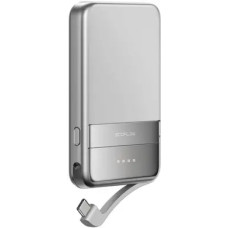
A power bank is a portable battery for charging phones, headphones, tablets, routers, or other small electronics without an outlet. It is essential when you need a power reserve on the go or during power outages.
Power banks are essential for backup power for small electronics. They allow you to stay connected, access the internet, use navigation, or charge your phone without access to a power outlet.
The main characteristics of a power bank are capacity, charging power, number of ports, output types, and fast charging support. Most often, buyers look at mAh, USB-C or USB-A, as well as PD, PPS, or QC, if they need to charge devices faster.
Power banks most often use lithium-ion or lithium-polymer batteries. Both options are common, but lithium-polymer models are often made thinner or more compact in shape.
A 20000 mAh power bank does not deliver its full stated capacity in real-world use, as some energy is lost during voltage conversion. The usable output is typically lower than the nominal capacity, so for a phone, this usually means several full charges, and less for more demanding devices.
The best capacity depends on the task. For everyday carry, 10000 mAh is often sufficient; for multiple phone charges or trips without an outlet, 20000 mAh is more practical; and for a laptop or longer autonomous operation, 25000 mAh and more are considered.
A power bank is better for phones, headphones, tablets, and small electronics, while a charging station is for longer autonomous operation and more powerful devices. If you need to carry something compact in a backpack, it's more logical to choose a power bank. If you need to power a router for a long time, a laptop, or electronics from an outlet, a charging station is more practical.
For a router, it's better to choose a power bank not only by capacity but also by power compatibility. It's important to check if it supports the required voltage and power, as not every power bank is suitable for this scenario. If long autonomous router operation is needed, it's often more practical to consider a power station.
The most important characteristics are real capacity, output power, fast charging support, number of ports, and decent build quality. If you only charge a phone, you can opt for a simpler model. If you need a laptop, router, or several devices at once, USB-C PD and higher power become important.
The price depends on capacity, power, and brand. For 10000 mAh, this is usually the lower price segment, 20000 mAh is mid-range, and powerful models at 25000 mAh and above are noticeably more expensive.
You can buy a power bank at FlashArmy, where models are available for various tasks. If you need a power bank for a router or just for everyday use, you should primarily look at capacity, power, and port types, not just the mAh label on the case.