Dipole Antennas: Principle of Operation and Application for Drones
Control of unmanned systems — military FPV drones or civilian quadcopters — is achieved via radio signal. The quality of communication directly affects flight range, control precision, and video clarity.
To understand the principle of drone control and choose the most suitable device for receiving or emitting radio waves, it is necessary to understand what a dipole is. A dipole antenna is the simplest type of antenna, commonly used for radio communication due to its simple design and omnidirectional radiation pattern.
This article was prepared by Flash Army for those who work with unmanned systems, set up radio communications, and select components for FPV drones. The material will help to better understand the principle of operation, types, and differences of dipole antennas.
Principle of Dipole Antenna Operation
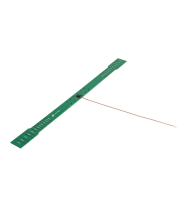
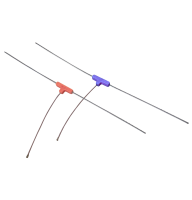
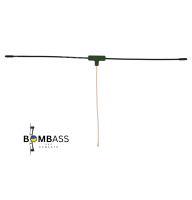
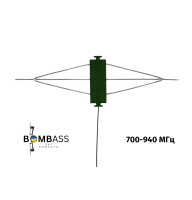
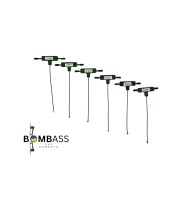
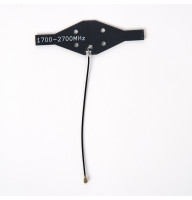
A dipole antenna consists of two identical metal conductors arranged on a single axis. Its simple design makes the device accessible and reliable, which is why this type of antenna is the most common among users.
When alternating current flows through these conductors, an electromagnetic field — radio waves — is created, which propagates in space. During reception, this process occurs in reverse: radio waves act on the conductors, causing an electric current to arise.
The dipole is chosen according to the system's operating frequency, for example, 2.4 GHz or 5.8 GHz (unmanned system operating frequency). The correct frequency selection determines whether the connection between the transmitter and the dipole antenna will be clear and stable, which directly affects the actual available flight range.
Dipole Antenna Radiation Pattern
The dipole's radiation pattern is a graphical representation of radio signal emission in space. It usually has a toroid shape, also called a "doughnut."
Maximum emission or reception occurs perpendicular to the antenna axis, while the signal will be weakest along the direction of the conductors.
To install a dipole on drones, the antenna must be correctly oriented: during flight, FPV drones change their tilt angle, so it is important to consider the antenna's position relative to the receiver.
Stable communication is impossible with incorrect orientation, even with a powerful transmitter.
Types of Dipole Antennas and Their Features
Dipole antennas come in various designs, created for specific user needs.
Linear
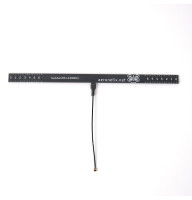
A linear dipole antenna is a classic design with two symmetrical conductors, forming omnidirectional radiation in the horizontal plane. This type of system is typically used in standard transmitters.
Advantages of a linear dipole include a stable radio signal within a defined range, affordable price, and simple construction.
Circularly Polarized
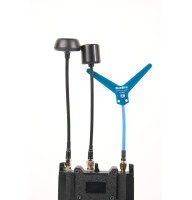
When working with FPV drones, circularly polarized antennas are used. This device is similar in type to a linear dipole but has certain modifications: radio waves will be emitted with clockwise or counter-clockwise rotation.
This system provides better video transmission quality from the drone and communication stability with the device.
Using Dipole Antennas for FPV Drones
The vast majority of users choose dipole antennas for FPV drones due to their simple design and reliability.
Devices such as drone detectors, for which sensitivity and stable radio signal reception are important, also operate using a dipole.
Advantages of Dipole Antennas
Key characteristics of dipole antennas that make them a frequent choice for users:
- low weight, compactness;
- simple and reliable design;
- clear and predictable radiation pattern;
- ease of installation in field conditions.
All this ensures convenience and reliability during operation.
Features of Choosing Dipole Antennas
When choosing a dipole antenna, consider:
- operating frequency range;
- device weight;
- radiation pattern.
For stable communication at medium distances, a linear dipole is usually sufficient, while for active maneuvering, it is better to choose devices with circular polarization.
A correctly selected frequency range guarantees the highest signal quality. When working with dipoles, it is worth paying attention to a number of factors: antenna usage conditions, terrain where the devices are located, presence of obstacles, and radio signal spectrum congestion.
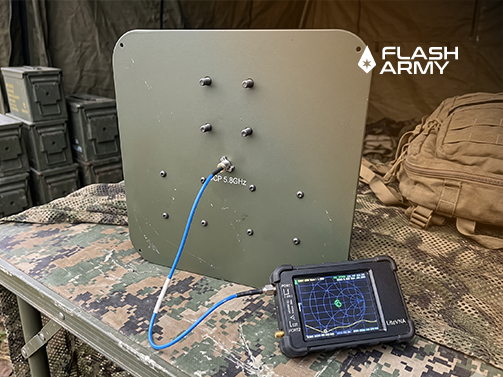
Military antennas are usually sealed to withstand vibrations and various weather conditions. Such devices are best suited for use in field conditions.
Conclusion:
A dipole antenna is a basic type of radio system. Among others, it stands out for its simple design and reliability, as well as ease of use in extreme conditions.
After reading this article, you understand all the nuances of selecting a dipole antenna, its principle of operation, and usage features. You can buy dipole antennas at Flash Army — the largest marketplace for military and outdoor equipment. Our catalog offers a wide selection of tested dipoles for various needs, as well as other necessary components for setting up radio communication.