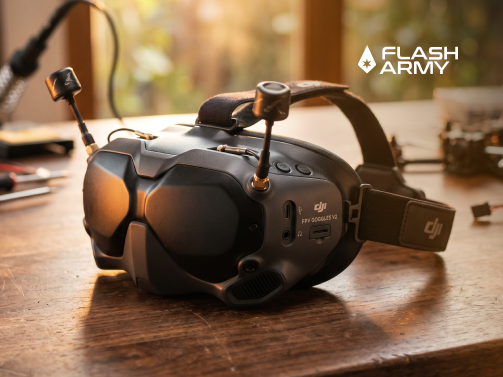
The role of FPV goggles in drone control is critical: they ensure precise maneuvering and high reaction speed. Thanks to realistic display, the pilot clearly controls speed, altitude, and flight trajectory, while minimal video signal delay allows for instant reaction to obstacles, wind changes, or loss of connection.
The level of comfort provided by FPV goggles is also very important. Proper optics eliminate the "seasickness" effect that can arise from desynchronization between visual perception and the vestibular system. Goggles make control more intuitive, isolate the pilot from external factors, and significantly reduce eye strain.
In this article, we will discuss how to choose FPV goggles correctly, what characteristics, nuances, and usage features to consider. The article is written by the Flash Army team for beginner pilots, unit commanders, logisticians, volunteers, etc.
What are FPV Goggles and How Do They Work?
FPV goggles or a helmet (First Person View) is a specialized device designed for real-time viewing of video streams from a drone. These goggles receive a video signal from the drone via a built-in receiver module and allow you to see the same view as the UAV's camera, providing an immersive experience in the UAV cockpit.
Key Characteristics for Selection
Different models of FPV goggles can vary significantly in image quality, compatibility with transmitters, latency, and user comfort. Therefore, it is necessary to carefully understand the characteristics of the goggles before making a purchase. What exactly should you pay attention to:
1. Resolution and Image Quality
This is the pixel density that forms the image — the more pixels, the higher the image quality. This parameter affects the pilot's spatial orientation (assessing distance to objects, terrain, obstacles), drone control at high speeds, maneuvering, and eye comfort.
One of the main factors determining resolution is the system, analog or digital.
- An analog system has limited capabilities regarding video signal quality. A weak signal can lead to lower detail, possible noise, color artifacts, and interference. Most modern analog goggles feature displays with a resolution of 1024×768 (XGA) or 1280×960. The main advantage of analog systems is minimal latency, which is critical for high-speed operation. Most often used for kamikaze drones.
- A digital system provides cinematic HD and Full HD quality images and modern interfaces. The level of detail is many times higher, without typical analog interference, and allows the pilot to clearly see the terrain. Most digital displays have a resolution of 1280×720 (720p) or 1920×1080 (1080p). Most often used for reconnaissance and heavy bomber drones.
The goggles and the drone must use a common system, so first of all, you need to determine which system the FPV drone uses.
The type of matrix is also important, as it affects image quality in challenging conditions. The following matrix types are typically used in FPV goggles:
- LCOS / LCD — have low contrast (1,000:1), making black appear gray, which particularly reduces image clarity in the dark. In addition, these matrices start to increase image latency at low temperatures.
- OLED / Micro-OLED — have very high contrast (100,000:1), clearly show object boundaries in the dark, and are the best option for night operations. They maintain a consistently fast screen response even in freezing temperatures.
If the goal is maximum image quality even at night, it is better to choose an OLED matrix, while LCDs are more suitable for training or as an additional monitor for the commander.
2. Refresh Rate and Signal Latency
These characteristics are among the most important in FPV goggles, as they determine the pilot's reaction speed, maneuverability, and level of control over the aircraft. That is why they are critically important for flights in complex terrain, assault missions, and controlling high-speed kamikaze drones.
- Refresh rate (Hz) — is the speed at which the display updates the image per second. The higher the signal refresh rate, the smoother the motion. This parameter significantly affects eye strain (a low frequency quickly causes fatigue and, in some cases, even headaches or nausea) and the operator's perception speed. The standard refresh rate for most goggles is 60 Hz; a good average level is 90–100 Hz, and high is 120 Hz and above.
- Signal latency (ms) — is the time between the image being captured by the drone and its display on the screen. Even minimal latency can significantly affect aircraft control, increasing the difficulty of maneuvering and the risk of accidents. The lower the latency, the better the aircraft responds to the remote control. For analog systems, a latency of 10–20 ms is considered normal; for digital systems, this figure is higher due to the need to encode and decode data, ranging from 25 to 40+ ms.
Low signal latency and a high screen refresh rate ensure the closest possible connection between the operator's perception and the drone, allowing for instant orientation and course changes when necessary.
3. Field of View and Wearing Comfort
These parameters seriously affect control, as too small a field of view, excessive goggle weight, and an ill-fitting design will lead to discomfort and rapid operator fatigue, and ultimately to regrettable errors.
- Field of View (FOV) — is the viewing angle at which the operator sees the image, or the sector of space visible through the goggles. The smaller the FOV, the smaller the screen; the eyes immediately encompass the entire image and do not tire, but discerning fine details is more difficult. With a large FOV, the screen is huge with an immersive effect, but the eyes tire quickly, and OSD numbers in the corner of the screen are quite far away. The optimal field of view for analog goggles is considered to be 39° – 46°, and for digital — 45°– 51°.
- Wearing comfort is especially important during long flights, as the pilot may spend several hours continuously in the goggles. The ergonomics of FPV goggles are a complex of factors such as weight and mounting, body balance, the quality and material of the padding, and the presence of ventilation for lens airflow. For people who wear corrective glasses, the ability to adjust diopters will also be an important factor.
For maximum comfortable long-term work, it is recommended to choose an FOV within 40°– 46°, goggles weighing up to 250 g, and a mask made of high-quality anatomical foam.
4. Compatibility with Transmitters and Drones
Compatibility is one of the key parameters when choosing FPV goggles, as the goggles will not be able to work with a drone that supports other transmission standards. First of all, compatibility is determined by the signal type — analog or digital.
- Analog systems: maximally universal, as everything here is combined based on the same frequency range (most often 5.8 GHz). To connect the goggles to the drone, it is enough to find the desired frequency. Modern FPV goggles have bays for receivers that allow switching to different, less common frequencies.
- Digital systems: here, compatibility entirely depends on the manufacturer. Each brand has its own protocol and encodes the signal in such a way that it is incomprehensible to devices from other manufacturers. There is a way to bypass the rigid system — external receivers (VRX), which allow using analog goggles with an HDMI input for digital systems.
Before purchasing FPV goggles, it is necessary to ensure that they support the required video transmission standard, frequencies, and manufacturer protocols, as this is the only way to fully integrate them into an existing system and get an image on the screen.
Useful Tips for Choosing FPV Goggles
Since choosing FPV goggles is quite a complex multi-stage process, here are a few tips that will simplify the task and help avoid common problems:
- Ecosystem Planning — always start with the FPV drone to clearly understand for which system and manufacturer the goggles are needed.
- Screen and Ergonomics — it is better to choose an OLED screen, which provides greater clarity and faster pixel response. The presence of a fan, mechanical lens adjustment, and video recording (DVR) is highly desirable.
- Adaptability — prefer goggles that have an HDMI input and support interchangeable receivers and external VRX modules. This will allow you to use different FPV systems and upgrade your equipment.
- Testing Before Purchase — if possible, it is better to briefly try on the goggles before purchasing to assess their weight, navigation, functionality, and try to adjust the focus.
Additional Features and Accessories
Since FPV goggles are only part of the system, there is a whole range of additional accessories and drone spare parts that can enhance the technical level of the equipment and improve the flight experience:
- DVR flight recording — video from drone cameras is immediately recorded to an SD card or internal memory. An essential function for analyzing errors, documenting hits, etc.
- Antennas — omnidirectional or patch, a necessary element for increasing communication range.
- Power banks and extension cables — much more comfortable than native batteries and provide stable autonomy for several hours.
- Lens insert case — sunlight instantly burns out the screens inside the goggles, so lens protection is vital.
- Diopter lens inserts — an accessory necessary for people with poor eyesight if mechanical adjustment is not provided in the goggles.
Before purchasing goggles, it is recommended to immediately budget for a few good antennas, lens protection, and a power bank cable, as these accessories are essential for full use of FPV goggles.
Conclusion
FPV goggles are not just equipment for displaying video — they are an interface of a complex system in which a person interacts with a machine. That is why not only the image qualitybut also the level of drone control, reaction speed, and pilot comfort depend on their characteristics. You can consult on the selection of FPV goggles and purchase a model at Flash Army.