Catalog
0
0

Hydraulic Valves

Sort By:
Hydraulic Valves

Hydraulic control distributors: how to choose and buy?

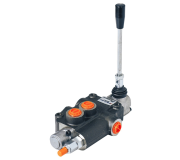
A hydraulic distributor is a special device that controls the flow of working fluid: it can change direction and start or stop the flow to control hydraulic cylinders or motors. The principle of operation is simple: channels are switched using moving elements. 

Hydraulic distributors are essential for the smooth operation of specialized transport systems used in construction, agriculture, and manufacturing.

By design, hydraulic distributors can be: 

  • Spool valves: have a spool that controls the working fluid;
  • Poppet valves: here the fluid flow is controlled by a valve;
  • Rotary valves: flow control is achieved by rotating the rotor.

By control type, a hydraulic distributor can be: manual (controlled by a lever or handle), electromagnetic (an electromagnet initiates valve movement), hydraulic (controlled by working-fluid pressure), or pneumatic (control element movement is achieved by air-flow pressure).

A hydraulic distributor has the following technical characteristics: 

  • Working pressure: indicates the maximum power of the device and compatibility to work in a specific hydraulic system of special equipment;
  • Number of sections: indicates the ability to control a certain number of actuators;
  • Control types: manual, electromagnetic, and hydraulic;
  • Compatibility with hydraulic systems: determined depending on the type of working fluid, pressure capabilities, and operating conditions;
  • Housing material: cast iron, aluminum, or steel. It determines the structure's strength, weight, pressure capacity, and usage conditions. 

When choosing a hydraulic distributor, pay attention to the technical characteristics, namely: whether the hydraulic system is compatible with other components of the structure. Choose a convenient mounting method and check the quality of the materials and the reliability of the fasteners.

In our store, you can find reliable, practical hydraulic distributors and a variety of hydraulic systems. There you will also find the latest models of powerful hydraulic motors and can view modern power units of various configurations. 

Expand

Frequently asked questions about products in this category Hydraulic Valves

A hydraulic control valve is a component that directs the flow of oil in a hydraulic system. It determines where the flow goes: to a hydraulic cylinder, hydraulic motor, or back to the tank. Without it, the pump would simply circulate fluid in a loop, and the bucket, boom, winch, or other mechanism would not receive the necessary command.
A distributor is needed when equipment requires not just pressure, but controlled movement. It starts or stops the working mechanism, changes the direction of cylinder movement, and allows several units to operate independently. For example, in one system, it can control lifting, rotation, and winch drive.
Monoblock and sectional hydraulic distributors are most commonly used. A monoblock unit has a ready-made housing with a fixed number of sections and is suitable for simpler circuits. A sectional unit is convenient where multiple actuators need to be controlled: its configuration is easier to match to specific equipment. Models also differ in the number of sections, flow capacity, and control method.
For special equipment, it is important that the distributor withstands loads, maintains controllability during operation, and matches the number of machine functions. On a loader or manipulator, one section may be responsible for lifting, another for tilting or turning. In such systems, not only the dimensions of the unit are considered, but also pressure, oil flow, spool type, and the possibility of fixed or floating positions.
The pump supplies oil to the distributor, which directs it to the desired channel. After moving the lever or applying an electrical signal, the spool opens one passage and closes the other. This causes the hydraulic cylinder to extend or retract, and the hydraulic motor to rotate in the desired direction. In the neutral position, the system enters the mode provided by the design of the specific model.
The simplest models are controlled manually — by a lever that the operator moves directly. Electromagnetic distributors receive commands from a button, remote control, or the vehicle's electrical system. There are also pneumatic and hydraulic options with remote control. Manual control is convenient for basic mechanisms, while electrical control is more often needed where the operator is not standing near the unit itself.
First, determine how many mechanisms need to be controlled: a single cylinder, a pair of circuits, or a more complex hydraulic system. Then, check the maximum pressure, oil flow from the pump, center type, number of sections, port threads, and control method. If the control valve passes less oil than the pump delivers, the system may overheat and lose speed. An error in the spool type changes the operating logic of the entire mechanism.
Hydraulic distributors in Ukraine cost approximately from UAH 4,000 for simple manual models. Two-section, multi-section, and electromagnetic options cost more. The price is affected by the number of sections, throughput, permissible pressure, control type, body materials, and compatibility with equipment.
When a piece of equipment has one hydraulic cylinder, a simpler circuit is sufficient. A lift, loader, or other machine with multiple moving parts requires a different number of sections and a clear control logic. Flash Army offers monoblock and sectional Badestnost hydraulic distributors with manual and electromagnetic control, so you can search for the component by hydraulic system parameters, not just by appearance.