You watched
Catalog
2
0
0

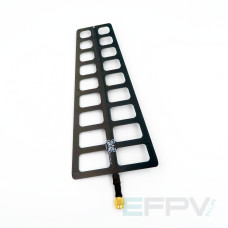
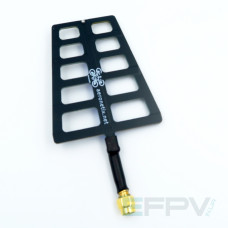
Military log-periodic antennas
Sort By:
In stock
In stock
In stock
Log-periodic antenna 700-1300 MHz
0
3 520 грн.
Add to Cart
In stock
Log-periodic antenna 350-650 MHz
1
3 850 грн.
Add to Cart
In stock
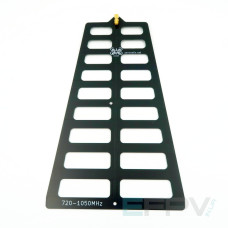
Log-periodic antenna 720-1050 MHz (textolite)
1
1 650 грн.
Add to Cart
In stock
In stock
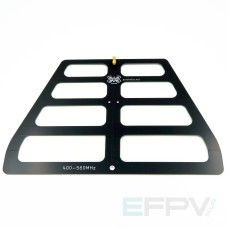
Log-periodic antenna 400-560 MHz (textolite)
0
1 650 грн.
Add to Cart
Log-periodic Antenna 700-1000 MHz
0
3 520 грн.
Add to Cart
Military log-periodic antennas

What are log-periodic antennas?

Log-periodic antennas are a type of broadband radiator that provides stable communication over a wide frequency range. Thanks to the special geometry of its elements, a log-periodic antenna combines simple design with high efficiency, making it relevant for military and specialized systems.

Purpose of log-periodic antennas

Log-periodic antennas ensure stable signal transmission and reception in challenging conditions. Log-periodic antennas are used for communication on various frequencies, including operation with multiple transmitters and receivers.

Features of log-periodic antennas

The key advantage is stable operation over a wide frequency range. A log-periodic antenna has uniform directivity, which allows maintaining communication quality even when the frequency changes. Another important feature is compatibility with multi-frequency equipment, making these antennas versatile in military environments.

Main antenna characteristics

  • Frequency range: wide, covering several operating bands at once.
  • Gain: moderate, but stable across the entire range.
  • Directivity: clear, with a controlled beam angle.
  • Power: sufficient for long distances.
  • Materials: lightweight and durable, resistant to field conditions.
  • How to choose log-periodic antennas?

When choosing, pay attention to:

  • Frequency range.
  • Signal gain.
  • Beam angle.
  • Connector type.
  • Materials and construction.
  • Mounting method.
  • Weight and dimensions.

A properly selected log-periodic antenna will provide a balance between range, signal quality, and practicality of use.

Where to buy antennas

You can buy high-quality log-periodic antennas at the Flash Army store. Here you can buy a log-periodic antenna complete with tested equipment, with a warranty and fast delivery across Ukraine. Flash Army is reliability chosen by military personnel and professionals.

Expand

Frequently asked questions about products in this category Military log-periodic antennas

A log-periodic antenna is a directional broadband antenna with a set of elements of different lengths arranged along an axis. It is used when a single antenna needs to cover not just one narrow frequency, but an entire operating range. In Flash Army, this is clearly visible in the category itself: there are models from 350–650 MHz to 400–6000 MHz, meaning it's about wide frequency coverage, not an antenna for a single fixed point.
The operating principle is that different antenna elements handle the main load at different frequencies. Longer elements work at lower frequencies, while shorter ones work at higher frequencies. This allows the antenna to operate across a wide band and eliminates the need for a separate model for each sub-band. In Flash Army descriptions, log-periodic antennas are directly presented as broadband solutions for stable signal reception and transmission.
Here, everything depends on the specific model. Flash Army offers antennas for 350–650 MHz, 400–560 MHz, 500–1040 MHz, 550–1100 MHz, 620–1040 MHz, 700–1020 MHz, 720–1050 MHz, 1700–2700 MHz, 2200–2700 MHz, and 400–6000 MHz. Thus, a log-periodic antenna is not a single standard range, but a type of design made for various tasks and different frequencies.
Flash Army models most often feature gain in the 6–9 dBi range. For example, 400–560 MHz has 6–7 dBi, 400–6000 MHz — 7 dBi, 550–1100 MHz — 7 dBi, 720–1050 MHz — 8–9 dBi, 1700–2700 MHz — 9 dBi, and 350–650 MHz — 9 dBi. This is no longer the level of an omnidirectional antenna: the signal is concentrated in the operating direction, but without an overly narrow beam.
The beam angle also depends on the model, but Flash Army's catalog often features values of 70° and 80°. For example, 400–6000 MHz has 70°, 350–650 MHz has 70°, while 400–560 MHz, 550–1100 MHz, and 720–1050 MHz have 80°. This means the antenna needs to be oriented in the desired direction, but without the extremely fine aiming required for much narrower solutions.
In Flash Army, aluminum and fiberglass are most often featured for such antennas. Aluminum elements provide rigidity and normal corrosion resistance, while fiberglass is used in more compact platforms and housing parts. For example, the 400–560 MHz model has active elements made of aluminum and a fiberglass housing, the 550–1100 MHz and 720–1050 MHz models are explicitly designated as fiberglass, and the 350–650 MHz is an aluminum model.
At Flash Army, these antennas are offered for FPV, video channels, repeaters, mobile radio systems, monitoring systems, and tasks requiring a stable directional signal across a wide range. The FPV LPDA 700–1020 MHz is specifically described for FPV drones, telemetry, and mobile radio systems, while the 550–1100 MHz and 720–1050 MHz models are for repeaters. This means a log-periodic antenna is chosen not for a single narrow function, but for systems where both directionality and a wide frequency band are important.
The main advantage is that one antenna covers a wide frequency band at once. There is no need to select a separate model for each channel or sub-band. In practical work, this simplifies antenna selection for the system, provides more flexibility, and reduces the number of separate solutions for different frequencies. This is precisely what Flash Army emphasizes in the descriptions of log-periodic models.
If you look at Flash Army, prices for log-periodic antennas range from 630 UAH and up. The cost depends on the frequency range, gain, beam angle, material, and the specific task for which the antenna is designed. Simpler models are cheaper, while options with a wider range or specialization for FPV, repeaters, or more complex radio tasks are more expensive.
You can choose log-periodic antennas on the Flash Army website. Before choosing, you should check the operating range, gain, beam angle, material, and connector type, because the 350–650 MHz model, the 720–1050 MHz antenna for a repeater, and the LPDA 700–1020 MHz for FPV are different solutions in terms of operation.