You watched
Catalog
1
0
0

Signal & Noise Weapons

There are no products to list in this category.

Continue
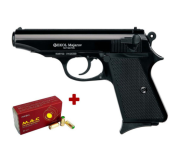
Signal & Noise Weapons

What is blank-firing and signal weaponry?

Blank-firing and signal weaponry is a safe tool for signaling, training, and simulating gunshots. It is a signal weapon that allows users to practice mechanism operation, trigger pull, magazine changes, or recoil reaction. Such models are often chosen by units that assemble their training kits along with equipment such as military knives — everything that helps build a realistic training process.

Purpose and advantages of blank-firing and signal weaponry

Starter weapons have a primary task: to create a loud, noticeable signal and a realistic gunshot simulation. The advantages are obvious: safety, accessibility, and reusability. Thanks to operation with a blank cartridge or primer, the user gets the desired sound and dynamics without risk. Often, such a tool is used in range exercises alongside military two-way radios to coordinate group actions.

Types of blank-firing and signal weaponry

The most common models are blank-firing pistols and revolvers, created as copies of combat counterparts. They differ in caliber, firing pin design, and loudness level. There are lightweight training options, and there are durable models for intensive training. They are often purchased along with equipment from the website catalog to form a complete training kit.

Technical specifications

The main parameters are mechanism type, magazine capacity, recoil force, and primer retention stability. Materials are usually metal or combined, designed to withstand active loads. Loudness is also important: for tactical simulation, it should be as close as possible to the combat sound, but controlled.

What to look for when choosing?

To choose, focus on your tasks: for training, models with a realistic trigger pull and reliable firing pin are suitable; for signaling, those with increased loudness. Also, pay attention to the caliber, mechanical quality, and availability of blank cartridges. In the weapons for training and simulation section, it is usually easy to find the optimal option.

Where to buy blank-firing and signal weaponry?

Reliable solutions should be sought from trusted sellers. The Flash Army website offers a wide selection of signal, starter, and blank-firing models for training and technical tasks, so finding the right option for your conditions will not be difficult. With simple payment not only for individuals, but also for military units and public organizations.

Frequently asked questions about products in this category Signal & Noise Weapons

Signal and noise weapons are starter, blank, or signal models that simulate a shot with sound but are not designed to fire live ammunition. They are used for signaling, training, sports starts, learning weapon handling, or simulating a shot. In such models, the barrel is structurally modified so that it cannot function as a combat weapon.
Signal-noise weapons operate with blank or noise cartridges, which produce the sound of a shot without a bullet. When the trigger is pulled, the primer and powder charge ignite, creating a loud bang and gas discharge. In pistols with a magazine, the automatic mechanism can simulate the operation of a live-fire model: the slide moves, a cartridge is fed, and a spent casing is ejected.
A permit is usually not required for certified starter or blank-firing weapons that do not fire live or traumatic ammunition. However, before purchasing, it is still advisable to check the specific model, its certification, and the buyer's age. If the device is modified or shows signs of a firearm, this is a different legal situation: the Criminal Code of Ukraine provides for liability for illegal handling of firearms and ammunition.
A signal pistol produces sound, flash, or signal, but is not designed to hit a person with a projectile. Traumatic weapons use cartridges with rubber or similar non-lethal projectiles, and therefore belong to a different category.
Blank-firing weapons are not a full-fledged means of self-defense because they do not stop an attacker with a projectile. They are sometimes purchased for their loud sound and external resemblance to combat models, but relying on them as reliable protection is dangerous. It is also important to remember: a shot at close range, the flash, and hot gases can cause injury, so such a pistol should not be aimed at a person.
Blank, noise, or signal cartridges of the appropriate caliber are used for signal pistols. The most common calibers are 9mm and 8mm, but the specific option depends on the model. Some descriptions of signal-noise pistols explicitly state 9mm noise cartridges, so ammunition should only be selected for a specific pistol.
A blank shot matches the loudness and feel of a live shot, except without a bullet exiting the barrel. The exact loudness depends on the caliber, cartridge, barrel length, and pistol design. Indoors, the sound is perceived much sharper than outdoors, so it's best to use hearing protection during training.
A blank-firing pistol is chosen based on caliber, brand, body material, magazine capacity, weight, size, safety type, and intended use. For training, ergonomics, resemblance to the prototype, slide operation, and magazine convenience are important. For signaling, loudness, ease of use, and compatible cartridges are key. In the Flash Army category, there are pistols, revolvers, automatic firearms, models with metal or polymer bodies, and various magazine capacities.
Blank-firing weapons can be dangerous if misused. They do not fire a bullet but produce a loud sound, flash, hot gases, and pressure at the muzzle. Do not fire at point-blank range, aim the pistol at people, use faulty cartridges, or attempt to modify the design. For safe handling, treat it as a firearm, even if it is a signal weapon.
A certified signal or starter pistol can be carried if it does not belong to the category of weapons requiring a permit, but it should not be openly displayed in public places. People do not always distinguish a blank-firing model from a live-fire one, so a demonstrative gesture or threat can create problems. For carrying, it is better to use a holster or case, and keep cartridges separate from the pistol.
The caliber of a signal pistol is best chosen based on cartridge compatibility, ammunition availability, and the specific model. The most common options are 9mm and 8mm. 9mm is often chosen for its louder sound and wider selection of models, while 8mm can be more compact and lighter. For training, not only the caliber but also the weight, balance, magazine capacity, and ease of reloading are important.
Signal and noise weapons in Ukraine cost approximately from UAH 600, if simple signal elements are considered. Starter and noise pistols usually start from approximately UAH 3,000, while more expensive models with a metal body, larger magazine capacity, realistic ergonomics, or more complex design cost more. The price is influenced by the brand, caliber, body material, model type, weight, package contents, and availability of accessories.
It's best to choose signal-blank guns at Flash Army based on the actual task: signaling, training, simulating mechanical operation, or completing a training kit. For a simple signal, there's no point in taking a heavy model with a large magazine capacity, while for training, ergonomics, weight, safety, compatible cartridges, and ease of reloading are important. Before purchasing, you need to verify certification, caliber, and safe use rules to ensure the pistol remains a signal-blank tool and not a source of unnecessary risks.