Catalog
0
0

Antenna Cables

Sort By:
Antenna Cables

What are antenna cables?

Antenna cables are wires that connect an antenna to a device and transmit a signal. At first glance, it's a simple component, but it determines how stably the equipment operates and how cleanly data is transmitted. In field conditions or during training, a reliable antenna cable helps maintain uninterrupted communication. The wire, connector, and compatibility with equipment are important here, and an adapter adds versatility when you need to connect the cable to different systems.

Why are antenna cables needed?

An antenna cable is needed for the signal to be transmitted clearly and without loss. This is critical during combat missions, just as it is for tactical headphones – where even a small noise can interfere – and for drones, which depend on a stable signal for transmitting commands and video. If the wire is of high quality, communication will not be interrupted, and the equipment will work longer. Sometimes, the entire operation of a combat kit relies on this cable.

Where are antenna cables used and what functions do they perform?

Antenna cables are used in military communication systems, FPV drones, two-way radios, and other tactical devices. They transmit signals, maintain communication stability, and ensure compatibility with various connectors and adapters. In drones, the cable is responsible for clear video and command transmission. FPV drone accessories often complement the drone, making the system convenient and reliable, especially when the equipment operates in field conditions and cannot be skimped on.

Types of antenna cables

There are several types: 

  • Coaxial cables;
  • Armored wires;
  • Low-impedance cables for harsh conditions

Each type differs in signal stability, durability, and reliability. Some cables have a protective coating to withstand mechanical damage or temperature fluctuations. When choosing a cable, pay attention to the connector – this determines how smoothly the equipment will operate and whether it fits the required device model.

How to choose antenna cables correctly?

When choosing an antenna cable, you should evaluate signal stability, reliability, and compatibility with your equipment. The wire material, connector type, and adapter connectivity determine whether the cable will withstand field or tactical conditions. It's also worth remembering tactical medicine, as it is also a part of the equipment that is important to have at a critical moment – it's a matter of safety.

Where to buy antenna cables?

You should buy antenna cables at Flash Army, which offers reliable models. A high-quality cable works without interruptions in difficult conditions. This applies to tactical headphones and FPV drone accessories – all product categories are presented on the website, helping you find everything you need in one place. Expert consultation and fast delivery across Ukraine help ensure you have everything you need on time, without hesitation or waiting.

Expand

Frequently asked questions about products in this category Antenna Cables

An antenna cable is a coaxial cable that transmits a radio signal between an antenna and equipment such as a receiver, transmitter, communication module, detector, or other RF device. Its task is simple: to transmit the signal with minimal loss. If the cable is chosen incorrectly, even a good antenna may perform worse because part of the signal is lost before it even reaches the device.
Antenna cables are used to connect external antennas, or to mount an antenna on a mast, roof, equipment chassis, or other point with better reception. In drone electronics, EW, SIGINT, radio communications, and UAV detection systems, they are needed where the antenna cannot be placed directly on the device. For example, cables for remote antennas can be used to connect a drone detector to antennas in the 1.2, 3.3, and 5.8 GHz bands.
Antenna cables vary by brand, thickness, flexibility, loss, operating frequency, length, and connector type. Thin, flexible cables are often chosen for compact electronics, while thicker, lower-loss options are preferred for longer runs. There are also ready-made adapters such as SMA, MMCX, N-type, and other cables for specific antennas and devices. Flexible RG316 is convenient for short connections, but for long antenna extensions, cable loss over meters becomes more critical.
Antenna cables for radio communications and FPV systems most often have a characteristic impedance of 50 ohms. This is important because the antenna, cable, and device must operate in a single, matched system. If the impedance does not match, part of the signal is reflected back, increasing losses and degrading communication stability. 75 ohms is often used for television systems, but most RF equipment, antennas, and communication modules require 50 ohms. The ready-made RG316 cables for RF systems at Flash Army also specify a 50-ohm impedance.
Among popular antenna cable brands, RG316, RG58, RG174, RG213, LMR-200, LMR-240, and LMR-400 are frequently encountered. RG316 is convenient for short, flexible connections in compact systems, RG58 is often chosen for simple radio tasks, while thicker LMR cables are better suited for longer runs where signal loss is critical. The brand should be chosen not by name, but by length, frequency, connectors, and how much the cable needs to bend in a specific installation.
Shielding protects the signal in the cable from external electromagnetic interference and reduces unwanted radiation from the cable itself. Under other conditions, the difference may not be as noticeable, but near transmitters, EW equipment, or a large amount of electronics, weak shielding quickly causes problems. Good shielding, proper connectors, and careful installation help maintain signal stability, especially at high frequencies.
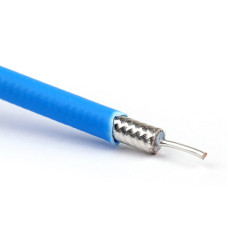
Antenna cables consist of a center conductor, dielectric, shield, and outer jacket. The center conductor can be copper or copper-clad, the dielectric is usually made of polymer materials, the shield from foil, braid, or a combination layer, and the outer jacket from PVC, fluoropolymer, or other protective material. For field and mobile systems, not only electrical parameters are important, but also whether the cable can withstand bending, moisture, friction, and frequent connections.
Antenna cables in Ukraine cost approximately from UAH 100 for short adapters or simple cables. Longer cables for external antennas, options with higher quality connectors, thicker lines, lower loss, or operation in multiple frequency bands cost more. The price is affected by length, cable brand, frequency range, connector type, shielding, brand, and specific equipment application.
Antenna cables at Flash Army should be selected for a specific pair: what antenna, what device, what frequency, and what distance between them. For a short connection, a compact RG316 with the necessary SMA or MMCX connectors may suffice, but for extending an antenna by several meters, you need to consider length, loss, and mechanical strength. If the cable is for a detector, receiver, or transmitter, it's best to immediately check not only the connector but also the frequency range, so that the system does not lose signal due to an incorrectly chosen connection.