

Hexacopters
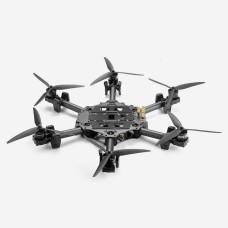


What is a hexacopter?
A hexacopter is a multirotor UAV with six motors and six propellers. A stabilized gimbal, thermal imaging camera, LiDAR, or other equipment can be installed on such a frame if the maximum takeoff weight allows for it. The flight controller controls each motor separately and stabilizes the platform based on the actual payload.
How does a hexacopter differ from other UAVs?
Quadcopters have four motors, while hexacopters have six. If the platforms are similar in class, the additional pair of motors increases the total thrust reserve and distributes the load across six propellers. On some models, the controller can compensate for the failure of one motor if the remaining five provide enough thrust for the current aircraft weight. When replacing a motor, it is important to consider that drone motors must match the parameters of the standard power system; otherwise, the distribution of thrust between the arms will change.
What is a hexacopter used for?
Hexacopters are used for working with equipment that is heavier than a standard onboard camera, such as a three-axis gimbal, thermal imaging camera, multispectral camera, or LiDAR. In surveying, additional requirements apply to platform stability and RTK/GNSS operation. The six-rotor configuration is also used in agricultural drones, where part of the payload capacity is occupied by the tank, pump, and working fluid. For remote ground tasks, UGVs are used, which have different requirements for the chassis, terrain capability, and payload placement.
Features of hexacopters
In a hexacopter, the battery, motors, and payload are evaluated together:
- Maximum takeoff weight — includes the drone, battery, gimbal, camera, and other equipment.
- Payload capacity — the manufacturer specifies the permissible weight for the standard mount.
- Motors and ESCs — the motor is selected based on the propeller and operating voltage, while the ESC is selected based on the permissible current.
- Battery — compare energy reserve in Wh, because the same mAh capacity at 6S and 12S provides different amounts of energy.
- Flight time — the value with the installed camera and gimbal is used if the manufacturer provides such a figure.
FPV drones generally do not use a heavy stabilized gimbal, so the requirements for the frame and chassis are different. On such compact platforms, FPV drone cameras are generally lighter than the modules installed on three-axis gimbals used on hexacopters.
How to choose a hexacopter?
A 900 g camera and a 600 g gimbal add up to 1.5 kg of load even before cables and additional modules are included. For such a setup, check the permissible weight on the mount, maximum takeoff weight, and flight time with a similar payload. A lower-mounted gimbal requires sufficient chassis clearance, and the battery must match the power system's operating voltage. If you plan several consecutive flights, consider the number of batteries and their charging time. Ground control should also be checked, as an FPV drone remote controller is not always compatible with a hexacopter due to differences in communication protocols and receivers.
Where to buy a hexacopter?
A six-rotor platform usually requires spare propellers, additional batteries, and charging equipment, with each of these components having its own compatibility requirements. At Flash Army, you can select a hexacopter and components for a specific power system: the battery — by voltage and connector, propellers — by size and mounting, and the gimbal — by mount and permissible weight. If you need a hexacopter, it is also easier to buy one for an existing camera when you know its weight, gimbal type, and power requirements.