You watched
Catalog
2
0
0

Weapon Slings for Military Use

There are no products to list in this category.

Continue
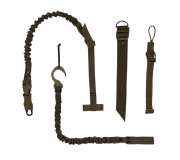
Weapon Slings for Military Use

What are weapon slings?

A weapon sling is not just a strip of material: it's a functional element of military equipment that keeps your weapon at hand, distributes weight, and adds comfort. A weapon sling must be durable, adjustable, and compatible with pouches and accessories.

Purpose of weapon slings

The main function is securing and providing quick access to the weapon. A weapon sling reduces shoulder strain, allowing stable carrying of a rifle or carbine during marches or long duty shifts. Slings are also used to immobilize weapons in transport.

Types of weapon slings

  • Single-point — simple, suitable for short movements.
  • Two-point — a balance between retention and mobility, popular with infantry.
  • Three-point — provides the best stabilization and quick transition to a firing position.

Features of weapon slings

Look for weapon slings with soft padding or mesh for ventilation. Quick-release systems, retainers, and adjustable buckles are useful. Materials include nylon, polyester, sometimes with metal components for reliability.

How to choose weapon slings?

Before buying a weapon sling, determine:  

  • Attachment type;
  • Length;
  • Material;
  • Ability to adjust to your gear;
  • Color
  • Uniform compatibility is also important — from camouflage to black tactical options.

Where to buy weapon slings?

For a weapon sling to last long, purchase from trusted stores. Flash Army offers a selection of weapon slings of various types and sizes. Together with the Pouches and Bags section and the Accessories section, you can choose a kit that meets your service requirements.

Frequently asked questions about products in this category Weapon Slings for Military Use

A weapon sling is a strap that holds a weapon on the body, relieves some of the load from the hands, and secures the weapon during movement, stops, or when transitioning to a firing position.
A weapon sling is essential for carrying, securing, and quickly accessing a weapon. During movements, patrols, operating equipment, or changing positions, it prevents the weapon from swinging freely and allows for quicker adjustment to the body or release when more freedom of movement is needed.
Most often, these are single-point, two-point, and three-point models. Two-point slings are currently the most common, but there are also hybrid options that can be converted from two-point to single-point mode if required for a specific weapon or task.
The color selection here is wide: black, olive, coyote, multicam, and others. This means you can choose a belt to match both a basic kit and a specific camouflage.
For two-point models, key features include quick length adjustment, the ability to cinch the weapon to the body or loosen the sling for movement, a soft shoulder pad, and compatibility with QD or direct attachment; for three-point models, a more rigid weapon retention on the body, quick release via a fastex buckle, and an anti-noise design without metal rattling.
Most often, nylon, polyamide webbing, and polyester are used, and in some models, Cordura 500D in structural details. In addition to the webbing itself, accessories are of great importance: acetal, YKK, reinforced carabiners, QD swivels, buckles, and seams that do not unravel under load.
If a more versatile option is needed, a two-point sling is more often chosen. It is easier to quickly adjust to oneself, simpler to tighten the weapon to the body or loosen it for movement. A three-point sling should be chosen when a more rigid fixation of the weapon on the body, longer transitions, or more stable carrying of long-barreled weapons are more important.
Most weapon slings in this segment currently range from approximately UAH 700–1600. More expensive models with better hardware, QD mounts, or more complex designs can reach up to approximately UAH 3300.
Weapon slings can be selected for different types of weapons and different carrying methods at Flash Army. Before ordering, it is best to check the number of attachment points, adjustment method, compatibility with swivels or QD, and whether a shoulder pad, quick release, or a combined 1/2 point mode is needed.