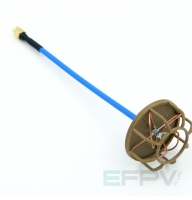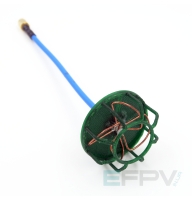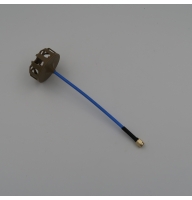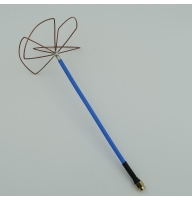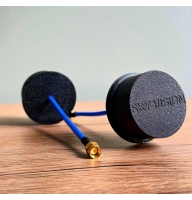
Circular antennas have long been the standard for many FPV systems, video links, and wireless equipment. They are used when it's important to maintain a stable signal even when the drone's position in the air is constantly changing. This is especially relevant for FPV, as a UAV tilts, turns, accelerates, and practically never stays in one position during flight.
Unlike some other antenna types, circular antennas tolerate such orientation changes better. Because of this, they can be seen on drones, video receivers, repeaters, and ground stations. To understand why they have become so popular, it's worth delving into their operating principle.
What are circular antennas and how do they work?
A circular antenna is an antenna that works with a circularly polarized signal. During transmission, the radio wave does not move in a single plane but rotates around its axis.
For the user, this sounds more complex than it works in practice. The main advantage of this approach is that the signal is less dependent on the antenna's position in space. While a conventional linear antenna reacts strongly to tilts or turns, circularly polarized antennas tolerate such changes much more calmly.
This is precisely why they are well-suited for FPV drones: during flight, a UAV can perform sharp maneuvers, tilt at large angles, or quickly change course. Meanwhile, the video channel remains more stable compared to many linear solutions.
Another feature of circular antennas is better performance with reflected signals. In urban areas, among buildings or a large number of metal structures, radio waves constantly reflect off various surfaces. Some of these reflections can degrade reception quality. Circular polarization partially reduces this effect.
What is circular signal polarization?
Polarization shows how an electromagnetic wave behaves during propagation. In linear polarization, the wave moves in a single plane. In circular polarization, it rotates.
Circular polarization comes in two types:
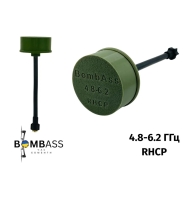
- RHCP — Right-Hand Circular Polarization;
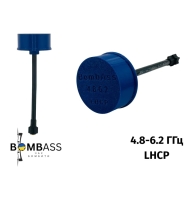
- LHCP — Left-Hand Circular Polarization.
The transmitter and receiver must operate with the same polarization. If an RHCP antenna is installed on the drone and an LHCP antenna is used on the receiver, part of the signal will be lost before reaching the receiving equipment. Therefore, when assembling an FPV system, not only frequencies but also the type of polarization are always checked.
For FPV, the 5.8 GHz band is most often used, although solutions for other frequencies also exist. The principle of circular polarization remains the same.
Main types of circular antennas
In recent years, several popular designs have emerged that are most commonly used in FPV.
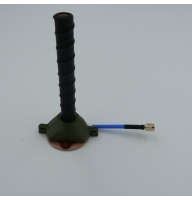
Cloverleaf Antennas
Cloverleaf antennas were among the first mass solutions for FPV. They got their name from the shape of their radiating elements, which resemble clover leaves.
These antennas provide circular polarization and work well on drones due to their low weight and simple design. Even today, they can be found on many FPV builds.
Pagoda Antennas
Pagoda antennas appeared later as an evolution of previous designs. They feature more precise radiating element geometry and better repeatability of characteristics during manufacturing.
Because of this, Pagoda quickly became popular among FPV operators. Such antennas ensure stable operation, have compact dimensions, and are well-suited for most modern drones.
Rose Antennas
Rose antennas use a similar principle of circular polarization but have a different radiating element design. They are often chosen for their combination of compactness, mechanical strength, and stable characteristics.
This is important for field conditions, as drone antennas regularly sustain impacts during landing or transport.
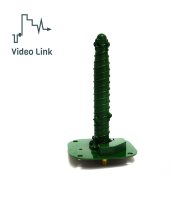
Helical Antennas
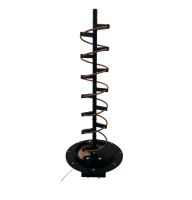
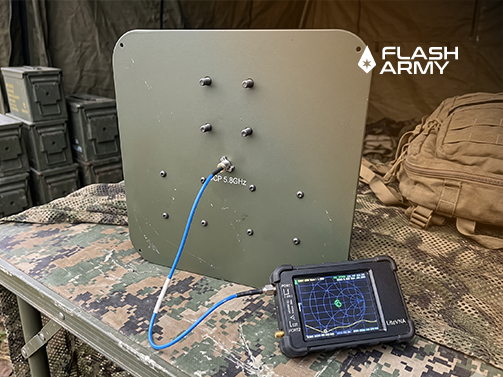
Helical antennas differ from previous models in that they are directional. They also work with circular polarization but concentrate the signal in a specific sector.
Most often, they are used not on the drone itself, but on the operator's side — on ground stations or receivers. Helical antennas allow for a higher gain and improved reception over long distances.
Advantages of circular antennas and their areas of use
The main reason for the popularity of such antennas is their stable operation in motion. For FPV, this is critical, as the UAV constantly changes its position relative to the operator.
Circular antennas also help to:
- reduce the impact of drone tilts and turns;
- work better with reflected signals;
- maintain a more stable video channel;
- reduce signal loss during maneuvers;
- improve reception quality in challenging conditions.
Today, they are used not only in FPV. Such antennas can be found in telemetry, video links, repeaters, ground stations, and various wireless communication systems.
How to choose a circular antenna for different tasks
For the receiving end, more attention is paid to amplification, antenna type, and operating sector. If long-distance operation is required, a circular antenna on the drone is often combined with a Helical directional antenna on the receiver.
Several basic parameters also need to be checked:
- operating frequency;
- polarization type;
- gain coefficient;
- connector type;
- compatibility with existing equipment.
A circular antenna does not increase range by itself and does not solve all communication problems. However, a correctly selected model helps to achieve a more stable video channel and make the FPV system's operation more predictable. This is why circular polarization antennas have remained one of the most common solutions for drones and wireless video transmission systems for many years.
At Flash Army, you can order circular antennas of various types and manufacturers.
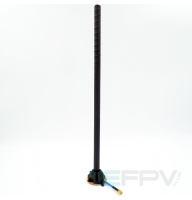
(1)-192x200.jpg "Antenna Helical 3.3 GHz 16.3 dBi 18 turns")
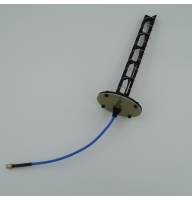
-192x200.jpg "Antenna Helical LHCP 17.8 dBi 22 turns 4.9-6.1 GHz")