An antenna is an important component of a drone system. Currently, various types of antennas are used on the battlefield, depending on the tasks to be solved. For example, Helical and Horn antennas are better suited for long-distance flights, while Clover antennas provide a more stable signal in conditions with interference.
In this article, we will focus on patch antennas. They belong to the class of directional antennas and are widely used in FPV systems. Patch antennas are so popular because they allow concentrating the signal in the desired direction, reducing the impact of interference, and ensuring stable data transmission.
At the same time, their effectiveness is achieved with proper setup, consideration of technical features, and use for their intended purpose. You will learn about these and other advantages from the material prepared by the Flash Army team.
What is a patch antenna and how does it work
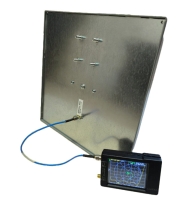
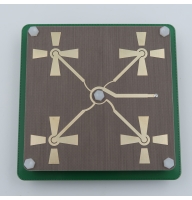
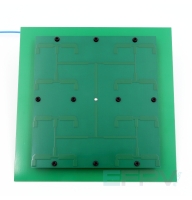
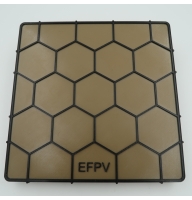
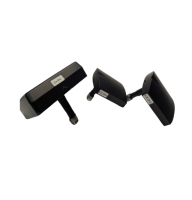
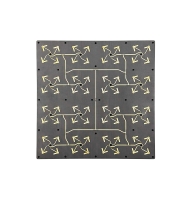
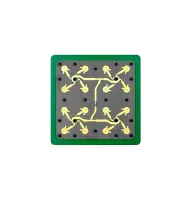
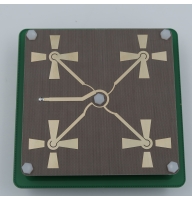
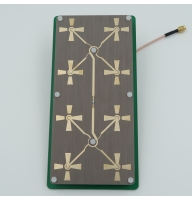
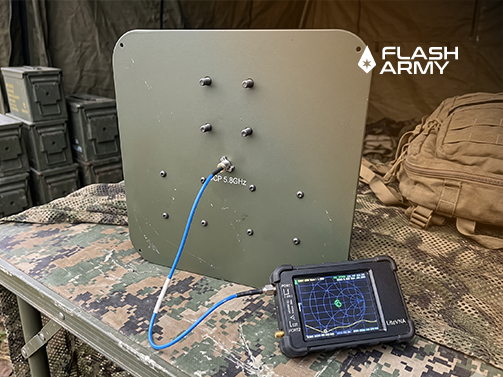
A patch antenna is a type of low-profile directional antenna that looks like a metal plate (radiator) placed on a dielectric base with a shielding layer underneath. It operates on the principle of resonance: when a signal of the appropriate frequency is applied, the antenna radiates and receives radio waves in a defined direction.
Purpose of patch antennas
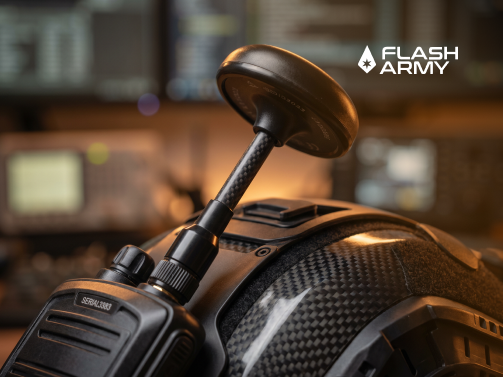
First and foremost, patch antennas are designed to receive video signals from an FPV drone over long distances in a defined direction. Thanks to their flat shape, these antennas are suitable for installation on ground control systems for UAVs, helmets, and repeaters. This provides you with fairly clear video with minimal delays.
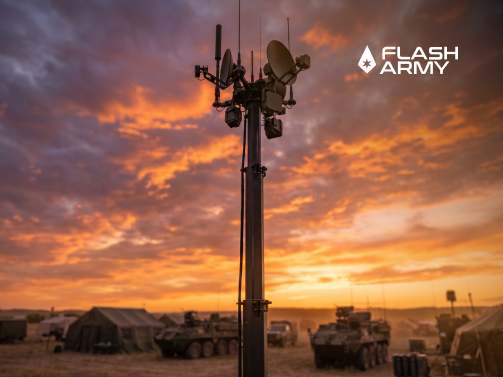
Secondly, they provide communication on the battlefield. A narrow beam increases the range of radio signal transmission in one direction.
In addition, patch antennas are used in telecommunications, Wi-Fi networks, and navigation systems.
Key technical features of patch antennas
Patch antennas have the following technical parameters:
Directionality.
They form a narrow radiation pattern (from 30° to 80°).
Operating frequency range.
The antenna must be matched to the system's frequency (e.g., a 5.8 GHz patch antenna), otherwise, transmission efficiency is significantly reduced. They usually operate on all frequencies.
Gain (dBi).
In most models, this value is 6–10 dBi, but more powerful options exist (up to 25 dBi).
Polarization.
Can be linear or circular (RHCP — right-hand, LHCP — left-hand).
Two-dimensional design.
The dimensions of the plate are approximately half a wavelength, allowing it to function similarly to a half-wave dipole.
Shape.
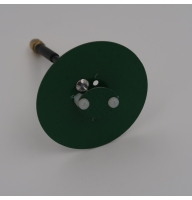
Square, rectangular, circular, or elliptical plates are most commonly used, although other options are possible.
Advantages of using patch antennas in drones
Patch antennas for FPV drones offer a number of advantages, making them effective solutions for field conditions.
- Easy integration with other devices.
- High directivity.
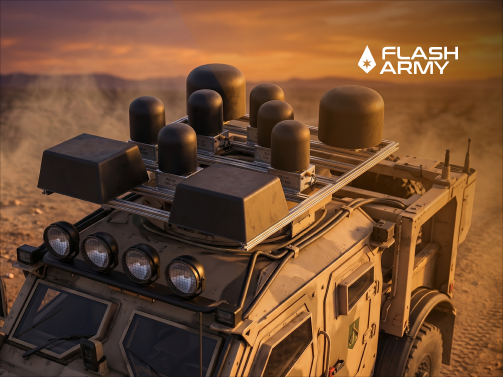
- Sufficient mechanical reliability and adaptability to curved surfaces, which is why they are often installed on vehicles and integrated into portable communication devices.
- Good polarization selectivity.
- Ideal frequency matching for 5.8 GHz, 2.4 GHz, 868/915 MHz.
- Ability to work with multiple feed points.
- Compactness and low profile.
- Communication stability.
How patch antennas are used in FPV drones
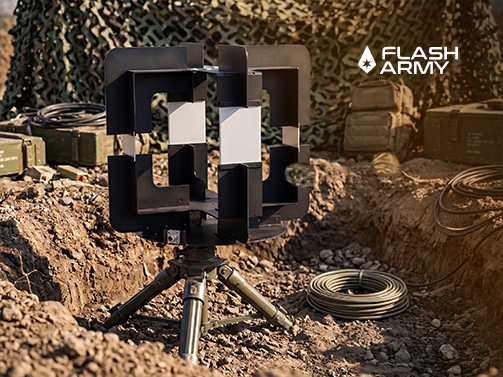
First and foremost, patch antennas are installed on ground stations, FPV goggles, or control remotes. They are connected to SMA/RP-SMA connectors (ensure the connector types match), but they require precise orientation towards the drone. If the flight takes place from cover, the patch antenna is extended on an extension cable, placed higher on a tripod. In this configuration, the antennas receive the video signal, concentrating the radio beam in the direction of flight. A narrow but powerful beam significantly increases the communication range.
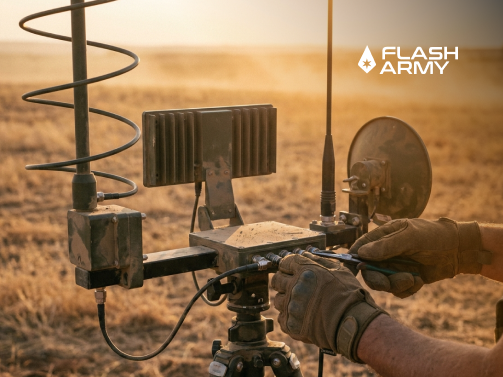
The second common option is their use in diversity systems. In this case, the patch antenna works together with an omnidirectional antenna: the former is responsible for range and signal quality in a specific direction, while the latter ensures stability when the drone changes position. The receiver automatically switches between antennas, choosing the best signal at any given moment.
Furthermore, it is important to remember that patch antennas are effective specifically for long-distance flights. We recommend always checking that your antenna has the same polarization as the drone. The coordinated operation of the entire FPV system depends on this.
Conclusion
Thus, patch antennas, as one type of military antennas, serve as a “long-range receiver” for FPV drones. Thanks to their directionality, compactness, and efficiency, they significantly increase signal transmission range and reduce the impact of radio interference.
To avoid flying blind, it is worth choosing proven models with clearly specified characteristics. You can purchase such options in the Flash Army online store.