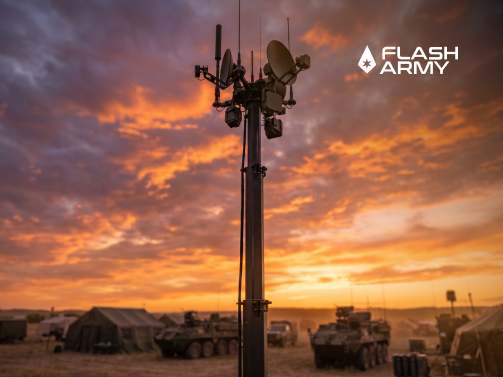
Telescopic masts play a very significant role in military operations: they provide rapid deployment (the ability to raise equipment up to 20–30 meters in a matter of minutes), stable communication by increasing the range of two-way radios and EW by several times when antennas are raised, as well as reconnaissance and surveillance, allowing the detection of enemy equipment and personnel at long distances.
Masts of this type fold very quickly, allowing for maximum operational withdrawal from a position before enemy shelling begins. These masts are easier to camouflage than a stationary tower, and their loss does not mean the destruction of the entire unit. One mast can carry different types of payloads, depending on the task (from communication antennas to radars).
In this article, we will examine what a telescopic mast is, how it is constructed, in which military tasks it is used, its advantages, and what nuances to pay attention to when choosing one. The material was written by the Flash Army team for UAV operators, EW/SIGINT specialists, and signalmen who would like to better understand the tactical and technical advantages of the equipment.
What is a telescopic mast and how is it constructed
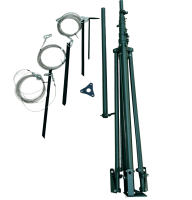
A telescopic mast is a vertical extendable structure consisting of several sections of different diameters that fit into each other like a telescope or a spotting scope. It consists of the following components:
- Sections (segments) — lightweight, durable tubes made of anodized aluminum or carbon fiber of different diameters (each smaller than the previous one) are nested inside each other.
- Lifting mechanism — masts can be extended in various ways: using cables and a winch (mechanical mast), compressed air (pneumatic mast), or pressurized fluid (hydraulic masts).
- Locks — mechanisms that rigidly fix each section and prevent unintentional retraction.
- Base — a tripod for ground installation or a mounting flange for vehicle attachment.
- Rigging — strong Kevlar or nylon ropes and stakes for securing the mast to the ground.
- Masthead — a mounting point at the top of the mast where antennas, cameras, or an EW unit are installed.
For installation, all mast sections are sequentially extended and fixed, ultimately forming a sturdy structure.
Main areas of application in military tasks
In the military sphere, telescopic masts are most often used for the rapid deployment of high-altitude platforms and the placement of communication, surveillance, and electronic warfare equipment on them without the need for complex lifting mechanisms or stationary structures.
They are most often used for the following military tasks:
- Communication and relay: ensuring stable communication between units even in difficult terrain by raising antennas, mobile relay stations (VHF/UHF), directional radio relay links, satellite dishes, etc.
- EW and SIGINT: intercepting and blocking enemy drone signals by raising jammer antennas, as well as detecting enemy radio station positions with remote scanners.
- Surveillance: round-the-clock perimeter surveillance and fire adjustment from cover using high-resolution day cameras, thermal imagers, laser rangefinders, and short-range radars (RLS) mounted on the mast.
- Lighting: deploying powerful searchlights to illuminate checkpoints, field camps, and engineering work sites at night.
- Mobile command posts: use in command and staff vehicles for rapid deployment of staff communication nodes anywhere.
- Camouflage: simulating combat positions to divert enemy fire.
Thanks to their speed, mobility, and versatility, masts have become an integral part of modern military communication, surveillance, and UAV support systems.
Advantages of using telescopic masts
Telescopic masts have a number of advantages that make them indispensable in military affairs:
- Speed of deployment: bringing into operational readiness by 1–2 soldiers takes from 2 to 10 minutes.
- Mobility: The length of a folded telescopic mast is only 1.5–2.5 meters, allowing for easy transport on a pickup truck roof or inside the cargo bed.
- Survivability: at the first threat of shelling, the mast can be retracted very quickly, unlike stationary towers.
- Increased range: the operating range of an EW or communication antenna in urban or forest conditions increases by 2–3 times after being raised by 10–20 meters.
- Personnel safety: operators can remain in a dugout at a safe distance from the antenna.
- Autonomy (for pneumatic models): do not require connection to generators, and a compact compressor, hand pump, or compressed air cylinder is needed for extension.
Telescopic masts allow for the creation of temporary communication, surveillance, and reconnaissance systems where the use of stationary towers is impractical, and provide the ability to quickly respond to changes in the operational situation.
Features of installation and operation
There are two ways to mount telescopic masts: mobile and ground-based. In the first case, the mast is attached to the body, bumper, or side of a vehicle (pickups, command and staff vehicles, armored vehicles). This allows for deploying communications or EW directly from the vehicle.
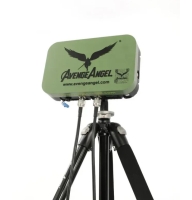
In the second case, the mast is installed on the ground using a special tripod. This approach is used for setting up stationary command and observation posts, dugouts, or checkpoints. For this type of mounting, it is necessary to choose dense soil or use special platforms or distribution plates to prevent subsidence.
Typically, installation proceeds in the following sequence: securing the mast base, raising the sections (manual or mechanized), evenly tensioning the guy wires or tie-down cables, and mandatory verticality control using a spirit level or laser level.
Features of telescopic mast operation:
- Weight control: To prevent significant play or deformation of the sections, the weight of the antenna (or camera) at the top should not exceed the mast's nominal load capacity.
- Grounding: It is essential to ground the mast using a metal rod driven into the ground, as it is a potential lightning rod — this will protect military antennas and expensive equipment from burnout.
- Field maintenance: To prevent jamming of locks and damage to internal mechanisms, it is necessary to regularly clean them of dirt, sand, and ice, and also to monitor the sealing of the glands.
The effectiveness of the mast directly depends on the quality of installation and the correctness of its operation.
What to look for when choosing a mast
There are several parameters that must be considered when choosing a telescopic mast:
- Maximum height: For operation in wooded areas, it should be 12–15 meters, while for steppes or open ground, 6–10 meters will suffice.
- Payload: It should be 20–30% greater than the weight of the equipment at the top.
- Drive type: The mechanical type is more reliable in bad weather and frost, is not afraid of dirt, is energy-independent, but requires physical effort and more time to raise. The pneumatic (compressor) type deploys in a few seconds at the push of a button, but is sensitive to air purity, cuff damage, and requires power for the compressor.
- Construction material: Anodized aluminum has a more balanced strength and weight, and is therefore more common, but composite masts can be extremely heavy and, due to their dielectric properties, do not interfere with antennas.
- Wind resistance and rigidity: The mast should have minimal play, especially if narrow-beam communication antennas or cameras with high zoom are mounted on it.
- Transport dimensions: The length in the folded state should not exceed the dimensions of the vehicle body or roof.
When buying a mast, it is better not to save on materials and the quality of mechanisms, as equipment falling will certainly be more expensive than the mast itself, and in military conditions, this can cost the loss of a position or the lives of personnel.
Conclusion:
Telescopic masts are critically important elements of modern military logistics and communications. With their help, mobile units can most effectively use communication, EW, and tactical reconnaissance equipment, having the opportunity to change positions as quickly as possible if necessary. The correct choice of mast affects the quality of communication, the survivability of equipment, and the safety of personnel. You can choose and buy a telescopic mast at Flash Army.
At Flash Army, you can order telescopic masts of various types and manufacturers.