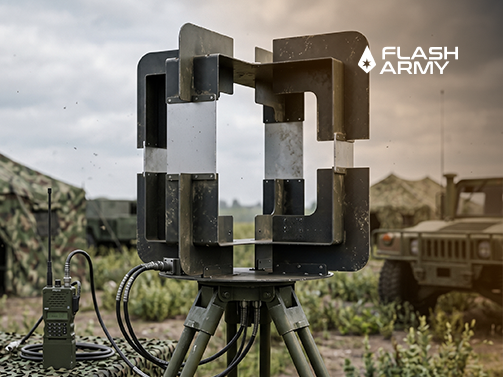
Antennas are fundamental for ensuring communication and protection against drones. They come in various types: horn, dipole, patch antennas, etc. Each has its specific purpose. Some are better suited for EW systems, while others are for communication and drone control. In this article, we will examine quadrifilar antennas. After reading, you will learn why they are unique, their technical parameters and applications, and what to consider when choosing one.
Quadrifilar antennas hold a special place in communication and signal reception systems due to their ability to provide stable coverage without the need for precise aiming. Their design allows for effective signal reception from various directions, which is particularly relevant in conditions where the signal source changes its position.
What is a quadrifilar antenna and how does it work?
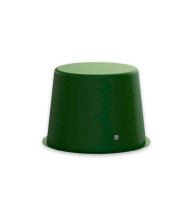
A quadrifilar antenna is a modern type of antenna featuring circular polarization and a hemispherical (almost spherical) radiation pattern. They differ from conventional antennas by having four spirally wound conductors arranged around an axis.
How does it work? If you observe a drone in flight, you'll notice it constantly changes its tilt and orientation. A conventional antenna with linear polarization (vertical or horizontal) struggles to adapt to radio frequency environments. Therefore, the signal can weaken or even disappear due to polarization mismatch. In contrast, a quadrifilar antenna significantly reduces the likelihood of such losses because it operates independently of the object's position in space.
Key design features
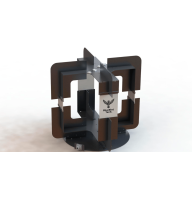
The design of a quadrifilar antenna is crucial for forming its radiation pattern and circular polarization. Four spiral conductors (filars) are symmetrically arranged around a central axis, forming a helix. They create two pairs of elements of different lengths, which are excited with a phase shift, allowing for the creation of circularly polarized signals.
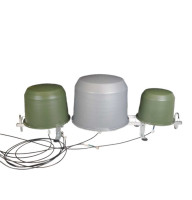
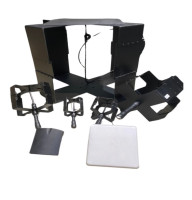
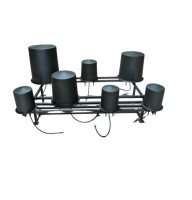
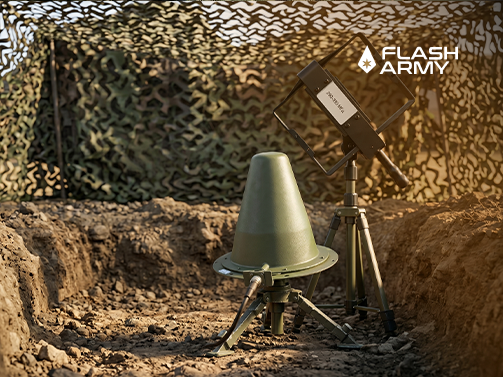
Components also include a feeding system and a reinforcing element (reflector). The latter is often installed on dome EW jammers to form a clearer protection dome. The feeding system ensures proper signal distribution among the spirals, which in turn forms the hemispherical radiation pattern.
Radiation pattern and operating principle
Each of the four conductors of a quadrifilar acts as a resonant element that generates radio waves. When these elements work together with a specified phase shift, a combined field with circular polarization is formed. The spiral geometry of the design allows for efficient signal transmission and reception at various angles, forming an almost uniform radiation pattern. This enables the antenna to cover a significant area without pronounced "dead zones."
Advantages of quadrifilar antennas
Hemispherical quadrifilar antennas stand out for their effectiveness for good reason.
Main advantages:
-
Spherical radiation pattern
Ensures effective operation at 360° (horizontally and a wide vertical angle).
-
Circular polarization
Minimizes signal loss due to polarization mismatch.
-
Interference resistance
Due to their design, quadrifilar antennas are less susceptible to reflected signals.
-
Wide frequency range
Although each antenna is usually optimized for a specific range, some models can operate across a wide spectrum of frequencies.
-
Effectiveness in EW systems
Thanks to their wide coverage, they are optimal for EW jammers targeting FPV drones and UAVs. Moreover, they are installed on both stationary and mobile systems.
Where quadrifilar antennas are used
Quadrifilar antennas are primarily used in electronic warfare systems, GPS receivers and navigation systems, as well as for satellite communication. Most often, they are used to create a protective zone around military facilities, command posts, critical infrastructure, or combatant positions.
What to consider when choosing
Before buying an antenna, we recommend paying attention to the following technical characteristics:
-
Operating frequency range
The antenna must be precisely matched to the system's frequency range (e.g., 300–5850 MHz, 700–850 MHz, 900–1050 MHz), otherwise reception efficiency will significantly decrease.
-
Connector type
This could be N-Type, SMA, RP-SMA, TNC, etc. A correctly chosen connector ensures compatibility with other equipment, such as antenna cables.
-
Power
It is important that the antenna is rated for the power output of the transmitter to avoid damage.
-
Gain (dBi)
It is usually moderate but must be sufficient for your usage conditions.
-
Installation location
The higher the antenna is located, the fewer environmental interferences it will experience.
Conclusion
Among all types of antennas, quadrifilar antennas hold a special place due to their effectiveness. They are considered a technologically sound and most productive solution for communication systems where stable coverage plays a key role. Thanks to their design, circular polarization, and hemispherical radiation pattern, they ensure uniform reception over a wide area, minimizing signal loss and interference.
You can choose available quadrifilar antenna options in the Flash Army online store. The catalog presents a wide selection of proven models, as well as other necessary components for setting up radio communication.