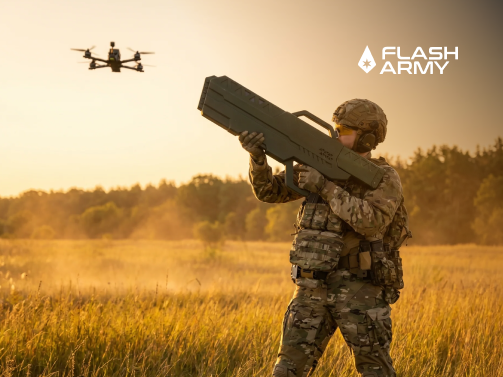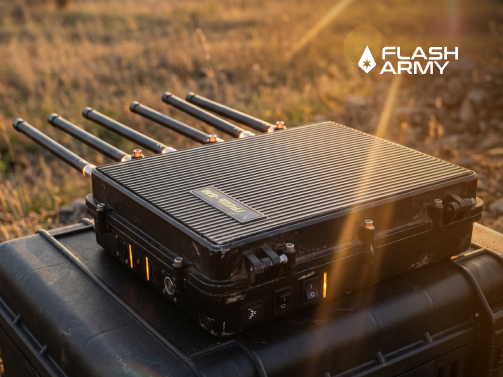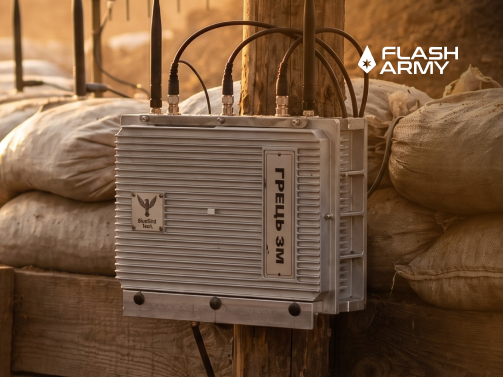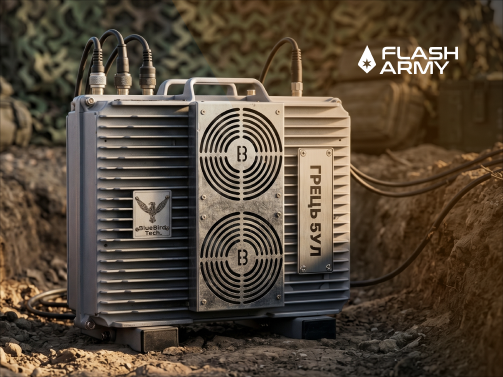
In conditions of active use of unmanned aerial vehicles (UAVs), electronic warfare (EW) equipment helps reduce the vulnerability of units to external threats. In addition, drones are actively used for reconnaissance, fire adjustment, and attacks. Under the influence of EW systems, they become uncontrollable, crash, or return to their launch site.
In modern combat, trench EW acquires strategic importance, serving as an “electronic shield” over positions. These compact installations quickly respond to threats, thereby reducing the damage that FPV drones can inflict.
This article was prepared by the Flash Army team for military personnel, technical support specialists, and everyone who works with electronic warfare equipment. The material will help to understand what trench EW systems are, how they work, and what tasks they can perform.
What are trench EW systems
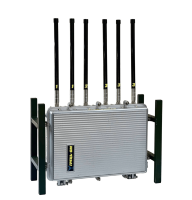
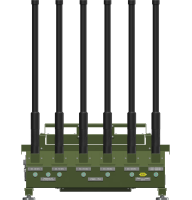
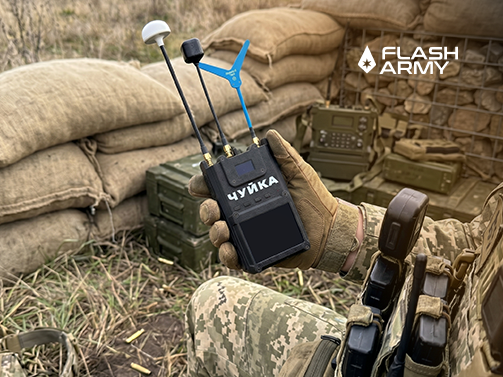
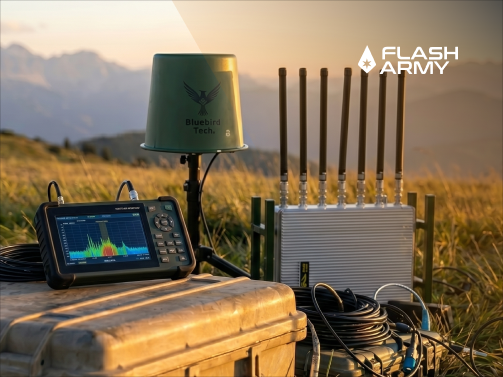
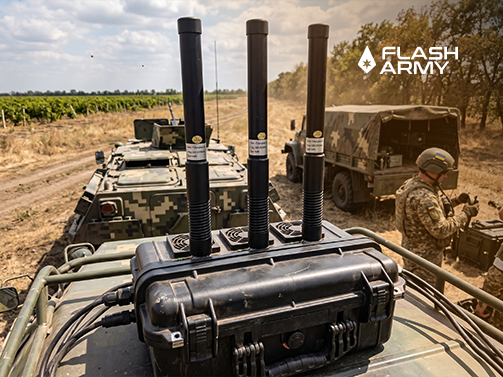
Trench EW is a portable tactical-level device used directly at forward positions (in or near trenches, dugouts) to protect units by affecting radio signals. It helps create a zone within which enemy electronic devices operate unstably or lose control. Simply put, it provides an electronic “umbrella” over positions and during the operation of mobile groups.
The main function of trench EW systems is to detect and suppress electronic signals, including drone control channels, navigation (GPS), and radio communications. This helps reduce the effectiveness of enemy reconnaissance and complicates targeting and coordination of actions.
The essence of trench EW operation is the generation of controlled radio interference in specific frequency ranges used by UAV control systems or navigation channels. In other words, the device distorts the signal and makes the drone “blind.”
Key features and characteristics
To understand the capabilities of trench EW, it is important to pay attention to its main technical parameters.
Power and range
The total transmission power is distributed across 2–8 bands, each generating at least 50 W. The systems are designed for rapid deployment and battery power.
The range of trench EW can vary depending on the antenna type, power, and terrain topography. Typically, the suppression zone is from 50 to 400 meters. This is sufficient to neutralize a drone before it reaches its target.
Signal types and frequency range
Modern systems can simultaneously suppress signals in different frequency ranges.
Thus, trench EW stations are classified by their operating range to counter specific threats:
- 300–1050 MHz — the most critical spectrum, as most kamikaze drones operate on these frequencies;
- 2.4 GHz — jamming control and video transmission channels;
- 5.8 GHz — suppression of digital video signals and FPV drone control channels.
Mobility and power
The built-in battery allows for autonomous operation for several hours. However, there is an option to connect to external power sources (generators, power banks, etc.).
Where and how they are used
Trench EW systems are used directly at forward positions as a tool for local protection, as well as to complicate enemy aerial reconnaissance.
Protection of own forces
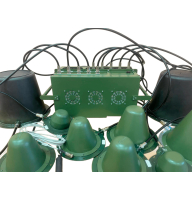
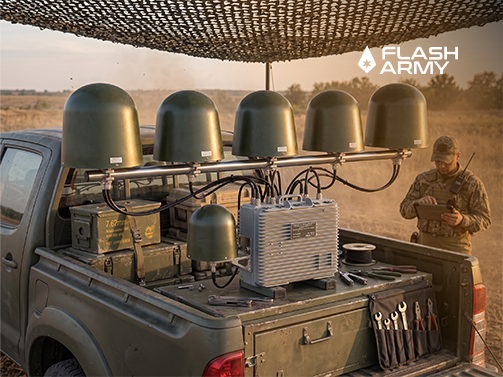
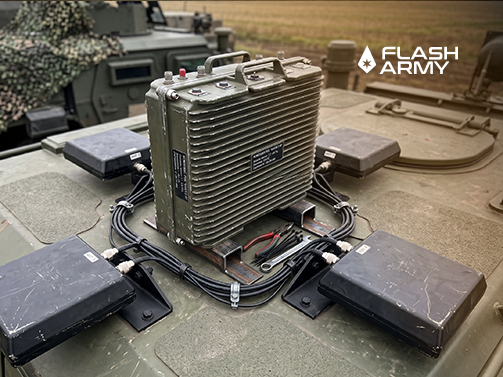
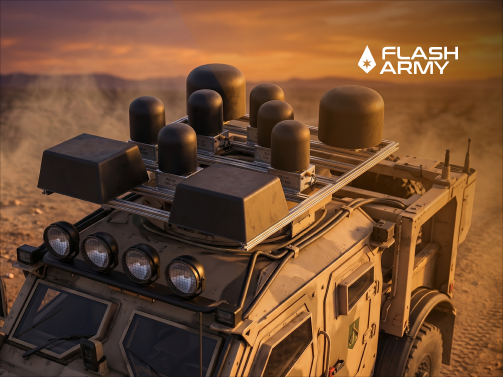
For maximum effectiveness, trench electronic warfare equipment is integrated into a comprehensive defense structure. In conjunction with radars and electronic reconnaissance (SIGINT) systems, a multi-layered protection system for own forces is created. In addition, systems with dome coverage are considered most effective for defending positions. They provide 360-degree protection.
Support for battlefield operations
Trench EW systems contribute to the effective execution of combat missions by influencing the electronic environment. They reduce the enemy's capabilities in communication and control, complicating data transmission and coordination of actions. This diminishes their ability to conduct surveillance and precise targeting of strikes.
How to choose a trench EW system
Before buying an EW system, it is necessary to consider the main conditions of use, technical components, and maintenance capabilities (if required). The effectiveness of the system on the battlefield depends on this.
Considering tasks and conditions of use
First, it is worth determining for which tasks the EW system will be used:
- neutralization of FPV drones;
- covering armored vehicles and logistics convoys;
- blocking communication channels of enemy operators;
- complicating enemy aerial reconnaissance.
The type of terrain also plays an important role. For example, in open spaces, the coverage area increases, while in forests or on uneven terrain, it decreases due to obstacles to signal propagation.
Technical specifications and compatibility
To avoid mutual signal interference and ensure stable system operation, attention should be paid to compatibility with UAV detectors and own communication equipment. The mounting must be strong and reliable to secure the EW system on masts or other fixed supports. In field conditions, EW systems can be mounted on mobile fixtures, allowing for quick repositioning.
Reliability and maintenance
Trench EW systems are quite simple to maintain and technically support. The main thing in maintaining their continuous operation is monitoring battery charge, as most devices require recharging. It is also necessary to regularly check whether the device is emitting interference and monitor battery temperature.
Conclusion
Trench EW is a modern technological electronic warfare system that has become a common tool on the front line. This portable device creates interference for enemy drones in the defense zone. As a result, the UAV loses contact with the operator and cannot complete its mission or reach its target.
The advantage of trench EW systems lies in their mobility and stealth, which makes them practical for front-line conditions. Available options for trench EW systems can be chosen in the Flash Army online store.
-min-192x200.png "Dome EW Jammer Hrets 4M with Quadrifilar Antennas")