Today, the battlefield sees high drone activity. They are used not only for reconnaissance but also for striking, dropping explosives, and more. With the development of UAV technologies and radio-controlled systems, there is a growing need for effective ways to protect positions, equipment, and personnel. Electronic warfare (EW) systems have become one such solution, capable of operating directly in the zone of potential threat. They can create a protected space where minimizing the impact of external signals is crucial.
One of the most common options is the dome EW jammer. It not only knocks FPV drones off course but can also save lives, equipment, and critical infrastructure.
This material was prepared by the Flash Army team for those who want to understand the principles and features of dome EW systems and choose the best solution for their tasks.
Main purpose of a dome EW jammer
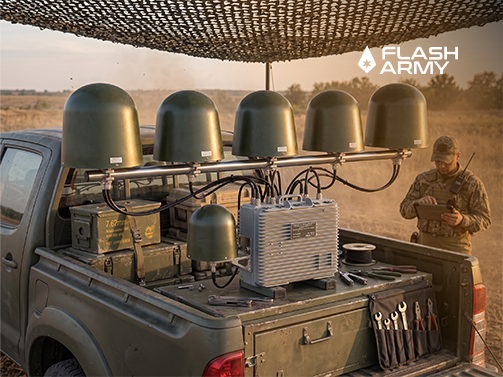
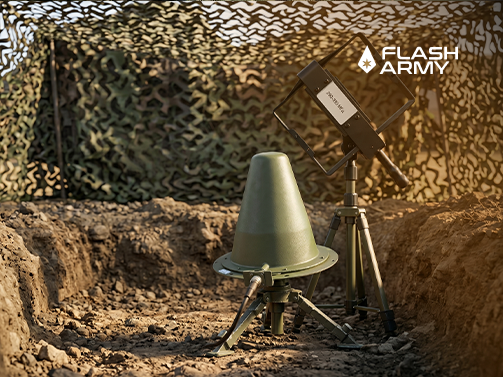
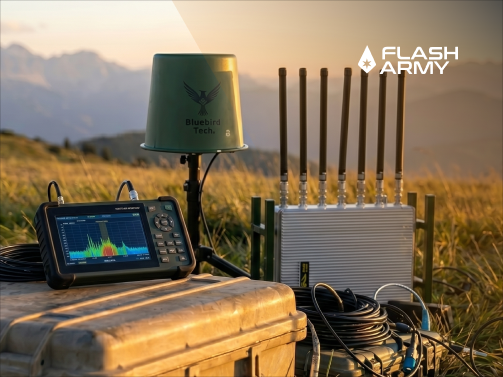
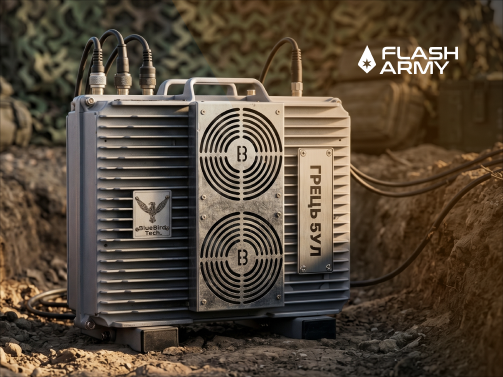
A dome EW jammer is a stationary defense system that forms a circular coverage zone using antennas. They create a certain "dome" of radio waves, within which enemy equipment loses its ability to function properly. Thus, the drone does not receive commands from the operator, communication channels are blocked, and the signal at the required frequency is jammed.
Dome EW systems are typically used to protect headquarters, artillery positions, ammunition depots, field airfields, and critical infrastructure facilities. Their main purpose is to provide continuous defense against drone attacks and prevent data interception. For the military, this means greater confidence in the reliability and security of their own communication channels.
Design features
Among the main design features of a dome EW jammer, it is worth highlighting the special antenna structure, power, signal types, and frequency range.
Dome antenna shape
Dome EW systems use omnidirectional antennas. They are positioned to form a circular radiation pattern (360 degrees) around the object. This design allows for effective countermeasures against both vertically and horizontally polarized signals.
Power and range
Device power typically ranges from 50 W per channel (up to 300–400 W total power), providing a range of up to 3 km. It is also important to note that they have lower radiation power at the point directly above the antenna.
Dome EW jammers operate from a vehicle's onboard network or external batteries. However, they also have internal batteries that provide continuous operation for several hours.
Signal types and frequency range
The main types of signals blocked by EW systems:
- FPV drone control signals (in the 400–500 MHz, 700–900 MHz, and 900–1000 MHz ranges);
- video transmission signals (interference at 1.2 GHz, 2.4 GHz, and 5.8 GHz frequencies). This helps interrupt the video stream from the drone to the operator;
- navigation signals (GPS/GNSS).
In addition, they provide simultaneous suppression of several frequency ranges, operating on 3–5 channels, making them effective against various types of UAVs.
Advantages of dome EW jammers
Dome EW jammers have a number of advantages that make them an effective solution for protecting positions and objects.
Mobility and compactness
An EW dome can be both stationary and mobile. Its light weight allows for easy transport, even in a backpack. This enables quick installation at a new position or on a vehicle roof. Therefore, it is important that such systems provide protection in motion.
Reliability and ease of operation
Dome EW jammers usually do not require constant operator control after activation, so they can be considered autonomous. Moreover, they provide high reliability due to continuous operation, and deployment takes only a few seconds.
Additional elements (e.g., drone detectors) can also be connected to the basic system, expanding the device's functionality.
Wide coverage area
A dome EW system has a limited but reliable range, which contributes to uniform protection around the object, providing coverage from all directions. This allows for effective countermeasures against threats regardless of their approach direction.
Where dome EW jammers are used
Before buying a dome EW jammer, it is worth familiarizing yourself with all its operational options. This will help you better understand the system's capabilities and choose the optimal solution for specific tasks.
Protection of military facilities
The most common area of use is strategically important objects (military airbases, ammunition depots, etc.), as well as critical infrastructure (airports, power plants, government buildings). EW domes create a stable zone within which the effectiveness of drones and radio-controlled systems is reduced, increasing the level of security. This is especially important during massive attacks.
Support for field operations
In field conditions, such systems have also proven their effectiveness. They help provide additional protection during task execution, making enemy reconnaissance more difficult. Dome EW jammers reduce the effectiveness of data transmission and contribute to more stable unit operations. In addition, they "jam" drones approaching positions, equipment, or personnel.
Conclusion
A dome EW system is one of the key elements of modern defense systems that effectively counter threats in the radio spectrum. Thanks to its functional features, including omnidirectional antennas and the ability to operate simultaneously in several frequency ranges, dome EW jammers provide uniform coverage and stable effectiveness.
In short, a dome EW jammer is a device for countering FPV drones that allows control over the radio-electronic environment. It is considered an important tool for increasing unit safety and preserving critical infrastructure facilities.
The Flash Army online store offers a wide selection of dome EW systems. They may differ in suppression range, power, number of channels, or frequency range. Despite this, all options have proven their effectiveness in field conditions.
-min-192x200.png "Dome EW Jammer Hrets 4M with Quadrifilar Antennas")