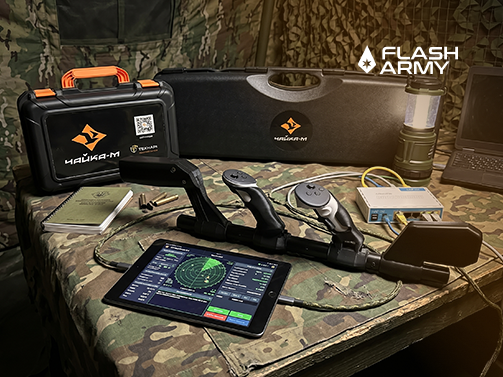
To learn how to shoot down drones, you need to complete relevant specialized courses and training. Training typically includes theory, simulators, and practical exercises at a firing range. Simulators are one of the newest technological solutions that allow anyone (even without experience) to try and master these skills.
Such systems enable safe and effective combat training without using real weapons and expending expensive resources. They simulate the operation of detection, tracking, and engagement systems for aerial targets, creating conditions as close as possible to a real combat environment.
In this article, you will learn where and how military air defense simulators are used, their advantages, and who will benefit from such training devices.
What are air defense simulators and what are they used for?
Air defense simulators are specialized training devices designed to imitate the operation of air defense systems. With these devices, operators learn to work with radars, guidance systems, control systems, and algorithms for responding to aerial threats.
The simulator generates a 3D space that mimics real terrain, weather conditions, and time of day. The operator uses real or mock control devices (joysticks, consoles, radar screens) to detect and engage targets. The main purpose of such systems is to prepare and train soldiers.
In addition, they are used for:
- improving operator skills;
- training coordination between units;
- modeling combat situations of varying complexity;
- checking reaction speed and correctness of decision-making;
- practicing actions in conditions of electronic warfare (EW) interference or massive attacks.
What types of weapons and systems are modeled in air defense simulators?
Air defense simulators allow training with various types of weapons:
Anti-aircraft machine guns:
- DShK;
- Browning M2;PKM.
Man-portable air-defense systems:
- MANPADS 9K38 «Igla»;
- MANPADS FIM-92 Stinger.
Small arms:
- M16A1 rifle;
- AK-74 assault rifle;
- Browning A5 Wicked Wing shotgun;
- Benelli M4 Super 90 shotgun.
The simulators themselves operate based on the following systems:
- VR technologies (virtual reality headsets).
- Computer-based trainers. Programs are installed on a computer or interactive panel, often using control consoles (e.g., for FPV drones).
- Laser emitters on real weapons to simulate firing at a virtual target.
What aerial targets are practiced in simulators?
Most often, air defense simulators can be used to practice neutralizing various types of drones (FPV drones, reconnaissance and attack UAVs). Small-sized targets have a low flight altitude and a small effective radar cross-section, making them harder to detect and track. However, there are also options for engaging larger aerial targets (e.g., cruise missiles).
Main training objectives with air defense simulators
Regarding the tasks that operators perform on air defense simulators, it is worth mentioning:
- mastering work with radar stations;
- detecting, recognizing, and eliminating aerial targets;
- practicing decision-making algorithms;
- training actions during massive or combined attacks;
- modeling operations in conditions of electronic warfare interference;
- checking reaction speed and accuracy of command execution.
Advantages of air defense simulators
Air defense simulators are effective training weapons with their own advantages.
Firstly, they allow for resource savings, as ammunition, fuel, and maintenance costs are reduced.
Secondly, operators do not risk their lives, unlike in real combat situations.
Thirdly, modern simulators are as close to real conditions as possible, taking into account all details.
Fourthly, they are adaptive: the program can be configured for a specific difficulty level.
Who will benefit from air defense simulators?
In fact, such military air defense trainers are quite versatile, so they can be useful for many specialists: air defense units, instructors in training centers, operators, and engineers working with unmanned systems. In addition, they are used for research and testing purposes (to test new tactical approaches and technical solutions).
Conclusion
Air defense simulators are a new, yet popular element of modern military training for those working with aerial targets. They prove their effectiveness by allowing various types of combat missions to be practiced in a realistic way. This ensures high-quality specialist training and improves unit coordination.
Explore the available air defense simulator options in the Flash Army online store and enhance your skills.