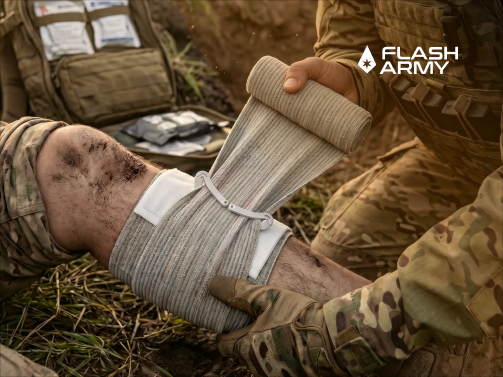
What is an Israeli Bandage and How to Use It
Bandages and tourniquets are essential first-aid tools during rescue operations, in medicine, and on the battlefield. They are used to stop massive bleeding, protect wounds, and immobilize injured body parts. Modern bandages differ in design and materials. One of the most effective and widely used options globally is the Israeli Bandage.
The Israeli Bandage, also known as the "Emergency Bandage," was developed by combat medic Bernard Bar-Natan in the late 1990s. Since then, this dressing has been used to stop bleeding in many countries. Its functionality has been proven not only in the military sphere but also in the work of civilian medics and rescuers.
In this article, we will examine what an Israeli Bandage is, its main functions, characteristics, and advantages. Additionally, you will find a step-by-step guide on how to use it, as well as a list of cases in which this device should not be applied.
What is an Israeli Bandage
The Israeli Bandage is an individual dressing for rapid bleeding control in traumatic injuries. It consists of an elastic bandage with a sewn-in sterile pad. The design also includes a closure and a special plastic pressure bar (applicator) to create compression up to 18 kg. Thanks to the combination of a compression bandage, a dressing, and a tourniquet, this tool integrates the functions of separate pieces of equipment into a single, easy-to-use device.
Key Characteristics of the Israeli Bandage
The characteristics of the Israeli Bandage determine its effectiveness in emergency conditions:
Simple Design.
Its compactness and quick application allow the Israeli Bandage to be used not only to help others but also for self-application. The ability to apply it independently with one hand is especially important for limb injuries.
Hemostatic Effect.
A special applicator in the form of a plastic arch creates directed pressure on the wound. The pressure force can be adjusted by changing the tension of the elastic bandage. This allows for both increasing and decreasing compression to avoid impairing blood circulation in tissues below the injury site.
Absorbent Pad.
This part of the bandage directly contacts the wound, so it's important that it does not stick to the skin. This helps in painlessly removing it during dressing changes.
Bandage with Limited Elasticity.
The quality material ensures strong fixation and even compression, and also reduces the risk of restricting venous blood flow. The bandage is also stitched with a special thread that prevents its premature unraveling.
Reliable Clip.
The clip secures the bandage at the end without the use of pins or tape.
Universal Size.
The Israeli compression bandage comes in several main sizes, determined by the width of the elastic bandage. It ranges from 10 to 20 cm, and the length of the bandage is usually about 4.5 m.
Functions and Advantages
The Israeli Bandage is used in tactical medicine due to a number of functions and advantages that distinguish it from other similar devices. Let's consider some of them.
Rapid Bleeding Control
The primary function of the bandage is effective bleeding control. The built-in applicator provides strong compression pressure on the wound, which helps quickly reduce or completely stop blood loss.
Ease of Use
The bandage has a well-thought-out design that allows it to be applied quickly and without complex manipulations. This saves time in critical situations where every second counts. It can be used not only by medics but also by people without special training.
Reliability in Field Conditions
The Israeli Bandage is designed for use in challenging conditions (during combat or rescue operations). Hermetic packaging ensures sterility and a long shelf life.
How to Use Correctly
When applying an Israeli Bandage to a limb, it is important to follow a specific sequence of actions to avoid harming yourself or the injured person. Therefore, we suggest remembering the step-by-step instructions.
Step-by-Step Application Instructions
- Remove the bandage from its packaging and place the sterile pad directly on the wound.
- Wrap the elastic bandage around the limb 1–2 times, maintaining the necessary compression.
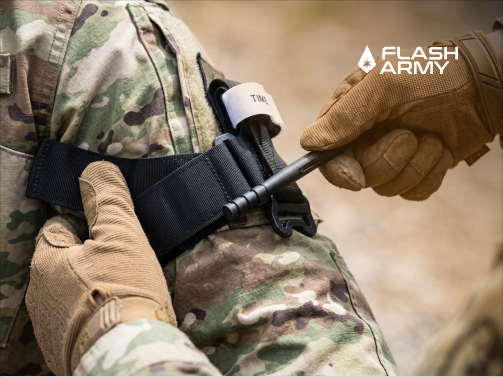
- Thread the bandage through the pressure bar (applicator), then change the wrapping direction and continue fixation over it, pressing the applicator firmly against the wound.
- Continue wrapping the limb, adjusting the tension of the bandage to control pressure on the wound.
- Once wrapping is complete, secure the end of the bandage with the special hook.
In combat conditions, it is also important to record the fact of assistance in the casualty card and transmit the information to medics.
Tips for Safe Application
When using an Israeli Bandage, it is also important to remember basic safety rules:
- apply the dressing as quickly as possible and without unnecessary movements;
- the tighter you pull the elastic bandage when wrapping, the higher the pressure on the wound;
- the applicator should be placed directly over the wound to apply pressure to the blood vessel;
- after application, always check circulation below the injury site, pulse, and limb sensation, as the dressing may need to be loosened;
- if bleeding continues, a second bandage can be applied over the first;
- after stabilizing the victim's condition, they should be transferred to medics as soon as possible.
When Not to Use an Israeli Bandage
Although the Israeli Bandage is considered a universal hemostatic agent, there are situations where its use is inappropriate.
First and foremost, it is not used to stop massive arterial bleeding from limbs. It is important to remember that in cases of spurting blood that are life-threatening, a tourniquet or hemostatic strap must be applied. The bandage cannot provide a sufficient level of compression.
Secondly, the Israeli Bandage is not suitable for deep penetrating wounds with internal bleeding, where the source of blood loss is inaccessible to direct pressure.
Thirdly, it is forbidden to use it as a substitute for a regular elastic bandage, ignoring the pressure applicator for bleeding.
Finally, it is important to understand the difference between dressing fixation and creating compression. Using a pressure bandage on areas where high pressure is not needed (e.g., on the abdomen) can be inappropriate and even harmful.
Conclusion
The Israeli Bandage is an innovative device for stopping bleeding. It has become an indispensable element in both military first-aid kits and civilian first-aid sets, as it combines elements of a compression dressing, a bandage, and a tourniquet. It stands out for its simplicity and ease of use, allowing for quick response to injuries and reduction of blood loss.
At the same time, the effectiveness of the Israeli Bandage depends on its correct application. It is important to understand its capabilities and limitations, as in complex cases, it cannot replace a tourniquet. Therefore, we recommend remembering the step-by-step application instructions to know how to help yourself or other injured persons in extreme situations.
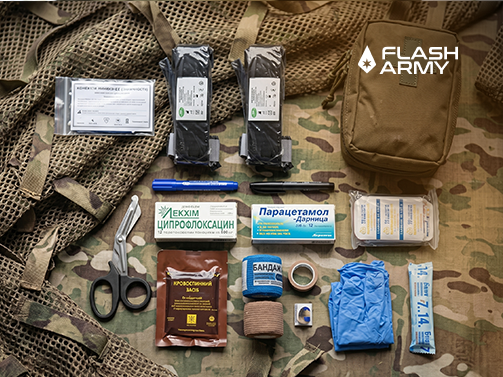
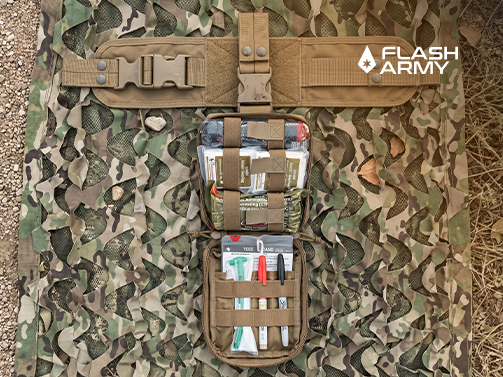
In the Flash Army online store, you can choose Israeli Bandage options of various sizes and configurations, as well as tourniquets, hemostatic straps, first-aid kits, and other tactical medicine elements.