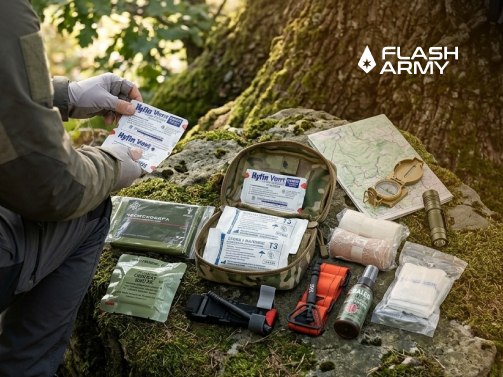
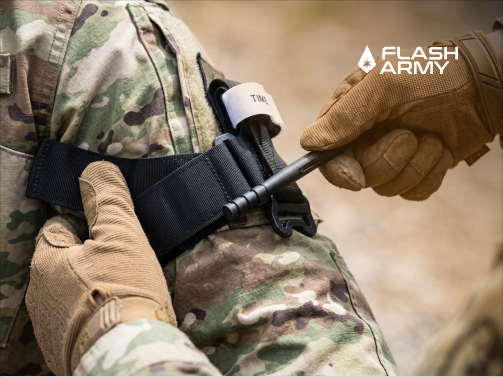
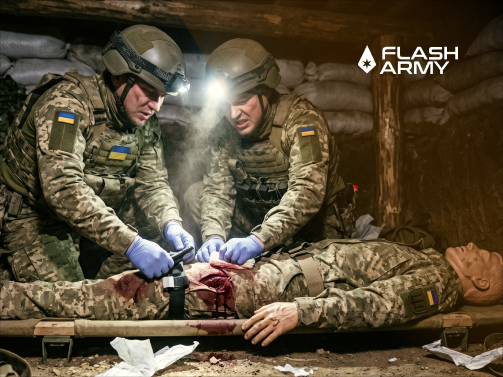
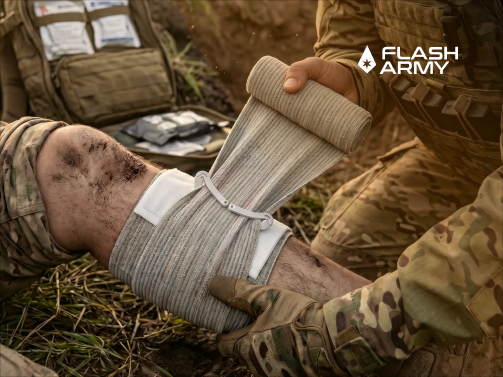
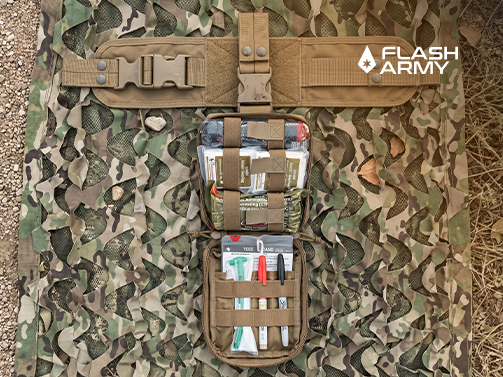
Almost every military first-aid kit (IFAK) includes a tourniquet, as it is one of the most effective means for emergency control of massive bleeding. Its application in injuries allows for compressing blood vessels and stopping blood flow. This is extremely important when quick action is needed, without losing a second, to save a life. That is why a tourniquet is considered a first-line pre-hospital aid.
The need to apply medical tourniquets arises not only on the battlefield. Current circumstances require civilians to know how to apply them. They are advised to always be carried by drivers, volunteers, police officers, and anyone who understands the reality of risks.
There are several types of tourniquets: mechanical (with a windlass), pneumatic, junctional, abdominal, etc. Each of them has its own characteristics and specific conditions of use. The most common option is a limb tourniquet, but today we will talk about an equally important type — the junctional tourniquet.
In the article, you will learn what a junctional tourniquet is, as well as its purpose and features. In addition, the Flash Army team has prepared recommendations for its selection and application, considering its advantages and limitations.
What is a junctional tourniquet
A junctional tourniquet — is a specialized medical tool designed to stop massive bleeding in complex areas such as the groin, armpits, and neck.
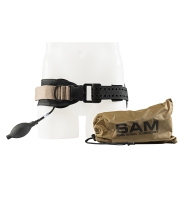
It has a more complex design compared to conventional tourniquets. Typically, it is a system of wide straps or belts (wide enough to wrap around the pelvis). Special compression elements (pads or plates) are attached to them, which directly press on the bleeding site. The tourniquet also has a tensioning mechanism, which can be mechanical (screw or lever) or pneumatic (inflatable chambers). One of the most popular models is the pneumatic junctional tourniquet SAM JT.
Purpose and main tasks
Conventional limb tourniquets are ineffective in the groin, armpit, and neck areas, so for junctional bleeding (from major vessels), the tourniquet is applied at the junction of the limbs with the torso. It provides pinpoint pressure on the damaged vessel and stops the bleeding.
In addition, some models of junctional tourniquets can be used to stabilize the pelvis in certain injuries.
Features of use
Let's consider the technique of applying a junctional tourniquet. This usually takes no more than 30 seconds.
Main steps:
- Position the tourniquet around the pelvis or torso so that the compression pad is directly over the source of bleeding (femoral or axillary artery).
- Wrap the strap around the body and tighten it as much as possible, ensuring the pad has not shifted.
- Using a mechanical or pneumatic device, gradually increase the pressure until the bleeding completely stops.
- Record the time of tourniquet application.
- Constantly check the reliability of fixation and the absence of bleeding.
It is important to remember that these points are for informational purposes only, so we recommend taking tactical medicine courses to gain practical skills in providing first pre-hospital aid.
Advantages and limitations
A junctional tourniquet has several advantages:
- effective where a conventional tourniquet cannot cope: with femoral artery injuries or high limb amputations;
- equipped with a manual rubber bulb or similar mechanisms that activate special capsules and create targeted pressure directly on the bleeding site;
- can sometimes serve as a pelvic binder for pelvic bone fractures;
- due to reliable fixation, the injured person can be transported without losing pressure on the artery;
- suitable for any body type;
- made of high-strength materials with reliable fasteners and straps that withstand loads.
However, a junctional tourniquet is not a universal tool. It should only be used for its intended purpose.
We can highlight the following limitations:
- does not replace a limb tourniquet;
- has a higher cost than conventional hemostatic tourniquets;
- requires special training for proper application, as the placement of the compression pad must be very precise;
- takes up more space in an individual first-aid kit;
- application takes a little more time (up to 30 s), while a limb tourniquet can be applied in 15–20 s;
- like any tourniquet, it should safely press on tissues for no more than 2 hours.
Recommendations for selection and application
When choosing a junctional tourniquet, you need to pay attention to its complete set:
- tourniquet strap;
- targeted compression device (TCD) — 2 pcs.;
- TCD extender;
- manual pump or screw mechanism;
- additional strap;
- storage pouch.
In addition, choose only certified models that are used in tactical medicine and have proven effectiveness in field conditions, such as SAM JT or "Shlyakh".
Remember that the pressure should be sufficient to stop the bleeding, but not excessive, so as not to cause additional damage. Do not use a junctional tourniquet on limbs where a conventional tourniquet can be applied.
Conclusion
A junctional tourniquet is no less important a hemostatic agent than a limb tourniquet. If applied correctly and in time, it will effectively stop massive bleeding in complex anatomical areas where conventional tourniquets do not work. Its use significantly increases the chances of survival in severe injuries when every second counts.
A junctional tourniquet has a more complex design, larger dimensions, and an additional compression mechanism (screw or pneumatic), so appropriate skills are needed to use it effectively. That is why understanding its principles of action and proper training form the basis for preserving life in both combat and civilian conditions.
You can buy a junctional tourniquet in the Flash Army online store. Choosing a proven model reduces risks and simplifies actions in a critical situation. When it comes to life, it is better to have a solution at hand that has already proven its effectiveness.