In modern warfare, electronic warfare (EW) has become a critically important component of defense. The enemy actively uses drones, radio control systems, and other technologies to gain an advantage. The question "how to choose an antenna for EW" has long ceased to be a technical nuance and has become a critical factor in a unit's survival. An EW antenna is responsible for receiving and transmitting signals, forming the radio frequency spectrum, and enabling effective impact on enemy systems. The choice of an EW antenna directly affects the range, quality, and stability of the entire system.
How an EW Antenna Works
An antenna performs two key functions simultaneously: it receives signals and radiates them into space. In the context of EW, this can be receiving enemy control channels or transmitting powerful interference that jams drone operations. To understand how an EW antenna works, it's worth recalling a basic principle: a signal has a certain frequency, and the antenna's task is to capture or "cover" that frequency.
Often in the military, the question arises: why is the antenna so critically important if there is an entire EW system? The answer is simple: even the most expensive jammer or signal amplifier will not be effective if the antenna cannot properly transmit energy into the air. It's like having a powerful engine but broken wheels – the car won't go anywhere.
Several parameters are important in an antenna's operation. First, frequency – the range in which it can operate. Second, the power that the antenna can "radiate." Third, directivity – the ability to concentrate the signal in one direction or, conversely, scatter it in all directions. These factors determine the effectiveness of defense against radio threats.
Types of EW Antennas
To understand what antennas exist and how they differ, let's look at the main types. This will help military personnel and volunteers navigate their choices.
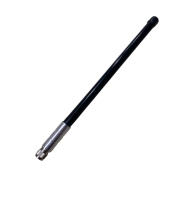
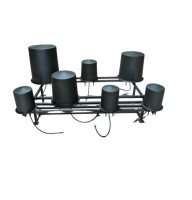
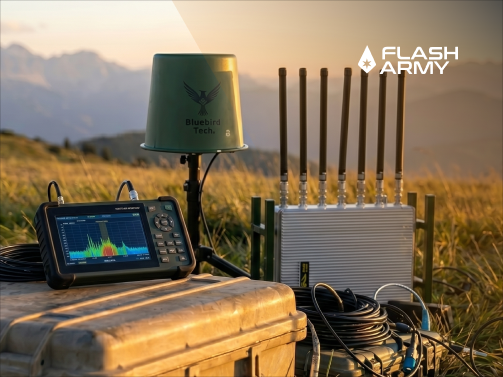
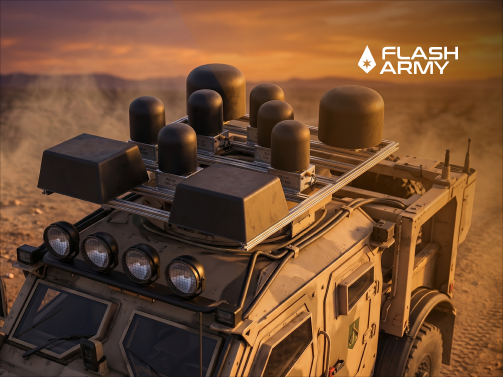
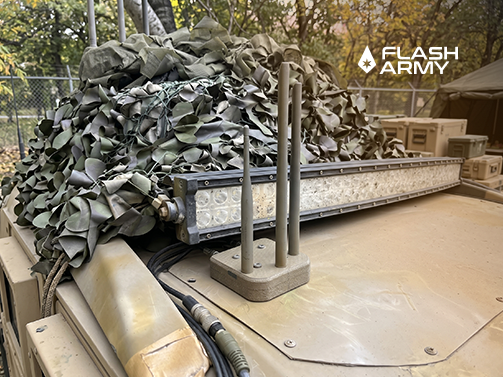
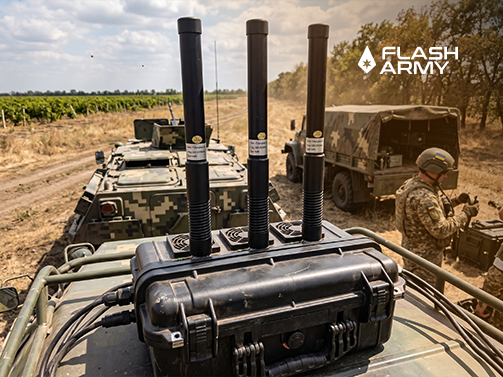
- Omnidirectional antennas. They radiate the signal uniformly in all directions, creating 360° coverage. This is especially convenient for protecting positions when a drone can approach from anywhere. Such antennas work well in mobile systems; they are mounted on vehicles or portable stations. The downside is that energy is distributed evenly, so the actual jamming range is less than that of directional models.
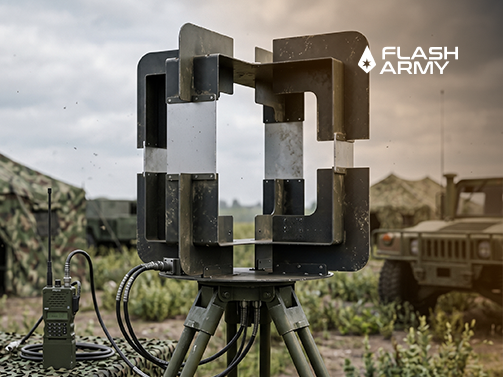
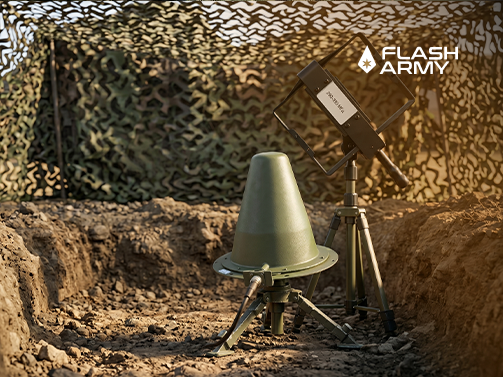
- Directional antennas. These are the "snipers" among antennas. They concentrate the signal in a narrow direction, allowing them to hit a specific target. For example, a reconnaissance drone hovering in the sky several kilometers away can be jammed. Their advantage is high efficiency and accuracy. The disadvantage is the need for aiming and more complex use in dynamic situations.
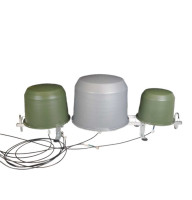
- Sector antennas. This is a compromise between the previous two. This type of antenna can cover a specific sector. This way, a "defense zone" can be created in the direction of probable enemy drone approach. In real conditions, sector antennas are installed to protect bases or fortified positions.
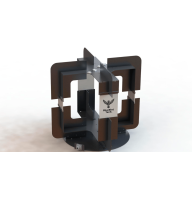
Additionally, it's worth mentioning a few more varieties. There are helical antennas (capable of working with circular polarization, used by some drone models), and phased arrays (modern solutions that allow flexible changes in radiation direction without mechanical rotation). The latter are more expensive but significantly increase defense effectiveness.
Features of EW Antennas
Antennas designed for EW have a number of characteristics that distinguish them from classic communication solutions.
- Wide frequency range. Ordinary antennas are tuned to a specific channel, while an EW antenna must "cover" several ranges at once. Modern drones can operate in the 2.4 GHz to 5.8 GHz range, and some models at higher frequencies. Therefore, versatility is critically important here.
- High radiation power. The antenna must be capable of transmitting significant energy levels to penetrate channels with high interference immunity.
- Interference resistance. Often in combat conditions, the airwaves are overloaded with signals; enemy and friendly radio stations, alarms, and control systems are operating. An EW antenna must ensure stability and accuracy in such conditions.
- Mechanical reliability. Antenna weight matters, as it often needs to be carried or mounted on equipment. Resistance to rain, dust, and impacts is also important. Soldiers cannot waste time on "fragile" equipment.
- System compatibility. Each antenna must work together with amplifiers, jammers, and control units. If a model does not fit the existing system, its usefulness will be minimal.
What about the cost? It is important to correlate the price and the task of the EW antenna. For a small unit, a compact, medium-power antenna is sufficient, while for protecting large objects, stationary solutions with wide coverage are needed.
Criteria for Choosing an EW Antenna
For an informed choice, it is worth considering not only technical characteristics but also practical aspects.
- Frequency range. If the antenna does not support the necessary frequencies, it will be useless. Civilian drones primarily operate effectively in the 2.4 GHz - 5.8 GHz range. However, the enemy may also use non-standard channels. Therefore, it is desirable to choose wide-spectrum antennas.
- Power and gain coefficient. These indicators determine the range and strength of the impact. If the task is to "take down" drones at high altitudes, an antenna with a high gain coefficient is needed.
- Directionality. Omnidirectional antennas are suitable for patrols or mobile groups, as situations change rapidly. For object protection, sector or narrow-beam antennas are better.
- Weight and mobility. If the antenna is carried by hand, extra kilograms will not be forgiven. A 2–3 kg drone is much more practical to use than a heavy 15 kg model, even if the latter has slightly better parameters.
- Cost and availability. There are expensive solutions with unique capabilities, but they are not always justified for the tactical level. Volunteer units often choose a balance between price and effectiveness.
Another piece of advice is to always focus on real-world application scenarios. If a unit operates in an area where the enemy constantly launches FPV drones with cameras and large batteries, then a high-power, narrow-beam antenna is needed. If it's about guarding a warehouse or headquarters, a sector or omnidirectional antenna for circular coverage would be a more logical choice.
Conclusion
An EW antenna is the heart of an electronic warfare system. It determines whether the system will be effective in real combat conditions. To make the right choice, it is necessary to consider the types of EW antennas, their features, and the tasks facing the unit.
A correctly selected antenna can cover the radio frequency spectrum, provide reliable protection against radio threats, and increase defense effectiveness. Most importantly, it gives soldiers a chance to do their job without risking their lives due to imperfect equipment. Various solutions combining high efficiency and ease of use are available on the FlashArmy website.