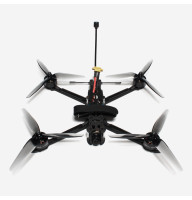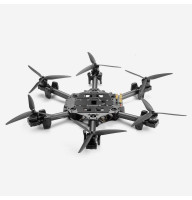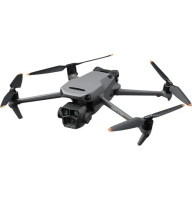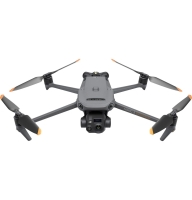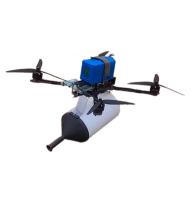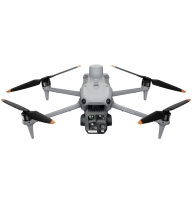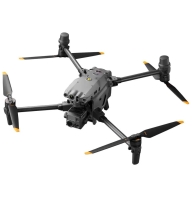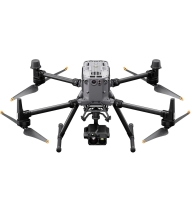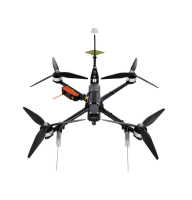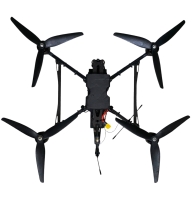
Today, FPV drones largely determine the situation on the battlefield. They are used for reconnaissance, artillery fire adjustment, striking, and delivering supplies to the front line. Accordingly, the market offers many ready-made systems, as well as options for self-assembly to meet your needs.
What explains the high popularity of FPV drones? First and foremost, their unique technology allows for first-person control of the aircraft. This creates a sense of presence and ensures high control precision.
However, to achieve maximum mission effectiveness, it is worth understanding some important design features of FPV drones. These are what we will discuss in this article.
What is an FPV Drone and How Does It Work?
An FPV drone is an unmanned aerial vehicle with a camera and a real-time video transmission system. Its operating principle is very simple: during flight, the operator receives images directly from the drone's camera to FPV goggles, a monitor, or a remote control. Simultaneously, the remote control transmits commands to a receiver installed on the drone. This allows the aircraft to perform the desired maneuvers.
Main Components of an FPV Drone
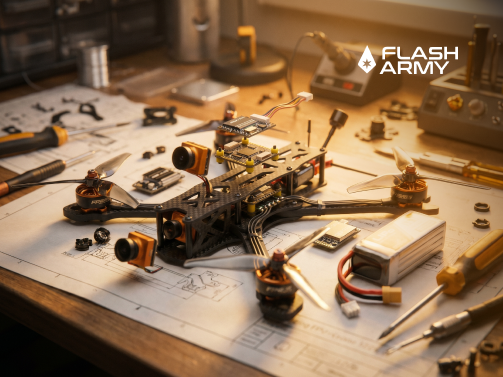
The core of an FPV system consists of the frame, motors, stacks, propellers, and battery.
Frame (Drone Chassis)
The frame is the base of the FPV structure to which all other components are attached. Most often, drone frames are made of carbon fiber, as it is lightweight and highly durable.
Motors
Drone motors generate the thrust needed to lift them into the air. Most modern FPV drones use powerful brushless motors.
Stacks
Stacks coordinate the interaction of all electronic systems of the drone. They consist of motor speed controllers and flight controllers.
- ESCs (Electronic Speed Controllers) are responsible for motor operation. They receive commands from the flight controller and regulate power delivery to each motor individually. This ensures precise changes in motor RPM, smooth, and stable flight.
- The flight controller processes signals from the receiver and transmits corresponding commands to the speed controllers. This allows the drone to maintain the set flight mode and execute operator commands.
Propellers
Propellers are rotating aerodynamic blades attached to the motor shaft that convert motor rotation into lift.
Battery
Batteries for FPV drones are the power source for the entire system. Their capacity, voltage, and weight directly affect flight duration.
FPV Drone Control System
Interaction between the operator and the UAV occurs through a signal receiver and a remote control.
Drone receivers are specialized devices that receive commands from the remote control and transmit them to the flight controller. The most common receivers today support ELRS and TBS Crossfire protocols, which ensure minimal latency.
FPV remote controls operate on the other side, specifically in the pilot's hands. Using sticks and switches, one can change altitude, speed, direction of movement, and activate additional functions.
FPV Video Transmission System
Equally important in the FPV drone's structure are the elements responsible for video transmission.
FPV Camera
Drone cameras are usually installed in the front of the aircraft to capture images during flight.
Video Transmitter (VTX)
An electronic module that receives a signal from the camera, modulates it, and transmits it via a radio channel is a video transmitter. Drone transmitters must ensure good range and signal stability, as well as image quality.
Antenna
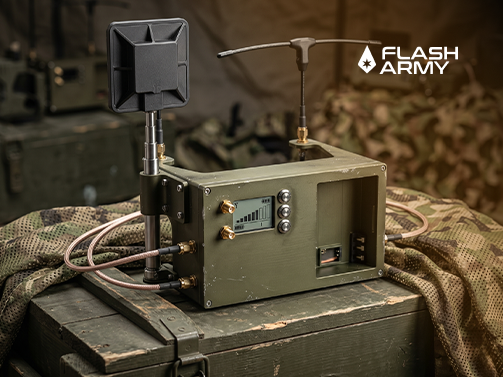
Drone antennas are installed both on the drone itself (for transmission) and on the goggles (for reception). For FPV systems, circularly polarized antennas are often used, which help reduce the impact of reflected signals.
FPV Ground Equipment
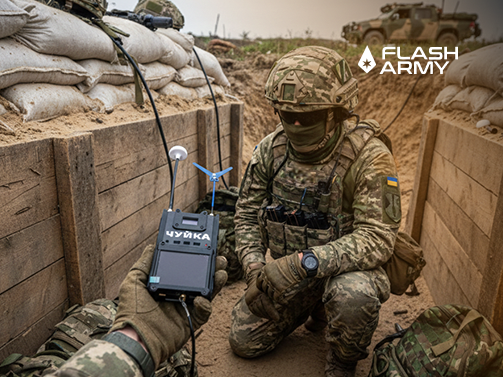
For full operation of an FPV system, equipment installed on the drone alone is not enough. The operator also needs ground devices for receiving and displaying video. FPV goggles or a monitor are typically used for this.
FPV goggles provide the maximum sense of presence, as the image is transmitted directly before the pilot's eyes. The pilot sees everything that enters the camera's lens: obstacles, the horizon line, the target, etc. This contributes to better immersion in control.
Monitors are an alternative option for video display. They can be used as the primary viewing device or as an additional screen for observers and instructors.
In addition to the main components, an FPV drone can be equipped with additional modules that extend its functionality and improve ease of use. Next, we will discuss the power distribution system (PDB / BEC) and additional modules.
- PDB is a power distribution board that is responsible for transmitting electrical power from the battery to the drone's main components: electronic speed controllers (ESCs), video transmitter, etc. In modern FPV drones, PDB functions are often integrated directly into the ESC or flight controller, which reduces the number of separate boards and simplifies system assembly.
- BEC is a voltage regulator that converts battery voltage to the level required to power individual electronic components.
- Additional modules significantly expand control, navigation, and flight safety capabilities:
- A GPS module allows determining the drone's coordinates, displaying its location, and using navigation functions. In some systems, it also helps implement automatic return to the launch point or flight route recording.
- Telemetry modules provide the transmission of service information from the drone to the operator. This can include data on battery charge level, signal quality, altitude, speed, coordinates, and other parameters.
In addition, depending on the tasks, other additional devices can be used: onboard buzzers for finding the drone after landing, LED lighting, current and voltage sensors, as well as various drone status monitoring systems.
How all elements work together
We have reviewed what an FPV drone consists of. But no element works separately. It assembles into a holistic system where components complement each other.
Thus, the battery powers the electronics and motors, and the operator sends commands to the receiver via the remote control. The receiver, in turn, transmits them to the flight controller, which processes the signals and directs them to the ESC. The speed controllers manage the motor revolutions, and they drive the propellers, creating lift and movement.
Simultaneously, the FPV camera transmits images to the video transmitter, which broadcasts the signal via an antenna to the operator's goggles or monitor.
Thanks to the coordinated work of all components, the pilot gains full control over the drone and can perform assigned tasks.
Conclusion
Thus, a modern FPV drone is a complex multi-level system, each element of which has its function and affects overall operational efficiency. Therefore, we advise you to carefully approach the selection of components or ready-made systems, focusing on the specifics of operation. And you can buy reliable and proven FPV drones at Flash Army.