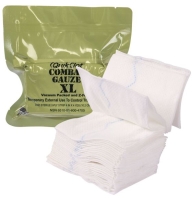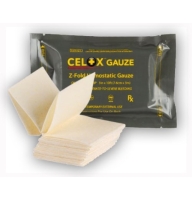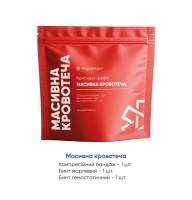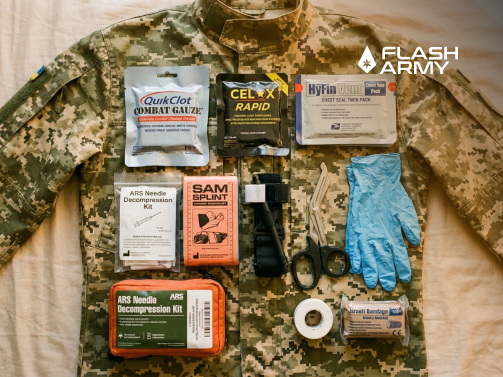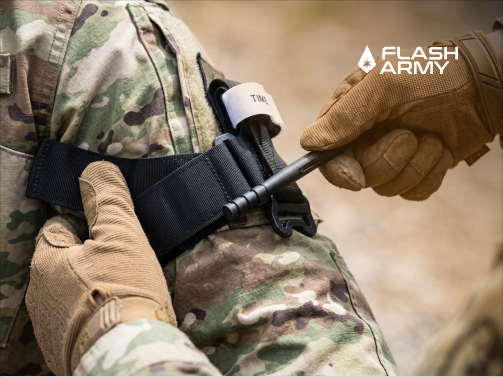
Critical arterial or venous bleeding is the primary cause of death in tactical medicine, which is why hemostatic agents are critically important. While tourniquets are typically used for limb injuries, for junctional zones—armpits, neck, groin—the main method of stopping bleeding is a hemostatic bandage.
In this article, we will explore what a hemostatic bandage is, its purpose, advantages, and how to properly use and choose one. This material was developed by the Flash Army team for individuals beginning to study tactical medicine.
What is a Hemostatic Bandage
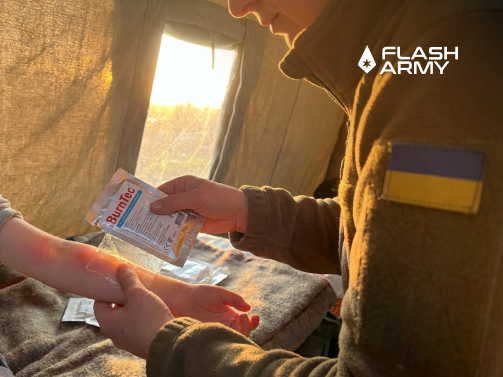
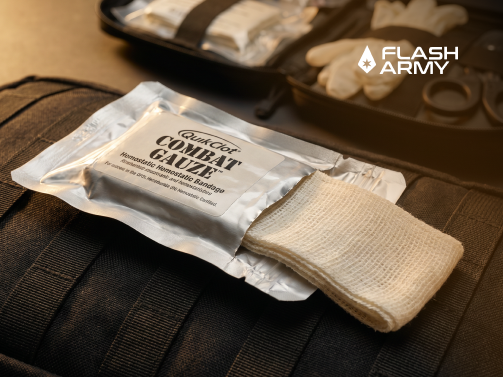
A hemostatic (or blood-stopping) bandage is a special medical dressing designed to stop significant critical bleeding, for example, from damage to large venous and arterial vessels. Technically, it is a special bandage made of non-woven or cotton material, impregnated with a blood-stopping substance—a hemostatic agent (kaolin, chitosan, fibrin, or alginate).
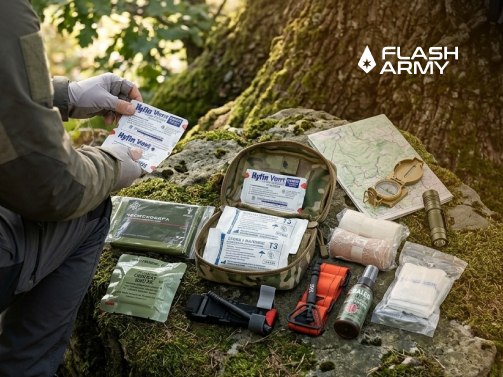
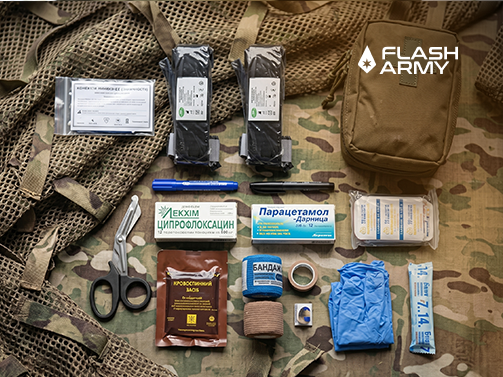
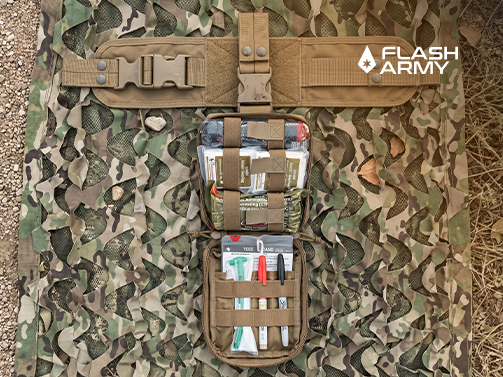
It doesn't just absorb moisture like a regular bandage or gauze; it performs an active function by applying pressure to the wound and clotting blood at a chemical level. Other hemostatic agents exist, such as powders, wipes, gels, and compresses, but the bandage is the most convenient option for combat conditions and a basic element of a standard military first-aid kit (IFAK).
Purpose and Main Tasks
The main purpose of a hemostatic bandage is to quickly stop intense bleeding during pre-medical care. It is typically used in the following cases:
- deep wounds (shrapnel, bullet, stab wounds);
- injuries to "junctional" zones (groin, armpits, neck);
- severe open injuries in extreme and combat conditions, during road accidents or in industrial settings;
- in cases where applying a tourniquet or regular bandage is impractical.
When packing a wound, a hemostatic bandage performs several important tasks:
- Vessel Blockage (Occlusion) — The bandage is tightly packed into the wound, filling its entire volume and pressing the damaged artery or vein against soft tissue or bone, providing mechanical control of bleeding.
- Instant Blood Clotting (Chemical Hemostasis) — The hemostatic substance impregnating the bandage, upon contact with blood, forms a clot within 3 minutes of manual pressure, whereas under natural conditions, this takes at least 10 minutes, which means fatal blood loss in massive hemorrhages.
- Functioning in Shock Conditions — Significant blood loss is usually accompanied by shock and hypothermia (decreased body temperature). Blood clotting is almost non-existent under such factors. Hemostatics are capable of effectively clotting blood even in these cases.
- Fixation for Transport — The bandage (in combination with a pressure dressing) after stopping bleeding keeps the wound stable and thus prevents re-bleeding during evacuation.
Hemostatic bandages save people from fatal blood loss in cases where a tourniquet is ineffective, by physically compressing the vessel from within the wound and forming a strong clot.
How to Use Correctly
Using a bandage (or wound packing) is a clear sequence of actions, where an error at any stage can lead to clot dislodgement and re-bleeding.
Here are the stages of wound packing:
- Preparation. It is necessary to try to ensure relative safety for yourself and the injured person (in a combat zone, this is a "green zone") and put on medical gloves to protect against blood-borne infections.
- Ensuring wound access and manual pressure. To see the wound edges and work with it unhindered, cut away clothing. Immediately apply strong pressure to the wound with your fist or fingers—pressure on the source of bleeding will save time needed to open the first-aid kit and minimize blood loss.
- Wound cleaning. Using gauze, a piece of cloth, or simply your hand, quickly and briefly remove old blood clots so that the hemostatic agent reacts to fresh blood—directly from the artery—rather than "old" blood.
- Packing. Take the hemostatic bandage from its packaging and form a small, dense "ball" (anchor) from its end. Using a finger, push the anchor as deep as possible into the wound, trying to feel with your finger the spot from which the blood is gushing. One finger should constantly press the bandage into the wound while the other hand inserts a new portion. It is necessary to fill the wound channel as tightly as possible, centimeter by centimeter, as if driving a piston.
- Manual compression. After filling the wound with the bandage, place the remaining gauze on top and press the wound with both hands as hard as possible, using your body weight. Maintain this compression without any slack for at least 3 minutes—during this time, the chemical substances will begin to interact with the blood and form a clot.
- Check and fixation. After 3 minutes, you can carefully release the pressure and check if blood is seeping through. If everything is dry, the packed wound can be secured with a pressure dressing (an Israeli bandage or a regular elastic bandage). If bleeding continues, it means you failed to hit the injured vessel. In this case, you must remove the old bandage, repeat everything from the beginning, using a new hemostatic bandage.
After 3 minutes, you can carefully release the pressure and check if blood is still seeping through. If everything is dry, you can secure the packed wound with a pressure dressing (an Israeli bandage or a regular elastic bandage). If the bleeding continues, it means you failed to reach the injured vessel. In this case, you need to remove the old bandage, repeat the entire process from the beginning, using a new hemostatic bandage.
Wound packing is a painful procedure for the injured person, but even in case of resistance, it is necessary to remain resolute and act very confidently, because only rapid bleeding control can save a person's life.
Advantages and Features of Use
The effectiveness of a hemostatic bandage largely depends on the rescuer's actions, so it is necessary to know several important features of its use:
- Packing of abdominal and chest cavities — a hemostatic bandage is not intended for abdominal or chest wounds, as it is impossible to provide the necessary pressure in this area, and there is a high risk of damaging internal organs.
- Premature release of pressure — if you do not wait the necessary 3 minutes and release the pressure, the bleeding will resume, but it will not be visible under the bandage, which is very dangerous for the injured person.
- Using the bandage on the surface — if you simply wrap the wound from above or apply a compress, no effect will be achieved, and the bleeding will continue. A hemostatic bandage works exclusively inside the wound under significant internal pressure.
- Maximum tightness — the bandage must be packed into the wound as tightly as possible, like a piston, to displace excess fluid and form a monolithic plug.
- "Blind spot" control — during wound packing, there may be remnants of clothing, bone fragments, or shell fragments in the wound. It is necessary to resolutely continue working, but to do everything carefully so as not to cut the gloves.
Compared to conventional dressing materials and other hemostatic agents (such as powders), modern hemostatic bandages have a number of advantages:
- Time saving: thanks to the hemostatic component, only 3 minutes of continuous pressure are needed to form a stable clot in the wound; without a hemostatic, this process takes at least 10–15 minutes, which is fatal in arterial bleeding.
- Effectiveness in hypothermia: with significant blood loss, body temperature drops rapidly, and the blood clotting system begins to fail. Hemostatics are able to work even with cold blood and under low pressure.
- Local action: the bandage acts strictly at the point of contact with the ruptured vessel, without causing systemic thrombosis in other parts of the body; in addition, modern bandages, unlike older versions, do not cause tissue burns.
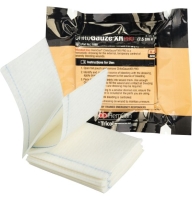
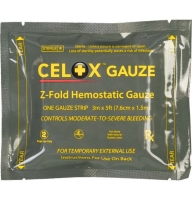
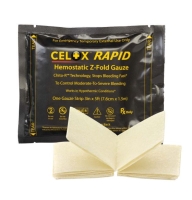
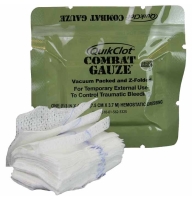
- Ergonomic packaging: The "accordion" or (Z-fold) form allows the bandage to be instantly removed from the packaging, saving precious time and preventing the risk of contamination of the bandage during unwinding.
- Removal in the operating room: the bandage is easily removed from the wound channel as a continuous strip, leaving no particles, and a radiopaque strip allows checking whether any gauze remnants are left in the wound.
Recommendations for Selection and Storage
To choose a quality hemostatic bandage, it is important to follow several important recommendations: mandatory Z-fold (rolled formats are inconvenient and impractical in extreme conditions), verified manufacturers and CoTCCC certification (prefer global and domestic standards with proven effectiveness), type of active substance (preferably chitosan, as it is more effective in hypothermia), and the presence of a radiopaque strip (look for markings on the packaging).
The bandage must be stored exclusively in its original sealed packaging — any breach of the vacuum renders the bandage unusable. It is important to ensure protection against mechanical damage in the first-aid kit — so that the hemostatic does not rub against the sharp edges of other instruments. Do not forget to regularly check the expiration date (for a hemostatic bandage, it is 3–5 years) — an expired bandage loses its hemostatic capabilities.
Conclusion
A hemostatic bandage is an active biochemical tool that, in a critical moment, can be the only way to save a person's life. This tool allows stopping fatal bleeding in a few minutes where it is anatomically impossible to apply a tourniquet. However, it must be remembered that the effectiveness of the bandage directly depends on the rescuer's skills — it will be powerless if the strict algorithm of actions for wound packing is not followed.
On Flash Army, you can order hemostatic bandages from various manufacturers.