Modern military operations are unimaginable without the use of UAVs. Their operating conditions are becoming more complex, leading to the evolution of communication systems. With the development of electronic warfare (EW) systems, classic radio channels have become vulnerable to jamming and interception. In response to these challenges, a technological solution emerged: fiber optics for drones.
Fiber-optic drones have already proven their effectiveness in reconnaissance and engagement on the battlefield. The uniqueness of fiber-optic drones lies in the signal being transmitted through a thin optical fiber that physically connects the drone to the control point. This avoids the impact of radio interference, as the signal is not transmitted over the air.
This material was prepared by the Flash Army team. In this article, you will learn what fiber-optic communication for drones is, its operating principle, main technical parameters, and advantages.
What is fiber-optic communication in drones
Fiber-optic communication in drones is a technology for transmitting video and control via light pulses through a thin cable, rather than radio waves. This means the drone is physically connected to the operator. The main feature is that this system cannot be detected by drone detectors or jammed by EW systems.
The complex consists of a fiber-optic reel and a ground control station.
- A fiber-optic reel is a special mechanism with a tightly wound thin cable.
- The ground station provides the connection between the drone and the operator. It consists of a light signal receiver, a decoding unit, and a monitor.
How fiber optics work in UAVs
The operating principle is quite simple. Let's look in more detail at how fiber optics work.
Data transmission via light signal
In a fiber-optic communication system, information (video, telemetry, control commands) is converted into light pulses. These are transmitted through the optical fiber at very high speed. This allows the operator to receive a high-quality image and precisely control the drone in real time.
Connection features
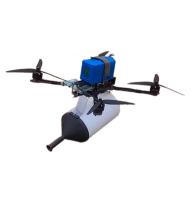
Connection is quick and effortless. The drone is equipped with a special fiber-optic reel, which gradually unwinds during flight. The optical fiber trails behind the UAV, but due to its small thickness and flexibility, it creates almost no additional air resistance. The other end of the cable is connected to the ground control station.
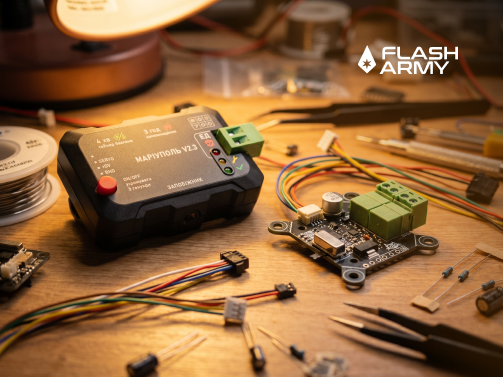
A media converter is also installed, connected to the drone's video transmitter on one side and to the ground station's receiver on the other. This design allows for a stable connection throughout the available cable length.
Channel stability
Since the signal is not transmitted over the air, this makes the channel virtually inaccessible to interception and ensures stable operation even in an environment with intensive EW use. Therefore, it is considered one of the safest for battlefield application.
Main characteristics
Fiber optics for UAVs have a number of technical parameters that ensure the effectiveness of such systems. These include cable length, high bandwidth, no signal delay, and protection from interference.
Line length
The operating range of an FPV drone on fiber optics directly depends on the cable length on the reel. Typically, it is 3–10 km, and sometimes 15–20 km.
It is important to choose the right reel and fiber-optic cable, considering the drone's weight and payload capacity. If the drone is used not only for reconnaissance but also transports ammunition, installing a large reel will not be possible. In such a case, one has to settle for a more compact option, which, accordingly, reduces the maximum operating range. At the same time, even a distance of 1–2 km is sufficiently effective for performing reconnaissance tasks or adjusting fire.
Bandwidth
Fiber optics for drones provide high bandwidth, allowing video transmission in HD or even 4K format.
Signal delay
One of the features is minimal, almost zero, data transmission delay. The light signal passes through the fiber almost instantly, ensuring a quick drone response.
Protection from interference
Furthermore, the light signal is not susceptible to radio interference. Only wind and rain can affect the movement of a fiber-optic drone.
Advantages of fiber optics for drones
Fiber-optic communication opens up new possibilities for FPV drone flights.
We can highlight the following advantages of fiber-optic UAVs:
Complete EW resistance.
Since the signal is transmitted via cable, it cannot be jammed by classic electronic warfare systems. This allows the drone to operate even in environments with strong interference.
Protection against interception.
The fiber-optic channel virtually eliminates the possibility of signal interception. Data is transmitted physically, so access to it without direct connection to the cable is extremely difficult. This increases control security.
Invulnerability to electronic reconnaissance (SIGINT).
The drone cannot be detected by enemy SIGINT systems, and the operator remains hidden.
Communication stability.
Unlike radio channels, which can lose signal due to terrain, fiber optics provide a stable connection without breaks or quality fluctuations.
High data transmission quality.
Fiber optics provide much higher bandwidth than radio channels. This ensures a stable, high-resolution image without interference.
Navigation accuracy.
Stable communication allows for precise control.
Conclusion
Fiber-optic FPV drones have become an innovative technological solution in the military sphere. They have already proven their practical value in reconnaissance and fire adjustment.
By transmitting data via a physical cable, such systems provide a stable, secure, and virtually unjammable communication channel, which significantly increases the effectiveness of drones on the battlefield. They can only be shot down by firearms, anti-aircraft weapons, or by cutting the fiber-optic cable.
In the Flash Army online store, you can find fiber-optic reels for drones from various manufacturers, differing in weight and cable length. This allows you to choose options for specific tasks and usage conditions.