UAVs have changed the course of modern warfare. They are widely used directly on the battlefield, as well as for attacks on civilian and critical infrastructure. In such conditions, airspace control and effective counter-UAV measures become necessary. Progressive solutions have already been found and tested — from detection systems to interception methods. One of the newest means is interceptor drones.
This type of drone provides an active response to air threats. They are capable of quickly detecting, tracking, approaching enemy UAVs, and promptly neutralizing them. Interceptor drones can be called an innovative technological solution, as they have one of the highest coefficients of hitting enemy unmanned targets.
The article was prepared by the Flash Army team for everyone who wants to better understand the phenomenon of interceptor drones, their operating principles, features, and types.
What are interceptor drones
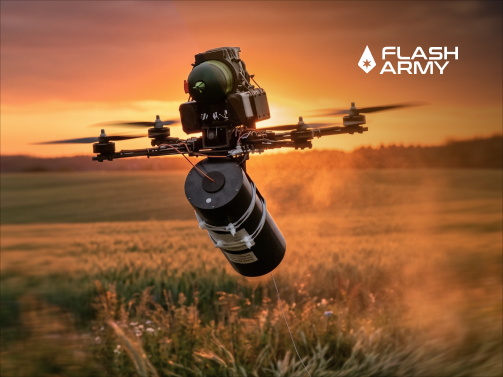
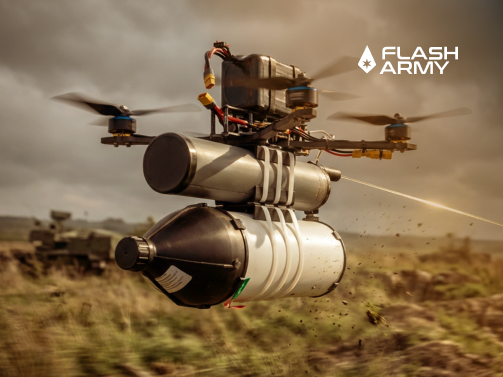
Interceptor drones — are specialized UAVs (primarily high-speed FPV quadcopters) designed to detect, pursue, and destroy enemy drones. They act as mobile air defense for engaging slow but numerous aerial targets (e.g., “Shahed” type UAVs). Such anti-Shahed drones can operate autonomously or under operator control, receiving target data from radars, air defense systems, or ground observation posts.
Types of interceptor drones
Interceptor drones can be divided into several types depending on their operating principle and method of neutralizing the target:
Kinetic (strike) or FPV interceptors.
Destroy UAVs by direct collision (ramming) or high-explosive fragmentation detonation. Because of this, they are often single-use. They operate autonomously with artificial intelligence or under operator control (in real-time). FPV interceptors develop high speed, but are effective mainly for close combat.
Aircraft-type anti-aircraft drones.
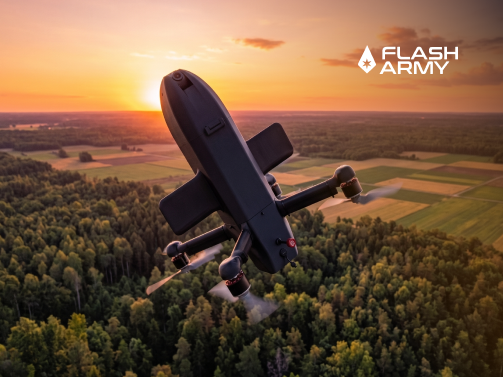
Operate on the principle of FPV quadcopters: they quickly gain altitude, cover significant distances, and can intercept targets in various ways. The difference is that they can stay in the air for a long time and cover distances of 10–20 km or more. Thanks to their winged design, they are more resistant to wind and maintain a more stable course. The possibility of contactless interception allows the drone itself to be preserved. At the same time, launching sometimes requires additional devices (catapults or an acceleration system).
Interceptors with nets.
Equipped with special mechanisms for deploying a net that entangles the propellers of an enemy drone. This allows the target to be neutralized without an explosion.
Interceptor drones with EW elements.
Operate through electronic warfare influence. Such drones jam control channels, video transmission, or navigation (GPS). As a result, the aerial target loses control.
Key characteristics of interceptor drones
To understand how interceptor drones work, it is worth considering their technical characteristics. The effectiveness of this type of military drone directly depends on them.
- Maximum speed is 250–350 km/h. This is one of the key parameters, as the interceptor must be able to catch up with the target and react to its movements.
- Flight altitude reaches from 1 to 6 km, and the range — 25 km (in some cases, it can exceed 70 km).
- Time in the air is usually no more than 25 minutes. However, the short flight time is compensated by rapid deployment.
- Interceptor drones carry a warhead weighing up to 1 kg for kinetic impact or self-detonation.
- In addition, modern models are equipped with thermal imaging cameras for day and night operation.
What objects can interceptors neutralize
Interceptor drones often operate as part of mobile groups, reinforcing EW and air defense systems.
The first scenario is the protection of infrastructure facilities from strike drones within the general air defense system, both in frontline areas and in the rear. In addition to “Shaheds,” interceptors can shoot down “Geran,” “Gerbera,” and other UAVs. They can also hit first-wave strike drones: “Mavic” and “Molniya.”
The second method is covering the frontline, artillery positions, and units. Here, the main goal is to shoot down reconnaissance UAVs (“Orlan,” “Zala,” etc.) to prevent reconnaissance.
Advantages of using anti-aircraft drones
Interceptor drones have a number of tactical and strategic advantages:
Cost-effectiveness.
The cost usually starts from 40,000 UAH, which is many times cheaper than a missile for classic air defense systems.
Rapid response.
Capable of quickly taking to the air and intercepting targets in real-time, which is especially important for sudden threats.
Versatility of application.
Can operate both on the front line and in the rear.
High accuracy and maneuverability.
Allow neutralizing specific targets with minimal collateral damage.
Reduced load on the air defense system.
Take over the fight against mass air targets, allowing missiles to be saved for other purposes.
Reusability.
In case of an unsuccessful attack, the drone can be returned and launched again.
Thanks to these advantages, interceptor drones are becoming an important component of modern security and airspace control systems.
Conclusion
Interceptor drones clearly demonstrate how unmanned technologies are transitioning from auxiliary reconnaissance tools to a full-fledged instrument for countering air threats. They do not replace traditional air defense systems but effectively complement them, especially in conditions of massive drone use. Thanks to their maneuverability, speed, compactness, and relative affordability, such solutions significantly increase the effectiveness of sky protection.
In modern warfare conditions, interceptor drones provide an adaptive response to new threats, allowing for prompt detection and neutralization of aerial targets. That is why this area of defense is actively developing, forming new approaches to protecting both military and civilian objects.
The article analyzes what interceptor drones are, what they are used for, and what their advantages are. You can familiarize yourself with available models of interceptor drones on the Flash Army website.