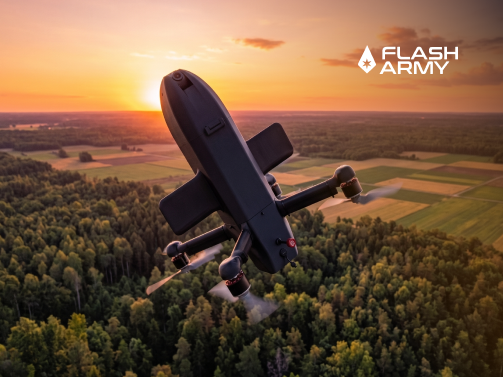
UAVs hold a leading position in modern military affairs. They come in various types: radio-controlled, autopilot, fiber-optic, kamikaze drones, etc. Each has its own scope of application, technical parameters, advantages, and disadvantages. In this article, we will focus on fiber-optic drones, as this technology has, to some extent, changed the approach to drone application on the battlefield.
Traditional radio control channels are increasingly subject to jamming and interception, which significantly limits UAV effectiveness. In such an environment, fiber-optic communication serves as an alternative solution, allowing for stable control and data transmission regardless of EW influence.
The material prepared by the Flash Army team will help you better understand what fiber optics is, how a fiber-optic drone works, and where it is used.
What is Fiber Optics
Fiber optics is a thin, flexible cable made of glass or special plastic, used for transmitting data in the form of light pulses. A fiber-optic cable consists of a transparent core through which light travels, and protective coatings. It is the basis of modern global communication networks.
Accordingly, fiber-optic communication in drones is a method of transmitting video signals and control commands using light pulses that pass through a cable, rather than through radio waves. This provides the UAV with a physical connection to the operator.
Principle of Operation of Fiber-Optic Drones
The principle of operation of fiber-optic drones is quite straightforward and does not require special effort in launching or controlling. At the same time, this technology has both advantages and disadvantages.
Advantages
Firstly, the use of fiber-optic technologies eliminates one of the main vulnerabilities of UAVs — the communication channel. Traditionally, it operates on radio frequencies, which can be detected and suppressed by electronic warfare systems. In addition, radio communication can be interrupted for other reasons, leading to loss of drone control, forced landing, or even a crash before reaching the target. Thus, the main advantage of fiber-optic communication is its complete resilience to EW and SIGINT systems.
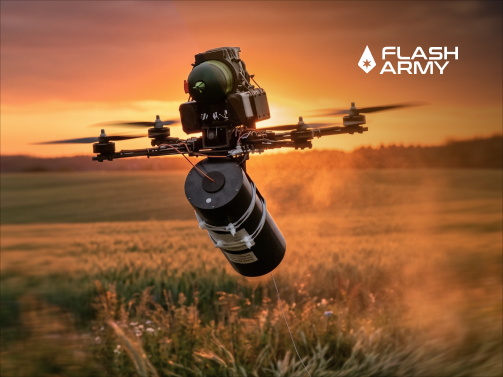
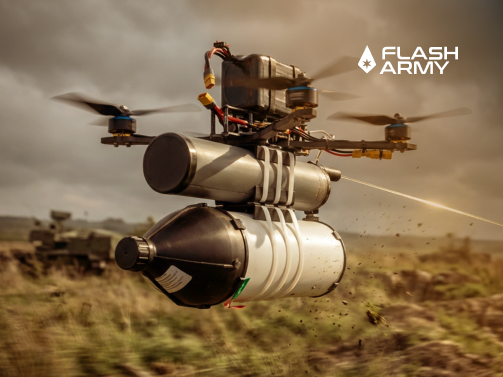
Secondly, the use of a fiber-optic reel in an FPV drone control system ensures fast and stable data transmission. It is attached to the drone and gradually unwinds as it moves. This allows the operator to precisely control the UAV and receive real-time video and telemetry. This maintains a reliable connection between the drone and the ground station throughout the flight.
Thirdly, fiber optics provides much higher bandwidth than a radio channel. This guarantees a stable, high-resolution image without interference.
Disadvantages
Fiber-optic drones, despite their EW resilience, have some disadvantages that need to be considered:
- flight range is limited by cable length;
- fiber optics can get caught on trees, power lines, or break during sharp maneuvers, leading to loss of control;
- reduced maneuverability due to the weight of the reel;
- difficulty in piloting in wooded areas, as the terrain can hinder cable unwinding;
- slower than classic FPV drones due to the additional weight of the reel.
Key Characteristics of Fiber-Optic UAVs
Fiber-optic drones can vary depending on their technical specifications. Let's consider some of them.
Flight Range
The operating range of an FPV fiber-optic drone directly depends on the length of the cable on the reel. Typically, it is 3–10 km, and sometimes 15–20 km.
Payload Capacity
Fiber-optic drones can usually carry up to 4 kg of ammunition, but a significant portion of the weight (up to 1.5 kg) is accounted for by the reel with the cable itself.
Size
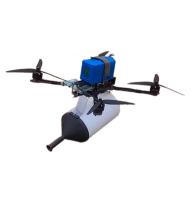
10-inch FPV quadcopters are primarily used for integration with fiber optics. They are more massive and heavier than conventional FPV drones due to the added weight of the fiber-optic reel.
Use of Such Drones in Military and Civilian Spheres
In the military sphere, such UAVs are used for reconnaissance, fire adjustment, and strike missions in an environment with active electronic warfare systems. Thanks to the secure communication channel, the operator can stably control the drone even where conventional radio channels do not work. Thus, they have proven their effectiveness on the battlefield.
It is important to note that the use of fiber-optic drones is not limited to military applications. For example, they are used for work in underground and confined spaces, as well as for inspecting pipelines and heating mains. However, they are less common in the civilian sector, as such conditions do not involve the influence of EW systems.
Conclusion
Fiber-optic drones are an innovative technological solution that addresses one of the key problems of unmanned systems — vulnerability to electronic warfare. Thanks to data transmission via a physical cable, they offer stable control, high signal quality, and complete resilience to EW and SIGINT.
However, certain limitations of such UAVs should be considered. For example, they cannot fly beyond the length of their cable, as they are, to some extent, "tethered" to the control station. Therefore, when choosing, we recommend paying attention to the potential conditions and objectives for using fiber-optic drones.
The Flash Army online store offers options from various manufacturers and sizes. They can also differ in frequency range, flight range and duration, speed, payload capacity, and camera. This allows you to choose drones for your specific tasks.