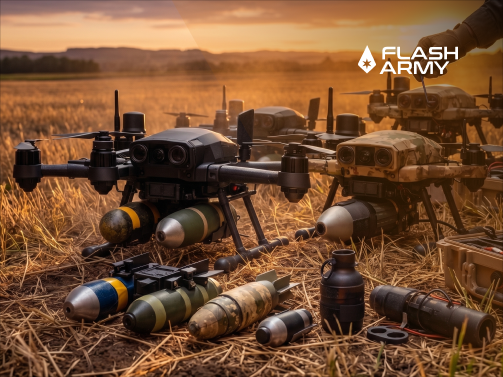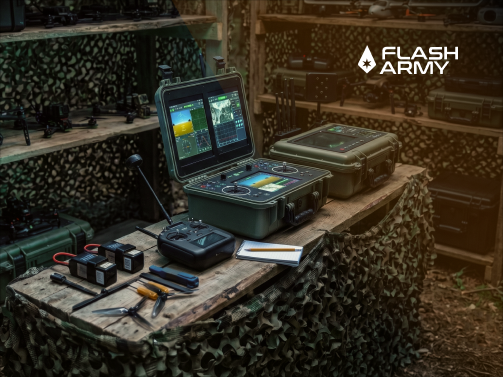
Kamikaze drones have become one of the most prominent tools of modern warfare in recent years. Their emergence has changed not only the technical side of combat operations but also the very logic of mission planning. A kamikaze drone is a single-use unmanned aerial vehicle whose primary goal is to precisely strike a designated target by self-destruction. However, reducing its role merely to a flying munition would be an oversimplification.
In wartime conditions, kamikaze drones perform several functions simultaneously: reconnaissance, situation assessment, route correction, and direct strike. This multifunctionality has made them critically important for modern units. The Ukrainian kamikaze drone today exemplifies how technology adapts to combat realities and becomes a tool for asymmetric advantage.
Origin of the Name and Functionality
The term "kamikaze" has historical origins and is associated with self-sacrifice for the sake of mission accomplishment. In the case of unmanned systems, this concept has acquired a rational rather than symbolic meaning. The single-use nature of the drone allows for maximum simplification of its design, concentrating resources on accuracy, range, or explosive power.
From a practical standpoint, a kamikaze drone is a comprehensive solution. In the initial stage, the aircraft is used as an aerial reconnaissance tool: the operator assesses the target, the environment, and potential risks. This is followed by trajectory correction, taking into account changes in the situation, after which the strike is carried out. In real combat conditions, such flexibility is often crucial.
Types of Kamikaze Drones
All kamikaze drones are conventionally divided into two basic types: copter-type and fixed-wing type. This division is not merely formal, as the design directly affects flight range, strike accuracy, autonomy, and application scenarios.
Copter-Type Drones
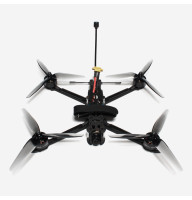
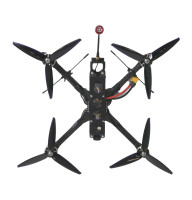
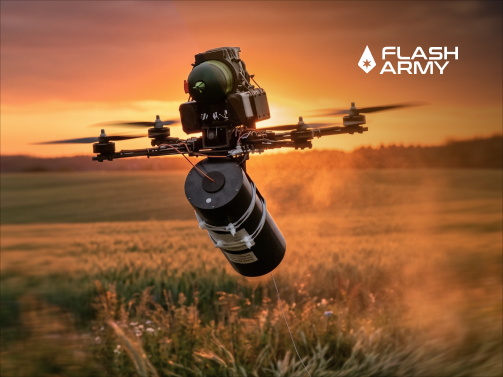
Copter-type kamikaze drones are distinguished by high maneuverability and the ability to operate at low and ultra-low altitudes. They can hover in the air, sharply change direction, and precisely approach a target even in complex conditions. These characteristics make them effective in urban areas, industrial zones, forest belts, or rugged terrain.
In practice, copter platforms are often used for striking armored vehicles, shelters, artillery positions, or individual targets with high precision. The FPV Drone Zhakh 10” is an example of a solution specifically designed for such tasks. Thanks to a stable video link and sensitive control, the operator can adjust the attack until the last seconds.
That is why, when there is a need to buy FPV drones for tactical operations, the copter format is usually considered the basic option. At the same time, such drones have limitations in range and flight time, and are also more sensitive to weather conditions and electronic interference.
Fixed-Wing Drones
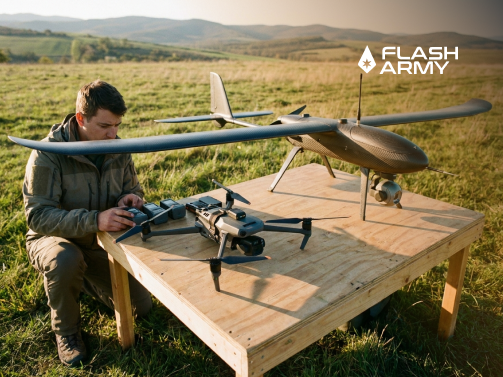
Fixed-wing kamikaze drones are created with a different priority: maximum range and autonomy. Thanks to their aerodynamic shape, they can cover significant distances with minimal energy consumption, making them effective for striking targets deep within enemy defenses.
Such platforms have stable cruise flight, higher speed, and less dependence on terrain. The Ukrainian UAV "Bebradrone" is an example of adapting fixed-wing drones to modern combat conditions. It is designed for missions where the key factor is the distance to the target, rather than pinpoint accuracy.
A disadvantage of fixed-wing drones is limited maneuverability in the final stage of an attack. However, for strategic or semi-strategic tasks, this compromise is justified and is factored in during the mission planning stage.
Key Characteristics to Consider When Choosing Drones
The selection of a kamikaze drone always begins with an analysis of application scenarios. There are no universal solutions, so it is important to consider several key parameters simultaneously.
First, flight range and airborne time are assessed. For short-range tactical tasks, copter platforms are optimal, while for deep strikes, fixed-wing drones are required.
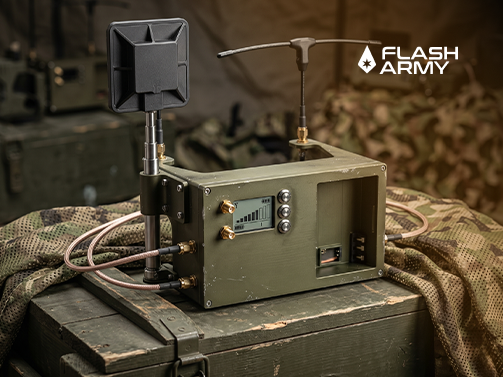
The second critical aspect is the quality of video communication and the security of control channels. In conditions of active electronic warfare, these factors often determine the success of an operation. Equally important are payload capacity, flight stability, ease of maintenance, and operator training speed.
In practice, it is often the combination of these characteristics, rather than a single parameter, that determines the effectiveness of a particular model.
Conclusion
A comparison of copter-type and fixed-wing kamikaze drones shows that each has a clearly defined niche. Copters provide maximum precision and control in complex conditions, while fixed-wing platforms offer an advantage in range and autonomy.
The modern Ukrainian kamikaze drone is the result of practical experience, continuous testing, and adaptation to real combat challenges. If the task is to buy FPV drones for specific conditions, it is advisable to focus on proven solutions. FlashArmy works precisely in this direction, offering platforms adapted to the real needs of the modern battlefield.