Today, almost no one is safe from power outages. The difficult situation in Ukraine's energy system requires rolling and emergency blackouts for residential consumers almost daily. Being in an apartment or house without electricity for several hours in a row is not the best option. Therefore, there is a simple solution to provide your home with light and increase your comfort in such unpleasant circumstances.
In this article, we will talk about portable power stations as an element of a backup power system for an apartment. Currently, options of any power and capacity are available, but before buying, we advise you to read this material. This will help you understand how to choose a power station for an apartment and how to use it safely.
What is a portable power station
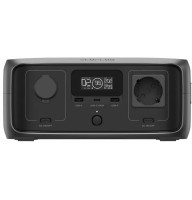
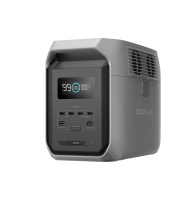
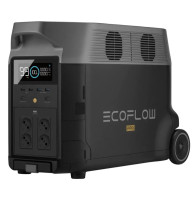
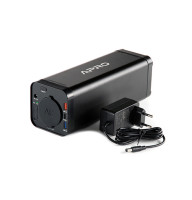
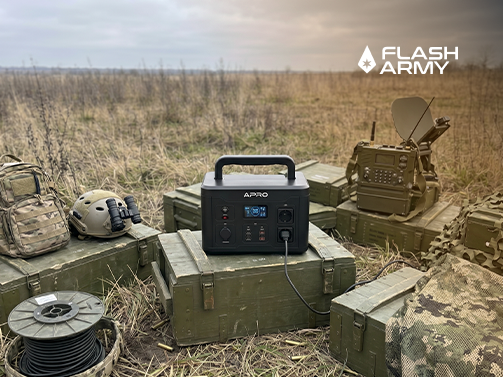
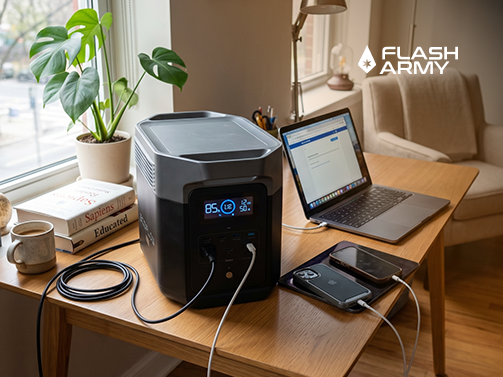
A portable power station is an autonomous battery for powering household appliances, devices, and gadgets in the absence of a power grid. In principle, it is similar to a power bank, only much more powerful and larger. It consists of a battery, an inverter, and output connectors for connecting electrical appliances.
The principle of operation is to accumulate energy: the station is pre-charged from an outlet or solar panels, after which it can power devices through standard connectors. The built-in inverter converts the battery's direct current into alternating current, suitable for most household appliances. Therefore, you can easily connect several devices at once, and their number will depend on the selected power of the station.
Advantages of power stations
Power stations are chosen for their functionality and ease of use. However, they also have other advantages:
- autonomy and independence from the grid;
- safety and environmental friendliness. Unlike gasoline or diesel generators, power stations do not emit exhaust gases and do not require fuel, so they can be safely used indoors;
- silent operation;
- alternative charging options: many models support connecting solar panels, which allows you to create an autonomous power system and use renewable energy;
- mobility and compactness: if the station's weight is small (up to 10 kg), it can be carried or even taken with you (although there are options weighing up to 80 kg);
- versatility of connection (presence of different types of connectors);
- fast charging — takes only 1–2 hours (most models have this option);
- simultaneous connection of several devices (usually up to 10);
- built-in BMS (Battery Management Systems), which provide protection against voltage spikes and temperature changes.
Choosing a power station for an apartment
When choosing a portable power station, first of all, it is worth clearly defining the conditions of its use. Manufacturers offer many options, but you need to consider the number and power of devices that will be connected to use this device as efficiently as possible.
Battery types
There are three main types of batteries:
- Li-ion (lithium-ion, including cobalt-based). Provide stable operation and have a resource of approximately up to 800 charge and discharge cycles.
- NMC (lithium-nickel-manganese-cobalt-oxide). Have a similar resource (about 800 cycles), but often provide higher energy density, which allows reducing the device's dimensions while maintaining capacity.
- LiFePO4 (lithium iron phosphate) — modern batteries with an increased service life (approximately 2500–3500 cycles). They are more resistant to overheating and wear, so they can work significantly longer without significant loss of capacity. They are considered the best choice for a power station in an apartment.
Power
The key parameter is the output power, measured in watts (W). It determines which devices the station can power and how many of them can be connected simultaneously. The higher this indicator, the wider the range of equipment available for connection.
Low-power stations (from 210 to 700 W) are suitable for charging small gadgets, powering gas boilers, and LED lighting.
Medium-power (from 700 W to 2 kW) are capable of powering refrigerators, air conditioners, boilers, etc.
High-power (up to 5 kW) are suitable for connecting all electrical appliances in a large house, including large household appliances.
Capacity
In addition to power, it is advisable to pay attention to the battery capacity (Wh). This indicator affects the duration of autonomous operation: the larger the capacity, the longer the station can provide power without recharging.
For an apartment, the optimal capacity of a power station depends on the needs: 500–1000 Wh is enough for gadgets and lighting, 1500–2000+ Wh — for a refrigerator, boiler, and TV.
Connectors
A power station for an apartment usually has the following types of connectors:
- standard 220 V/230 V (AC) outlets;
- USB Type-A and USB Type-C — for charging phones, tablets, and power banks;
- DC: ports for powering routers, LED lighting, etc.;
- XT60 — a special connector for connecting solar panels.
Tips for safe operation
Safe use of a portable power station in a residential area involves compliance with basic technical and operational requirements, but does not require additional effort. This avoids overheating, network overload, and premature battery wear.
First, we recommend placing the power station in a space with free air circulation. Do not cover it or install it in closed cabinets, as this can lead to overheating of internal components.
Second, the device must be kept away from water sources and places of high humidity. Liquid entering the case can cause a short circuit or damage to electronics.
Third, it is important not to exceed the rated power of the station. Connecting devices with excessively high power consumption can cause an emergency shutdown.
Fourth, if the station is not used for a long time, it is advisable to store it with a partial charge (approximately 40–60%) and periodically recharge it to maintain battery life.
Conclusion
Thus, a portable power station is an effective solution for providing electricity in conditions of an unstable energy system. It allows you to maintain the operation of household appliances, communication devices, and lighting even during long outages, providing basic comfort and autonomy in the apartment.
You can buy power stations for an apartment and other energy independence products in the Flash Army online store.