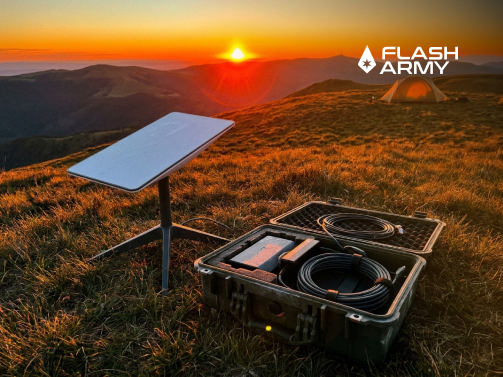
Starlink is not just an antenna and a cable, but a complete set of equipment that needs to be regularly transported, set up, and packed away. And it quickly becomes clear that without proper transportation, this kit won't last long. The terminal is flat but fragile to point loads, the cables have rigid connectors, and the power supply doesn't like impacts. If all of this is packed into a regular backpack, problems will start after a few trips.
Therefore, a Starlink backpack is not just about convenience, but also about the safety of the kit after transport. And about ease of use, so that it can be quickly deployed in the field.
Why Starlink backpacks and bags are needed
The main task is to preserve the form and integrity of the equipment. The Starlink kit has several elements that should not be compressed or pressed by other items: the terminal itself, the cable with connectors, the power supply, and the router (if it's separate).
When all of this is in one compartment without fixation, they start to press on each other during movement. This is why connectors and cables are most often broken, not the casings. A Starlink backpack solves this through its structure: separate zones for each element and minimal internal movement. A Starlink bag works similarly but is more suitable for car transport or short movements.
If the kit is constantly carried along with other gear, the difference between a regular bag and a specialized solution becomes obvious in use.
Choosing backpacks and bags for different Starlink models
The most common mistake is to buy any Starlink backpack and expect it to fit. Different kits have different dimensions and compositions. Compact versions take up less space, but that doesn't mean they can be thrown into any bag. There are still cables, a power supply, and small elements that require organization.
Larger kits take up significantly more space, and here it's important how exactly it lies inside. If the terminal fits snugly or the fabric bends, it means constant pressure on the casing.
A proper Starlink backpack is chosen so that:
- the terminal lies flat without bending;
- the cable does not bend near the connectors;
- the power supply does not press against the antenna;
- minimal play remains inside.
If you look at the options in Flash Army, the difference between models is well felt precisely in these details, not in the appearance.
Choosing by color and camouflage
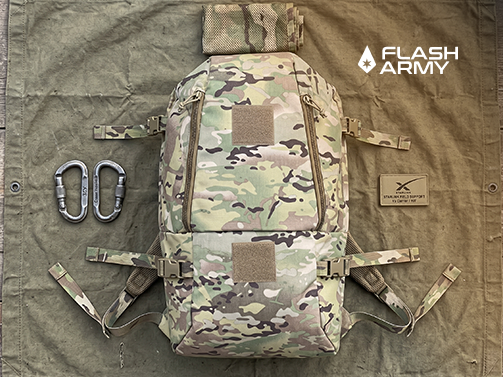
Color choice, especially for military personnel, is critically important. The color of pouches, covers, and backpacks is essential for camouflage in combat conditions. A white or light backpack is visible from afar. Black looks universal but also stands out in open terrain. Therefore, for trips outside the city, olive, coyote, or other muted shades are more often chosen. They do not contrast with the ground, grass, or equipment. If the Starlink backpack is used in the city or for civilian tasks, other factors are more important: that it does not attract attention and does not look like something specialized.
A separate story is when other elements are used nearby, such as Starlink terminals and additional network equipment. Then it is logical that it should be assembled as one kit, not a set of separate elements.
Materials and equipment protection
When people realize they need a Starlink bag, they often forget the importance of construction and materials when choosing. The material itself won't save it if the construction is wrong, and vice versa. There must be an overall system that works in harmony. Here are a few things that affect equipment preservation:
- material density — thin fabric quickly wears out and doesn't hold its shape;
- inner layer — foam or padding that absorbs impacts;
- back stiffness — prevents the backpack from collapsing under weight;
- zipper quality — to hold securely and not separate under load;
- moisture treatment — helps survive rain and dirt.
However, even a good Starlink backpack does not replace caution. If metal objects or tools are thrown inside, they will still find a weak spot.
Design features and space organization
The internal design of the backpack is no less important, because Starlink terminals need to be deployed quickly. If everything inside is haphazardly arranged, it will take more time to deploy the system, as each element will need to be found separately. A proper Starlink backpack organization looks like this: you open it and immediately see the entire kit. You don't need to pull out half the items to get to the cable or power supply.
Key points:
- a separate flat compartment for the terminal;
- pockets for cables so they don't unravel;
- space for the power supply without pressing on the antenna;
- quick access without complex fasteners;
- carrying handles for when you don't want to wear the backpack.
If these are missing, the backpack turns into a regular bag where everything is stored together. And then the point of specialization disappears.
Covers for Starlink terminal camouflage
A Starlink cover refers not just to a transport bag, but to a fabric case for camouflage in positions. Starlink terminals are usually white, which makes them highly visible in natural landscapes. For safety, camouflage solutions are used that change the appearance but do not affect operation.
There is an important point here: you cannot block the antenna's surface or disrupt its position. Otherwise, instead of camouflage, you might get communication problems.
That is, the cover must:
- not deform the casing;
- not press on the cable;
- not cover the working surface;
- not interfere with cooling.
Tips for operation and care
Even a good backpack won't last if it's used like a sack for things. Therefore, during use, it's important not to put foreign hard objects inside along with the terminal if the backpack doesn't have additional compartments. The cable should not be folded with sharp bends. When using the backpack, don't overstuff it and force it closed, and if it gets wet from rain, let it dry completely. And one of the most important points is wear control, so you need to periodically check seams and zippers. This is not difficult, but these small details determine how long your kit will serve you.
Conclusion
A Starlink backpack is part of the system, not an accessory. It affects how quickly communication is deployed and in what condition the equipment arrives at its destination.
If you choose it for a specific model, look at the internal organization, and don't ignore basic things like material and fit, transportation problems simply won't arise.
And when a Starlink backpack, the kit itself, and additional network equipment are used together, it's no longer a collection of separate items, but a normal working system that can be picked up, moved, and launched without unnecessary actions.