The issue of autonomous power supply has long extended beyond industry. Generators are increasingly appearing in private homes, apartments, offices, shops, and even cafes. When electricity supply is unstable, a generator becomes not a backup option, but a full-fledged part of the infrastructure.
At the selection stage, most face a basic dilemma: which is better, a diesel or gasoline generator. Both options look similar externally but differ significantly in operating principle, costs, and use cases. Because of this, a mistake at the start can be costly during operation.
To understand whether a gasoline or diesel generator is better, it's worth breaking everything down. The difference lies not only in the type of fuel but also in engine life, noise, economy, and stability under load.
Gasoline Generators
Advantages
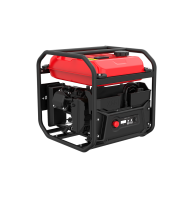
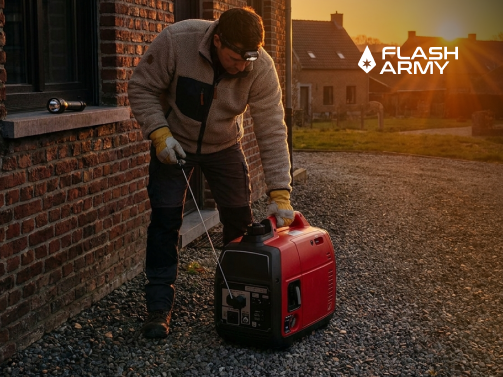
Gasoline generators are often chosen for household tasks and temporary backup power. They are simpler in design, easier to start, and do not require complex preparation for operation. For a user without technical experience, this is a big plus.
Another strong point is the affordable initial price. If comparing a gasoline or diesel generator of the same power, the gasoline model is almost always cheaper. This makes it a logical choice for a home, dacha, or small office.
Compactness is also worth mentioning. Gasoline generators are usually lighter and smaller, making them easier to transport or store in limited spaces. For urban conditions, this is often a decisive factor.
Disadvantages
The main drawback of gasoline generators is their limited engine life. Such engines are designed for shorter operating cycles and do not tolerate prolonged loads without breaks. With constant operation, wear occurs faster.
The second point is fuel consumption. Gasoline models are less economical, especially if the generator runs for several hours continuously. In conditions of frequent outages, this significantly impacts the budget.
It is also worth considering operational stability. Under high load, voltage can fluctuate, which is not always suitable for sensitive equipment. For household appliances, this is not critical, but for servers or medical equipment, it is a problem.
Diesel Generators
Advantages
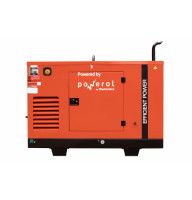
Diesel generators are designed for long and stable operation. The diesel engine is structurally more durable, so it easily withstands many hours under load without significant wear. For business or production, this is a key argument.
Another important advantage is economy. If comparing a diesel or gasoline generator, diesel almost always wins in terms of fuel consumption. With prolonged operation, the difference becomes obvious within a few weeks.
Stability is worth mentioning separately. Diesel generators maintain voltage better, allowing safe connection of equipment sensitive to fluctuations. This is critical for enterprises, medical facilities, and server rooms.
Disadvantages
The main disadvantage of diesel models is their higher price. Initial investments are significantly greater than for gasoline counterparts. For a household user, this is not always justified.
Also, diesel generators are usually noisier. Even with an enclosure, the noise level is more noticeable, especially in dense urban areas. This is important to consider when installing near residential premises.
Another nuance is cold starting. In winter, diesel requires more careful maintenance and quality fuel. Without this, starting can be difficult.
Selection by Characteristics
Price
Initially, gasoline looks more attractive. But in the long run, the difference between a diesel and gasoline generator is offset by fuel and maintenance costs. For long-term operation, diesel often proves more profitable.
Fuel Consumption
Diesel models consume less fuel at the same power. This is important if the generator operates daily or for several hours continuously. Gasoline generators lose in this aspect.
Engine Life
A diesel engine has a longer resource in hours. If the generator is not an emergency option but a constant power source, the choice is obvious.
Noise
Gasoline generators run quieter. For an apartment or private house, this is a significant argument. Diesel is more suitable for separate premises or industrial zones.
Operating Conditions
For periodic use, gasoline is suitable. For continuous operation, diesel. Here it is important to honestly answer how often the generator will be turned on.
Which Generator is Better for the City, Home, and Which for an Enterprise
In urban conditions, where the generator operates as a backup, it is logical to choose gasoline models. They are simpler to maintain, more compact, and less noisy. For apartments and small offices, this is more than enough.
For a private house, the use case should be evaluated. If outages are short and infrequent – gasoline. If the generator operates regularly and powers the entire house – diesel looks like a more reliable solution.
For business, warehouses, and production, the question of a diesel or gasoline generator doesn't even arise. Here, stability, economy, and resource are more important than the initial price. In such scenarios, the choice is unequivocal.
Conclusion
The choice between diesel and gasoline depends not on brand or price, but on tasks. Diesel or gasoline generator – it's about the use case, duration of operation, and load.
If a generator is needed as a backup – gasoline will be optimal. If it's about systemic energy independence, it's worth looking towards diesel models. For a more detailed selection and comparison, it is worth contacting specialized solutions from Flash Army, where various generators for specific tasks are presented.