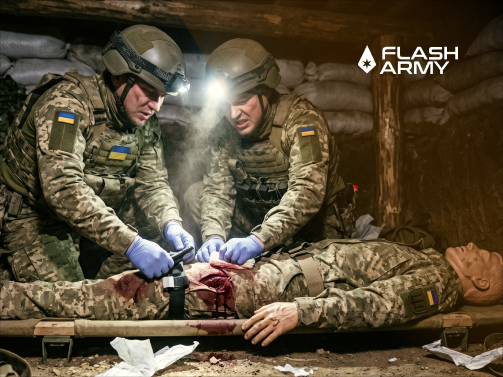
The topic of massive hemorrhage from extremities and the use of tourniquets is an important component of training for military personnel and volunteers. In critical situations, massive bleeding leaves no room for thought, and decisions must be made in seconds. In such situations, only clear and practically proven solutions work.
Just a few years ago, a tourniquet was primarily associated with military first-aid kits. Today, it has become part of civilian medicine, training courses, and basic safety kits. It is carried by volunteers, instructors, drivers, and people who are aware of the reality of risks.
Understanding how to choose a tourniquet is not about theoretical knowledge. It's about a conscious choice of a tool on which life depends.
What is a medical tourniquet
Functionality and purpose
What is a tourniquet in a practical sense, not in textbook definitions? It is a simple mechanism that allows for quick and reliable control of critical bleeding from the extremities. A medical tourniquet is used in cases where other methods do not work or take too much time. After all, in the case of massive bleeding, every second counts. In modern pre-hospital care protocols, the tourniquet has long ceased to be an "extreme measure." Its use is recognized as effective and safe, provided it has the correct design and is applied properly.
A medical tourniquet is an emergency device. It is applied for injuries with arterial damage, amputations, and blast or shrapnel wounds. The main task is to stabilize the person's condition until they reach medical professionals.
Design features
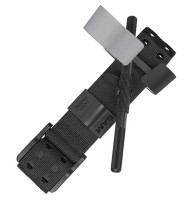
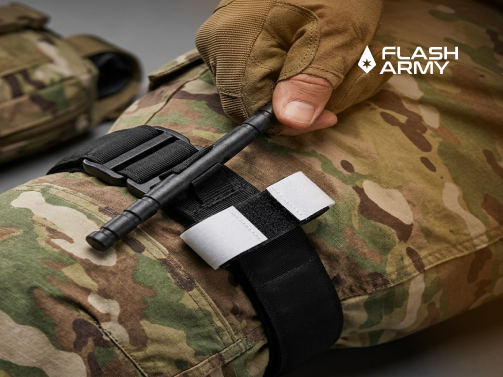
The tourniquet's design looks concise, but behind this simplicity lies precise calculation. The strap must be rigid enough to create pressure, yet not cut into soft tissues. The material must withstand loads without stretching or tearing.
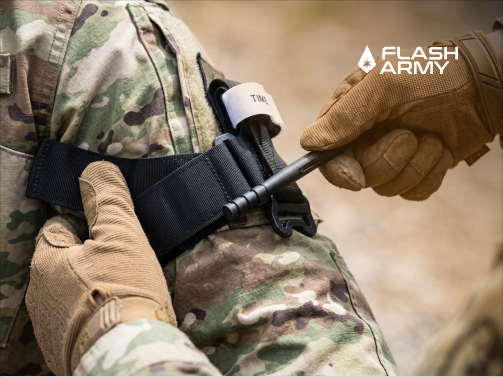
The tightening mechanism is another critical element. Most often, it's a windlass or a fixation system that allows for quick pressure increase and reliable retention. It's important that this mechanism works stably even in cold, wet conditions, or when hands are trembling from shock.
No less important is the quality of additional details – fasteners, hook-and-loop closures, and the time-recording field. In a critical moment, they eliminate unnecessary questions and simplify the work for the next stage of medical care.
Why it's important to use only proven models
In tactical medicine, experiments are too costly – they cost human lives. A low-quality tourniquet may look convincing but behave unpredictably under stress. A torn strap or a displaced fastener in a real situation means a loss of time and blood. Proven models undergo tests that simulate real conditions. They are tested for strength, pressure stability, wear resistance, and performance in extreme environments. This is not a formality, but a way to weed out solutions that do not stand up to practice. Such tourniquets are certified, confirming their quality and reliability. It is equally important to pay attention to the originality of the product, as cheaper fakes that are significantly inferior in quality to the original may also be found on the market.
Training should also be considered separately. Most instructors teach how to work with specific certified models. Using a different tourniquet can lead to confusion or errors at a critical moment.
What to look for when choosing
Reliability
Reliability is the first thing that should matter. A tourniquet must withstand strong tightening without deformation. Materials should not lose their properties after prolonged storage or temperature fluctuations.
Attention should be paid to small details. The quality of seams, the density of the strap, and the strength of plastic or metal elements often determine the outcome. In certified tourniquets, these aspects are considered during the development stage.
Recommendations
Recommendations from professional communities are a reliable guide. Tourniquets used by military medics and paramedics are selected in real-world conditions, not in laboratories.
It also matters whether the model is included in international protocols and training programs. This means that it doesn't just exist on the market, but is actually applied.
Authenticity
Counterfeits are a serious problem. They often copy the appearance of well-known models but are inferior in materials and manufacturing quality. The difference only becomes apparent under stress.
An original tourniquet has markings, a clear origin, and official supply channels. It is advisable to buy medical tourniquets from trusted sellers, among whom Flash Army holds a special place due to its work with official manufacturers.
Certified models
International CoTCCC Certificate
CoTCCC is an organization that sets standards for tactical medicine in combat conditions. Its recommendations are based not on theory, but on practical application in real conflicts.
Models approved by CoTCCC have proven their ability to effectively stop bleeding and maintain functionality in challenging conditions. For many units, this is a basic guideline when equipping first-aid kits.
List of the most popular models:
- CAT Gen 7 - a classic windlass tourniquet that holds pressure well and has long been a standard for military personnel and medics.
- SAM XT - a model with automatic tension control.
- SOF TT - a durable tourniquet with a metal windlass, designed for intensive use and stable performance.
- SOF TTW - a wider version of the SOF TT, which distributes pressure more evenly and is suitable for prolonged hemorrhage control.
- TMT - a compact tourniquet with a minimalist design.
These tourniquets differ in design details but are united by one thing – the trust of practitioners. The website offers a wide selection of models, including SOF-T Gen 5, CAT Gen 7, various Sich tourniquets, and other reliable solutions.
Which Ukrainian tourniquets can be trusted
Ukrainian manufacturers have gradually carved out their own niche. Sich tourniquets are created with real-world experience and constant feedback in mind.
They are valued for their adaptation to local conditions, accessibility, and consistent quality. In many cases, they are used alongside international models without loss of effectiveness.
Conclusion
Understanding how to choose a tourniquet comes down not to brands and names, but to safety. A medical tourniquet is a tool that must work predictably in the most dangerous circumstances.
Certified tourniquets provide consistent results and comply with modern pre-hospital care protocols. Choosing a proven model reduces risks and simplifies actions in a critical situation. When it comes to life, it's better to have a solution at hand that has already proven its effectiveness. In this category of tactical medicine tools, economy or random choice have no justification.