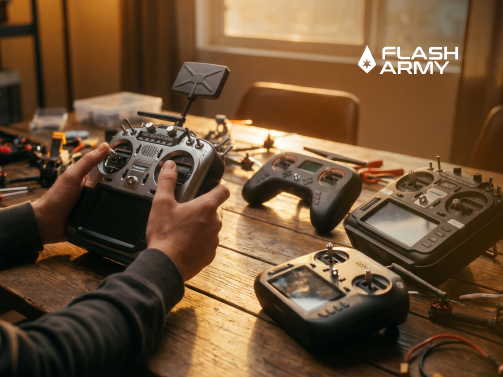
Often, FPV drone piloting training begins not with the drone itself, but with the remote control. It can be easily connected to a computer as a game controller for simulator practice. Some underestimate this stage, but such preparation builds muscle memory and helps you feel more confident with the remote in your hands.
Training is followed by real-world practice, which proves that the remote is the central link of the entire system, on which the mission's outcome depends. It connects the operator to the drone, so quality control equipment is undoubtedly an important component of an FPV system.
Let's figure out which FPV remote to choose for maximum convenience and efficiency.
What is an FPV Remote and How Does It Work?
An FPV remote is a device through which the operator transmits commands to the drone's onboard system. It controls the main flight parameters: altitude, speed, direction of movement, tilt, etc.
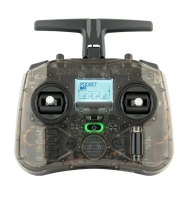
An FPV remote consists of sticks, switches, buttons, an antenna, a screen, and a radio transmitter. Stick movements are converted into digital signals, which are transmitted to a receiver installed on the drone. After this, the flight controller processes the commands and manages the motors, ensuring the necessary movements are executed.
Main Types of FPV Drone Remotes
Control remotes are classified by several parameters.
- By form factor:
- Gamepad-style — compact devices resembling game console joysticks. They are convenient for transport and ideal for FPV simulators;
- Classic (full-size) — ergonomic models with a larger body that fit comfortably in the hands.
- By communication protocols:
- With ExpressLRS (ELRS) — a standard that provides high response speed, minimal latency, and long signal range. Operates on 2.4 GHz or 868 MHz frequencies;
- With TBS Crossfire — a reliable 868 MHz protocol;
- Multi-protocol — features a universal built-in transmitter, allowing control of various drone types.
- By modularity:
- With built-in transmitter (most modern ELRS remotes);
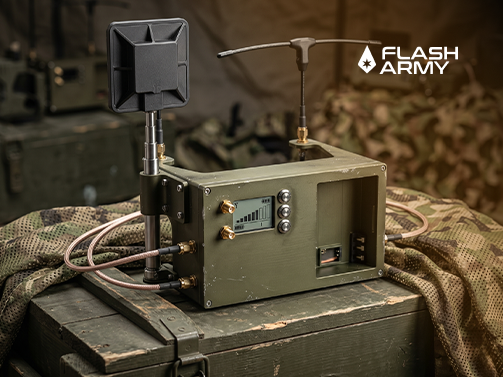
- With a JR module slot — allows connecting powerful external modules.
- By video transmission capability:
- Without a screen (image is transmitted to goggles);
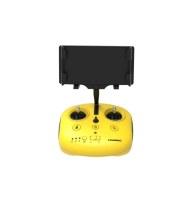
- With a screen / smartphone mounting capability (telemetry or image is displayed directly on the remote's screen).
Key Characteristics When Choosing Equipment
Choosing a drone remote is actually quite simple. You just need to consider the following parameters:
- Purpose of use;
- Communication protocol;
- Operating frequency;
- Maximum power (affects signal range and stability);
- Body ergonomics and stick quality;
- Number of channels;
- Battery capacity;
- Telemetry support;
- Module compatibility.
Popular Technologies in Modern FPV Remotes
Modern FPV remotes are often equipped with "smart" technologies. This significantly increases task efficiency, simplifies use, and makes it more convenient. Such technologies include:
- Low-latency communication protocols (ExpressLRS / ELRS).
- Hall Effect sensors. In many remotes, traditional potentiometers are replaced with magnetic ones, which provide higher stick positioning accuracy and do not wear out.
- Open-source firmware (EdgeTX / FreedomTX). Allows flexible configuration of buttons, switches, mixers, and customization of the equipment.
- Ability to save user profiles to an SD card.
- Telemetry support. Data on drone battery level, signal quality, coordinates, speed, altitude, and other flight parameters can be transmitted to the display or software interface.
- Wireless connectivity (Bluetooth / Wi-Fi) — for convenient connection to smartphones, tablets, or PCs.
How to Choose an FPV Remote for Your Skill Level and Tasks
Different types of remotes suit users with varying levels of experience. For example, beginners choose simple models with a basic set of functions.
For experienced users, additional customization options, telemetry support, a greater number of control channels, and software flexibility become important.
For professional use, models with advanced programming capabilities, support for interchangeable radio modules, and maximum stable communication are usually chosen.
Additionally, when choosing, we recommend considering the type of drone you will be working with.
- FPV Drones for Training.
For beginners, it's important to be able to connect the equipment to simulators.
- FPV Kamikaze Attack Drones.
In challenging conditions, a stable signal directly affects drone controllability. Therefore, it's worth paying attention to options with modern communication protocols. Among the most popular solutions are Crossfire and ELRS in the 868 MHz band.
- Reconnaissance Drones.
Here, low latency and uninterrupted video telemetry reception are paramount. For such tasks, ELRS 2.4 GHz systems are typically used.
Tips for Setting Up and Safely Using Equipment
- Before launch, ensure all control channels are working correctly, and sticks and switches respond to commands.
- Update the software regularly. Manufacturers frequently release new firmware versions that improve stability, fix bugs, and add new features. It is advisable to back up your settings before updating.
- Configure FailSafe – the drone's action algorithm in case of loss of control signal.
- Store batteries in special fireproof bags (LiPo Safe Bag) away from flammable objects.
- Do not turn on the remote control without an antenna installed, otherwise the output radio frequency amplifier may burn out.
Conclusion
Therefore, we advise you to carefully choose an FPV remote control, as it must provide effective and, most importantly, convenient control for the operator. You can buy FPV drone remote controls, as well as other UAV parts, in the Flash Army online store.