Choosing Drone Propellers: Main Types and Recommendations
At first glance, a propeller might seem like the simplest and least demanding drone component. It's structurally simple, inexpensive, made from readily available materials, and requires no electronics. So, what could go wrong when choosing such plastic "wings"?
The stability of flight, drone reaction speed, level of control, and overall system efficiency directly depend on correctly selected propellers. These small drone blades create the thrust needed for lift, maneuvering, and keeping the aircraft airborne. Therefore, their role in the drone's design should not be underestimated.
What are drone propellers and how do they work
Drone propellers are rotating, aerodynamically shaped blades attached to the motor shaft. They convert the rotational motion of the motors into an airflow that generates lift.
The principle of propeller operation is quite simple and based on changing air pressure. As the blades rotate, they push air downwards, and in response, a force is generated that lifts the drone upwards. Changing the rotation speed of individual propellers allows the drone to move forward, backward, sideways, hover, or perform maneuvers.
Main types of propellers
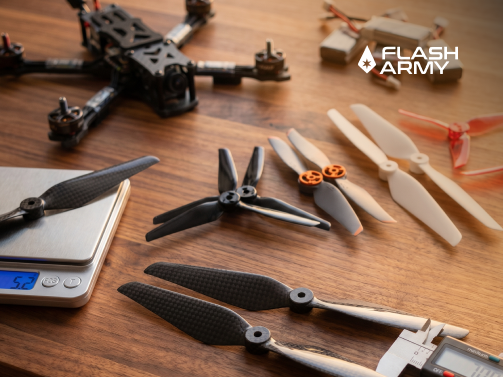
The basic parameter by which propellers differ is the number of blades. Accordingly, they come in:
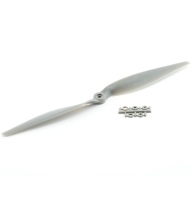
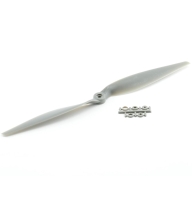
- Two-blade. The most common type. They have the highest aerodynamic efficiency because the second blade is less affected by the turbulent wake of the first. Such models provide high speed and energy efficiency but have less thrust.
- Three-blade. The golden mean for most FPV drones. They have a larger contact area with the air, thus creating higher thrust and smoother operation.
- Four- and five-blade. Used primarily in drones for professional photography. They provide maximum thrust but heavily drain the battery.
Propeller selection criteria
When choosing propellers for FPV drones, we recommend paying attention to the diameter, motor compatibility, pitch, and the material they are made from.
- Diameter. A large diameter means thrust and stability, while a small diameter means speed and responsiveness. It's important to match the diameter to the physical dimensions of the drone's frame. Thus, the blades of adjacent motors should not overlap or touch the body.
- Motor compatibility. The higher the KV rating (RPM per volt), the smaller the propeller diameter needed. If you put a large propeller on a high-speed motor, you can say goodbye to the motor.
- Propeller pitch. In short, this is the distance the propeller travels in one revolution.
- Low pitch (up to 4.0) provides a smooth start and excellent control at low speeds. Suitable for cargo and long flights.
- High pitch (4.5 and above) means quick response and sharp acceleration. However, it creates a huge load and drains the battery faster.
- Material. Propellers are usually made of plastic, nylon, and carbon.
- Polycarbonate (i.e., plastic) is ideal for training because it is very flexible. In case of a collision, it can simply be straightened and flown again.
- Nylon with fiberglass is stiffer and does not bend from the airflow under the weight of ammunition. Therefore, such options are used in combat FPVs.
- Carbon propellers are maximally lightweight, do not bend, and have high efficiency. They are mainly used for large quadcopters. Their main disadvantage is fragility.
Tips for installation and operation
The main rule for installation: always check the markings on the blades before fixing them. They must match the direction of rotation. CW and CCW propellers should only be installed on the corresponding motors, otherwise the drone will not be able to take off.
In addition, during installation, it is important to:
- securely fix the propellers without overtightening;
- check for any play;
- use compatible mounts and adapters;
- monitor the cleanliness of the installation area.
For propellers to work as efficiently and long as possible, we recommend paying attention to:
- the condition of the material before each flight;
- flight conditions and temperature;
- battery load.
Common mistakes when choosing and using propellers
When choosing and using propellers, users often make mistakes that can negatively affect motor life and overall drone efficiency. Incorrectly selected or damaged propellers can cause motor overload and impaired control.
Common mistakes also include:
- choosing propellers based solely on thrust or speed without considering the overall drone and motor configuration;
- insufficient fastening of mounts;
- ignoring balancing;
- using low-quality or incompatible adapters.
Sometimes users continue to operate after impacts, even if the damage appears minor. However, micro-cracks and distortions can cause strong vibrations.
Conclusion
We see that propellers are not just auxiliary structural elements of a drone, but important components on which flight stability, control, speed, and overall system efficiency depend. That is why it is necessary to approach the choice of "wings" for FPV responsibly, taking into account all technical characteristics.
You can buy drone propellers in the Flash Army online store. The catalog offers models with different numbers of blades and made from various materials, suitable for any task.