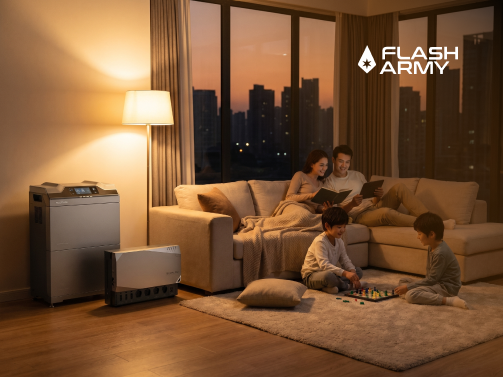
Today, backup power has become as commonplace as a water filter or a first-aid kit at home. Power outages force us to think not about comfort, but about basic things: communication, lighting, and the operation of household appliances. That is why a backup power system has become a necessity, not an additional option.
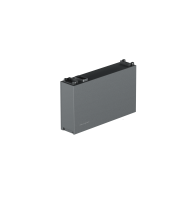
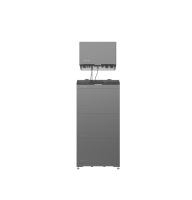
A typical backup power system consists of several components: a battery, an inverter, and protective electronics. The inverter generates a stable 220V voltage, the battery stores energy, and the controller monitors safe charging and discharging. Together, they work as a small power plant within a single apartment.
Today, even a simple home inverter can provide backup power for an apartment for several hours, and more powerful systems can keep appliances running even longer. And if previously this was equipment for enthusiasts, now such solutions are available to everyone. In the Flash Army catalog, you can find ready-made kits for various scenarios and budgets, as well as separate power independence systems and additional batteries.
Main System Components
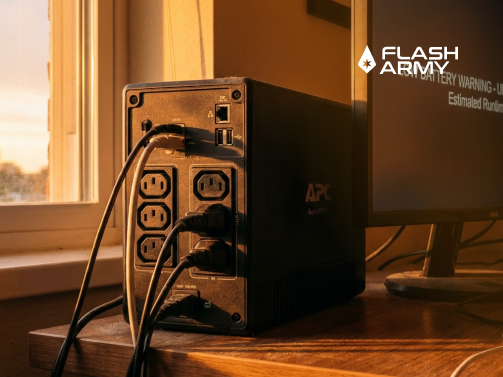
For backup power to work stably, it is important to understand the role of each element. At the heart of any kit is an inverter. It converts battery energy into the familiar 220V that powers our appliances. A home inverter can be simple or come with surge protection and built-in automation.
The second element is the battery. The number of hours the apartment's backup power will last depends on its capacity. Capacity is measured in ampere-hours, and here a simple logic applies: the more, the longer. But it is also important to consider the battery type - AGM, GEL, or LiFePO4.
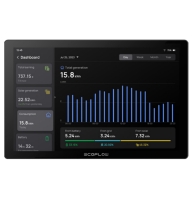
The third component is protective automation. It controls charging, cooling, overload, and switching between the grid and the battery. Without it, the backup power system can operate unstably or even dangerously. Automation increases reliability and extends the service life of all elements.
How to Choose a System for an Apartment
When choosing a backup power source for an apartment, it's worth starting with something simple - what exactly needs to work during outages. For some, it's just a router, lamps, and a laptop, while for others, it's also a refrigerator and small appliances. The power of the inverter and the capacity of the battery depend on the set of consumers, so it's important to honestly assess your needs.
Powering a Router, Lighting, Laptop, Refrigerator
For minimal tasks, an inverter of 300-500 W is sufficient. If a refrigerator is added to the system, it is better to choose 1000-1500 W, as the compressor creates a short but high starting current. Such backup power will be more stable and withstand peak loads.
Possibility of Connecting a Boiler or Electric Stove
A boiler or electric stove is a special category. They can only be connected to powerful systems, otherwise, the inverter simply will not withstand the load. Here it is advisable to choose either a stationary complex or a hybrid solution with the possibility of expansion.
How to Choose the Right System
Proper selection begins with identifying your critical consumers. For some, it's a refrigerator, router, and boiler; for others, it's work equipment or minimal lighting. After compiling the list, you can proceed to calculations.
Identifying Critical Consumers
Simply make a list of appliances that must work even during a long outage. Each of them has a rated power - these are the figures you need to use to understand the total load on the system. The more accurate this list, the more correct the choice will be. Usually, these are a refrigerator, boiler, router, lighting, and laptop. After determining the list, you should calculate their total power and the average time they need to operate.
Calculating Power (W) and Battery Life
Battery life calculation is based on the formula: battery capacity (Wh) / consumption (W). For example, if devices consume 150 W and the battery has 1200 Wh, the system will work for about 8 hours. In reality, the time may be slightly less due to energy losses in the inverter.
Important criteria:
- Inverter power - must exceed the total load.
- Battery capacity - determines the duration of operation.
- Expandability - adds flexibility.
- Battery type - affects service life and weight.
Types of Backup Power Systems
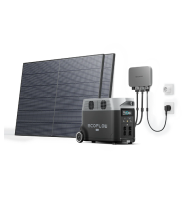
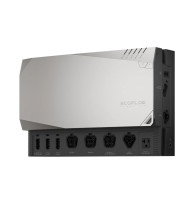
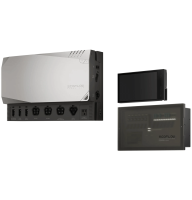
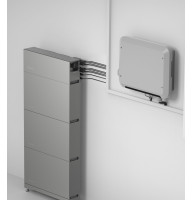
Types of backup power systems differ not only in power but also in how they behave during outages. Mobile stations are suitable for those who need something simple and fast, while stationary kits based on an inverter and a battery with additional batteries will provide longer autonomy and stable operation of appliances. There are also hybrid options that can be charged from solar panels and offer more freedom during long blackouts. When choosing the type of system, you should focus on your needs, available space, and desired level of energy independence.
Mobile Solutions: Portable Power Stations
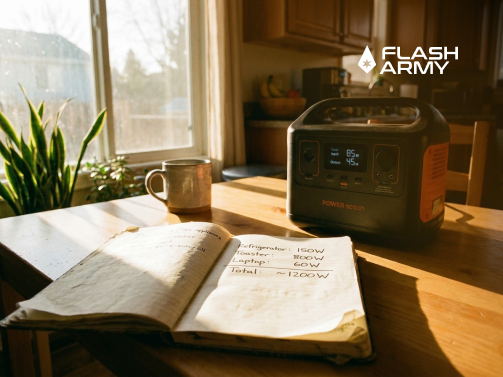
Portable stations are the simplest way to get backup power for an apartment without installation. They already have a built-in battery, inverter, and protection. Such stations are easy to carry, charge, and use in any room. Their advantage is mobility and simplicity.
These are more serious systems for those who want stable, long-term power. They can operate for hours or even days if the battery capacity is sufficient. Such a backup power system is suitable for cooling equipment, electronics, and even small heating appliances.
Hybrid solutions with solar panels
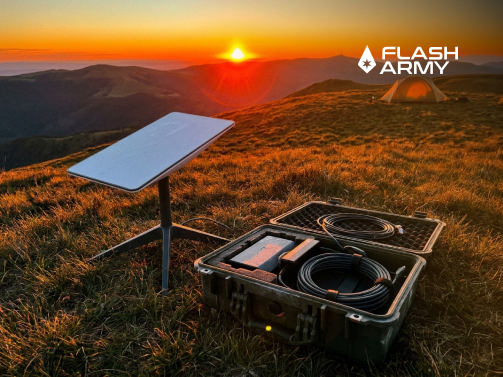
For those who want maximum autonomy, there are hybrid systems with the ability to recharge from the sun. During long outages, they become particularly effective. Solar panels will not completely replace the grid but significantly extend the system's operation.
Conclusion
Backup power during outages is a necessary element of a modern apartment and business. A backup power system allows you to stay connected, keep equipment running, and maintain comfort. The choice depends on the budget, the number of critical devices, and available space. The recommendation is simple: choose a solution with a power reserve and only certified components. A reliably assembled system will serve for years and provide true energy independence, even when the grid "goes down" again.