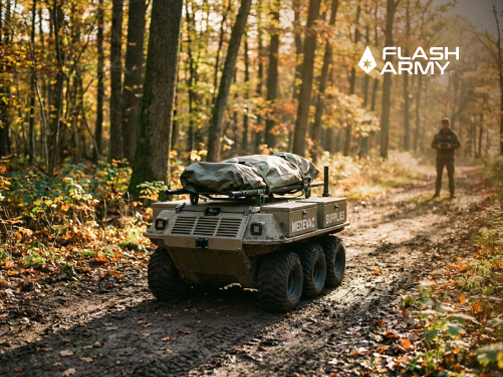
In professional military and security environments, the abbreviation UGV is being used increasingly often. From a technical standpoint, UGV stands for Unmanned Ground Vehicle, meaning an unmanned technical system designed to perform tasks on the ground without the direct involvement of an operator in a risk zone.
When the question arises of what a UGV is in practice, the answer goes beyond a single definition. It is a combination of a mobile platform, control systems, communication channels, sensors, and, when necessary, specialized payloads. Unmanned ground vehicles are developed with real combat conditions in mind: difficult terrain, unstable communications, weather influences, and the constant threat of destruction.
Today, UGVs are no longer viewed as an experimental technology but as a full-fledged element of the modern military ecosystem that increases unit effectiveness and reduces personnel losses.
Design Features
The design of a UGV directly determines its capabilities and area of application. During the development of such systems, engineers focus on balancing mobility, maneuverability, autonomy, and reliability. An important role is played by platform modularity and the ability to quickly adapt to specific tasks.
The key design element is the type of mobility system, as it determines the conditions in which the unmanned ground vehicle will be most effective.
Wheeled UGVs
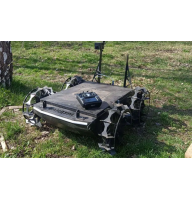
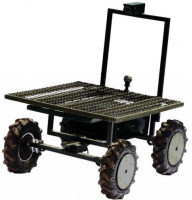
Wheeled UGVs are designed for rapid movement and stable operation on relatively even surfaces. They are ideally suited for urban environments, industrial areas, paved roads, and logistics routes.
The main advantages of wheeled platforms include higher movement speed, lower power consumption, and simplified maintenance. Such systems are easier to transport, provide longer autonomous operation, and respond more quickly to operator commands.
Wheeled unmanned ground vehicles are often used for cargo delivery, patrolling, reconnaissance, and support of units in rear and semi-frontline areas.
Tracked UGVs
Tracked UGVs are designed for operation in difficult conditions where mobility is critically important. Off-road terrain, rough landscapes, sand, snow, mud, or damaged infrastructure are the scenarios in which tracked platforms demonstrate maximum effectiveness.
The tracked chassis provides better stability, more even weight distribution, and the ability to transport heavy equipment. Such systems are commonly used for evacuation, engineering operations, demining, and missions in active combat zones.
Functions of Unmanned Ground Vehicles
The functionality of UGVs is much broader than it may seem at first glance. Modern unmanned ground vehicles are multi-purpose platforms capable of changing configuration depending on mission requirements.
Logistics
Logistics operations are one of the primary areas of UGV deployment. Delivering ammunition, food, water, medical supplies, and technical equipment to dangerous areas without involving personnel significantly reduces risks.
Unmanned ground vehicles make it possible to maintain a stable supply chain even under constant shelling or in difficult terrain. This increases unit endurance and allows personnel to focus on their primary combat missions.
Evacuation
Casualty evacuation is one of the most difficult and dangerous processes on the battlefield. Using UGVs in such scenarios minimizes risk for medical personnel and soldiers.
Robotic systems can transport casualties in semi-autonomous mode, overcoming difficult terrain while maintaining stability during movement. This is critically important for preserving life and health.
Mining and Demining
Engineering tasks related to mine deployment and mine clearance have traditionally been among the most hazardous. UGVs are an effective tool that allows such operations to be performed remotely.
Thanks to manipulators, optical systems, and specialized sensors, unmanned ground vehicles enable these tasks to be carried out with maximum precision and significantly faster than through traditional methods.
Reconnaissance and Combat Operations
The reconnaissance capabilities of UGVs are based on the use of optical systems, thermal imagers, acoustic sensors, and secure communication channels. These systems can operate both in passive observation mode and in active support of combat operations.
Unmanned ground vehicles provide units with real-time information, directly influencing the quality of tactical decision-making.
The Importance of Ground Drones in Modern Militaries
Ground drones are becoming an integral part of modern armed forces. They are changing the approach to operational planning by emphasizing personnel preservation and technological superiority.
The integration of UGVs increases unit flexibility, optimizes resources, and enables faster adaptation to changing battlefield conditions. This is a strategic investment in security and operational effectiveness.
Conclusion
In summary, it can be stated that UGVs are one of the key elements of modern armed forces. Understanding what a UGV is has become important not only for military professionals but also for those involved in shaping defense strategies.
Unmanned ground vehicles have already proven their effectiveness in real-world conditions. If the goal is to technologically strengthen a unit, it is worth considering the option of purchasing a UGV from a reliable supplier. Company FlashArmy operates in this field, offering solutions adapted to modern challenges.