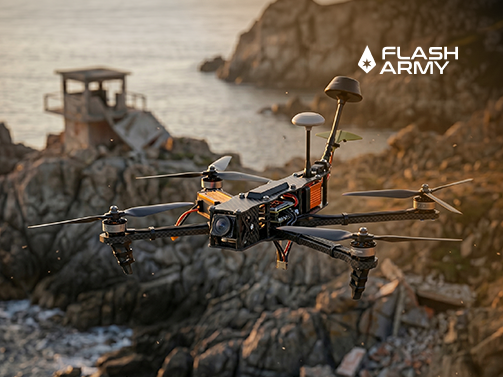
Unmanned aerial vehicles have significantly changed the rules of the modern battlefield. Thanks to their affordability and ability to perform tasks that previously required expensive aircraft or satellites, they have become one of the most influential tools for reconnaissance, artillery fire adjustment, engaging enemy equipment and personnel, logistics, and more.
However, the rapid proliferation of drones has created a need to develop appropriate countermeasures. This has spurred the development of new UAV detection and neutralization systems, namely mobile EW systems. One of the most important solutions in this class is anti-drone rifles, which allow for effective counteraction against individual UAVs. Their compactness, mobility, simplicity, and speed of use have made them an important element of a multi-layered UAV defense system in modern conditions.
In this article, we will examine what an anti-drone rifle is, its operating principle, main types of anti-drone rifles, and the areas and advantages of their use. The Flash Army team developed this material for military personnel and frontline fighters, procurement and security specialists, as well as civilians interested in military technologies.
What is an Anti-Drone Rifle
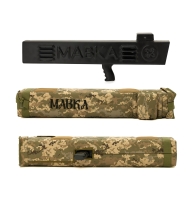
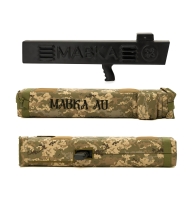
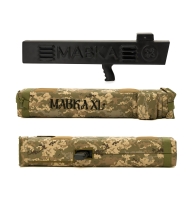
An anti-drone rifle is a mobile electronic warfare countermeasure in the form of a firearm, designed for the forced landing or neutralization of drones by suppressing their operating radio frequencies. Externally, they resemble a rifle, but when the trigger is pulled, they emit a directed electromagnetic signal rather than physical impact.
Most modern rifles consist of the following basic elements:
- High-frequency signal generator — a jamming module that creates interference in the required frequency bands.
- Directional antennas focus the jamming "beam" into a narrow sector, so the energy is not dispersed but directed precisely at the target. They are usually placed in a plastic casing that visually resembles a barrel.
- Battery and controls — removable or built-in batteries that provide autonomous operation, and buttons for selecting jamming frequency channels.
The main advantage of EW rifles is their mobility and pinpoint use: the operator only needs to aim the rifle at a specific threat, engage, and switch it off.
How Anti-Drone Rifles Work
The operating principle of anti-drone rifles is based on directed electronic suppression, i.e., disrupting the drone's communication and navigation systems. The rifle generates powerful interference at the UAV's operating frequencies, causing it to lose contact with the control panel and satellites, resulting in complete loss of control over the drone.
The process of neutralizing a drone with a rifle consists of several key stages:
- Jamming: After detecting the drone (visually or with a detector), the operator aims the rifle and presses the trigger button. The rifle begins to generate powerful radio noise on the UAV's operating frequencies, leading to the suppression of signals from the control panel or satellites. Typically, three types of signals are blocked: the control channel, the video and telemetry transmission channel, and the navigation channels.
- Directionality of action: The rifle's shape is due to directional antennas (Yagi or patch) inside the casing. A conventional trench EW jammer emits interference in all directions, reducing energy concentration and posing potential risks to friendly drones. An anti-drone rifle, however, focuses all its power into a narrow sector (a beam with an angle of approximately 15° to 30°), allowing it to engage enemy drones at a distance of several kilometers without affecting the radio-electronic environment in adjacent areas.
- Drone's reaction: After the frequency is jammed by the rifle, the drone's flight controller activates the Failsafe algorithm. It’s an instruction for loss of communication. Depending on the settings, the drone may perform one of the following actions:
-
Forced landing: if communication with both the remote control and GPS is interrupted, the drone may slowly descend vertically.
-
Hovering: if the drone has sufficient battery, it may simply hover at its current altitude, awaiting the return of communication. After the battery discharges, it will also land.
-
Return to launch point: if only the control channel is jammed, but not GPS, the drone may orient itself using satellites and return to its pilot.
-
In certain situations (for example, with FPV "kamikaze" drones or complete disorientation of the UAV), a hard crash with the threat of subsequent detonation is possible. In addition, the rifle's operation creates a radio-demasking effect for the operator. Therefore, when using the device, it is very important not to stand directly under the drone and to operate from cover whenever possible.
Main Types of Anti-Drone Rifles
Modern EW rifles can be classified by the following parameters:
-
Design (form factor)
-
Monoblocks combine antennas, jammer generators, and battery in a single housing. They provide maximum mobility and instant deployment but are fairly heavy (4–8 kg), which can cause arm fatigue during prolonged aiming.
-
Two-component (backpack) systems consist of a lightweight rifle with antennas and separate jamming boards, and a battery carried in a backpack. They are easy to operate and offer higher power and autonomy, but the connecting cable (feeder) can restrict movement, and deployment takes a little longer.
-
-
Purpose and Frequencies
-
Basic EW rifles are used for commercial UAVs (Mavic or Autel), have 3–4 jamming channels, and operate on standard control (2.4 GHz and 5.8 GHz) and navigation frequencies. Used for object protection in the rear and defense against spy drones.
-
Multi-band is a professional military solution, with 6 to 10+ channels and the ability to jam non-standard low bands (within 400–900 MHz), which are widely used by enemy FPV kamikaze drones and bomber drones.
-
There is also a hybrid type of anti-drone rifle that combines directional antennas (for precise long-range operation) with omnidirectional (collinear) antennas. Such a device can be used as a regular rifle, and in the event of an assault or a sudden attack from several sides, it can be switched to "dome" mode to provide circular protection for a position within a radius of several tens of meters.
Where Anti-Drone Rifles Are Used
The lightness and mobility of anti-drone rifles have made them indispensable in situations where deploying large, stationary EW systems is impossible or impractical. They are used in the following areas:
-
1.Military Sphere
-
Protection of trenches, positions, and assault groups: an operational way to ground or drive away a reconnaissance drone like a Mavic hovering over a dugout.
-
Cover for evacuation and logistics groups: local protection during the evacuation of wounded or delivery of ammunition to a group.
-
Onboard vehicle protection: repelling sudden drone attacks during missions by armored vehicle or pickup crews.
-
-
Civil Security
-
Protection of critical infrastructure: protection of power plants, oil depots, water utilities, and logistics hubs from saboteur drones.
-
Border and object security: control of airspace near borders, restricted areas, and objects with limited access.
-
Security of mass events and government facilities: escorting top government officials or patrolling the perimeter during important events to exclude the threat of terrorist attacks or unauthorized filming.
-
Advantages and Limitations of Using Anti-Drone Rifles
Anti-drone rifles, like any technology, have their strengths and weaknesses. Their advantages include targeted impact (jamming only enemy targets, without disrupting the operation of friendly drones and communications), mobility, autonomy, quick readiness for combat, and ease of use.
Limitations of use include operation only within the line of sight (radio waves require a direct line between the antenna and the target), physical fatigue of the operator due to the need to constantly hold the rifle and visually track the target until it lands completely, and the radio beacon effect (when jamming, the device creates a powerful digital "trace" in the air).
Conclusion
Anti-drone rifles are not a universal means of countering all aerial threats, but in their class, they remain one of the most effective tools for mobile, precise, and operational defense. They allow protecting people and objects directly here and now, in situations where trench EW and heavy air defense cannot be used. You can buy EW rifles and get help choosing specifications at the Flash Army store.