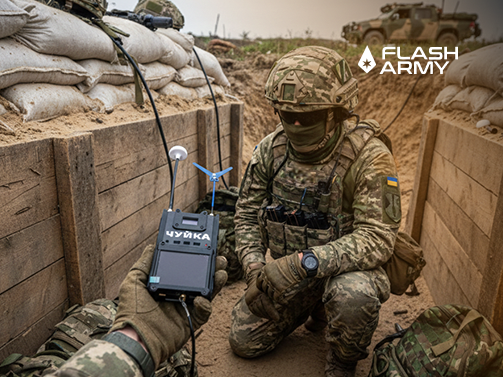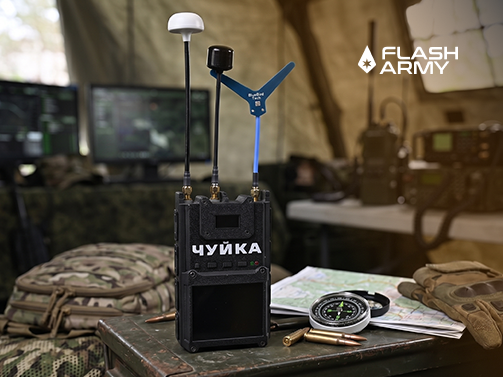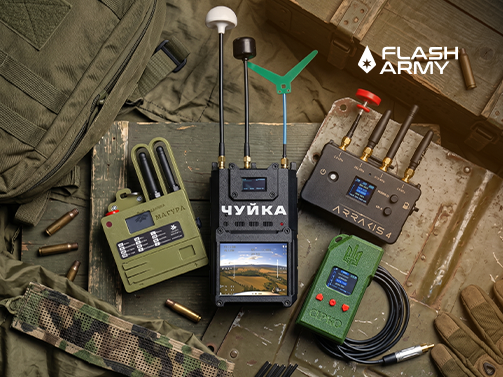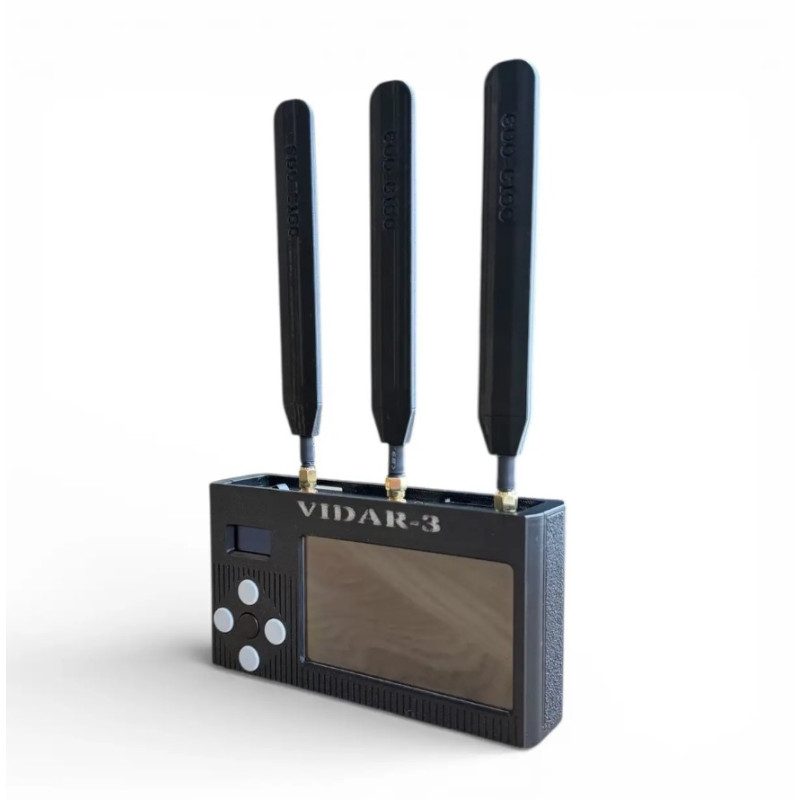
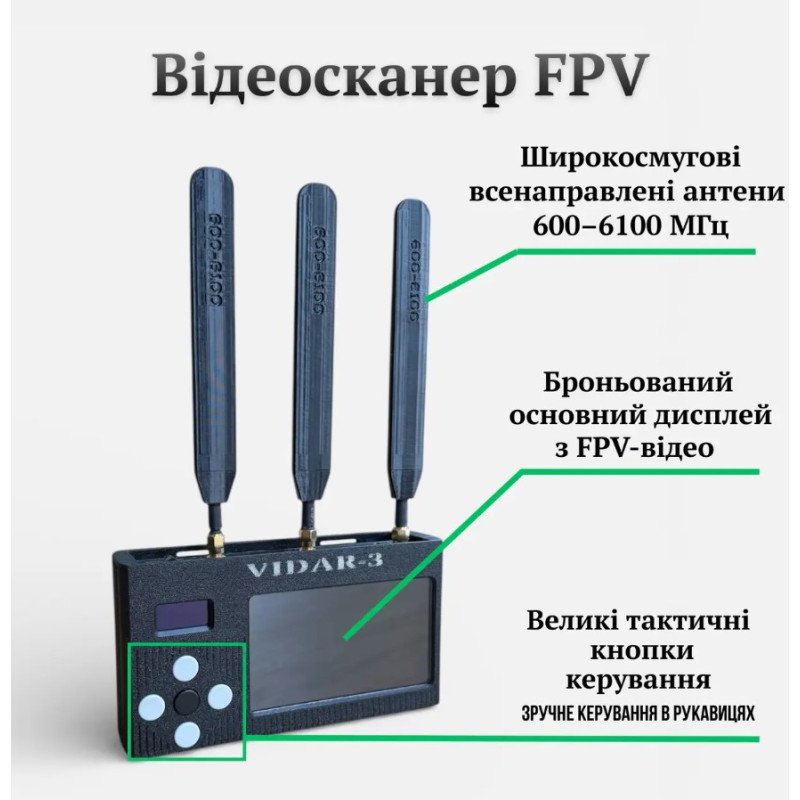
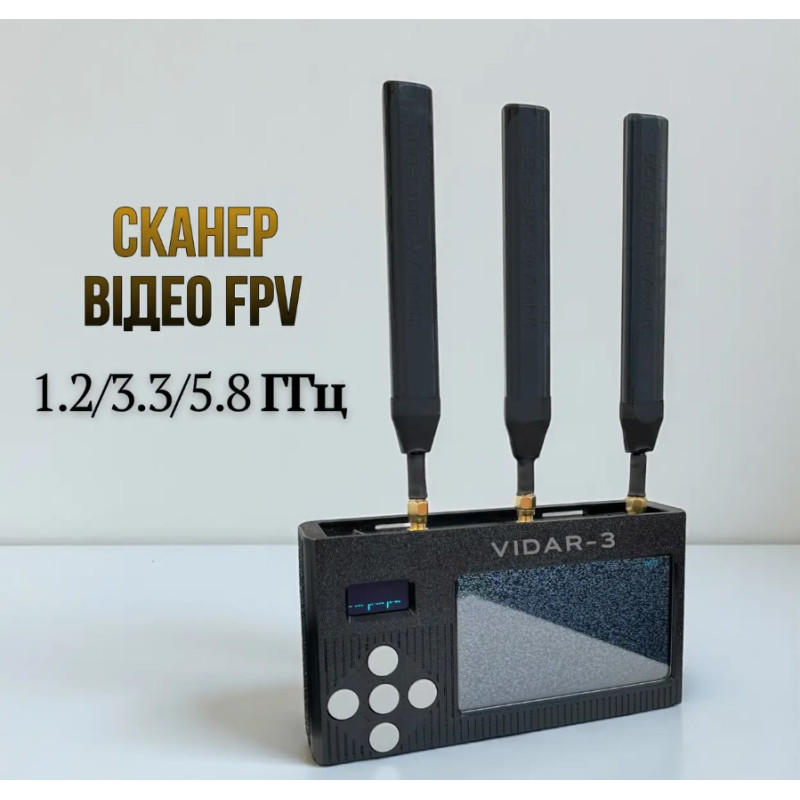
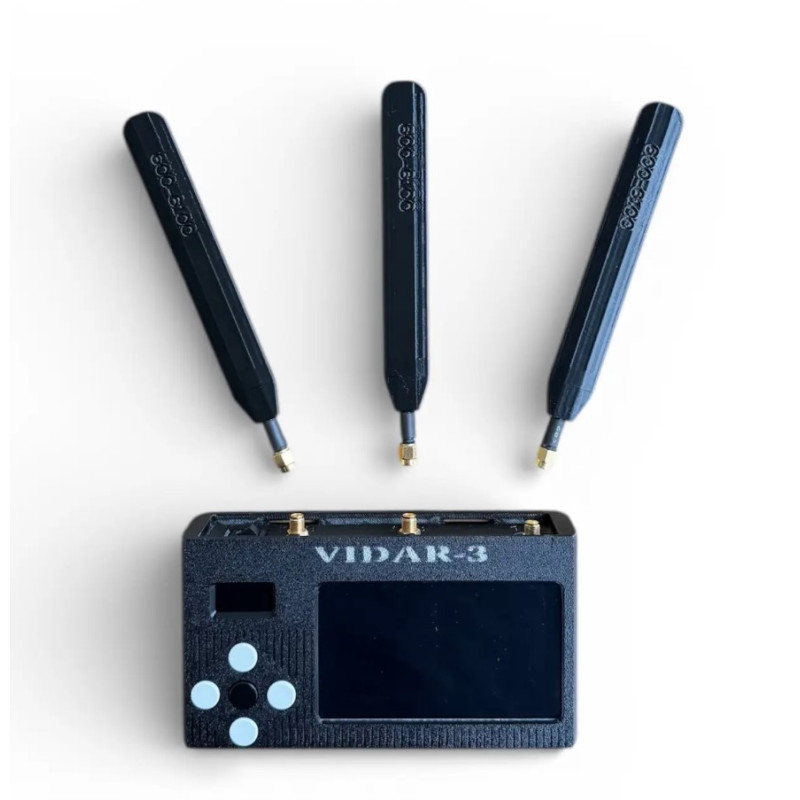
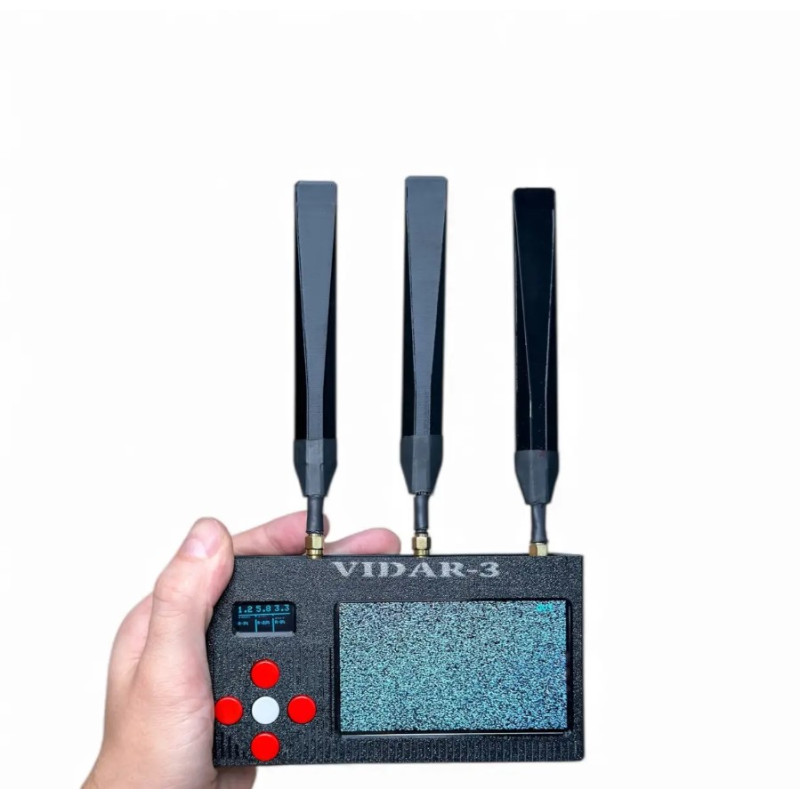
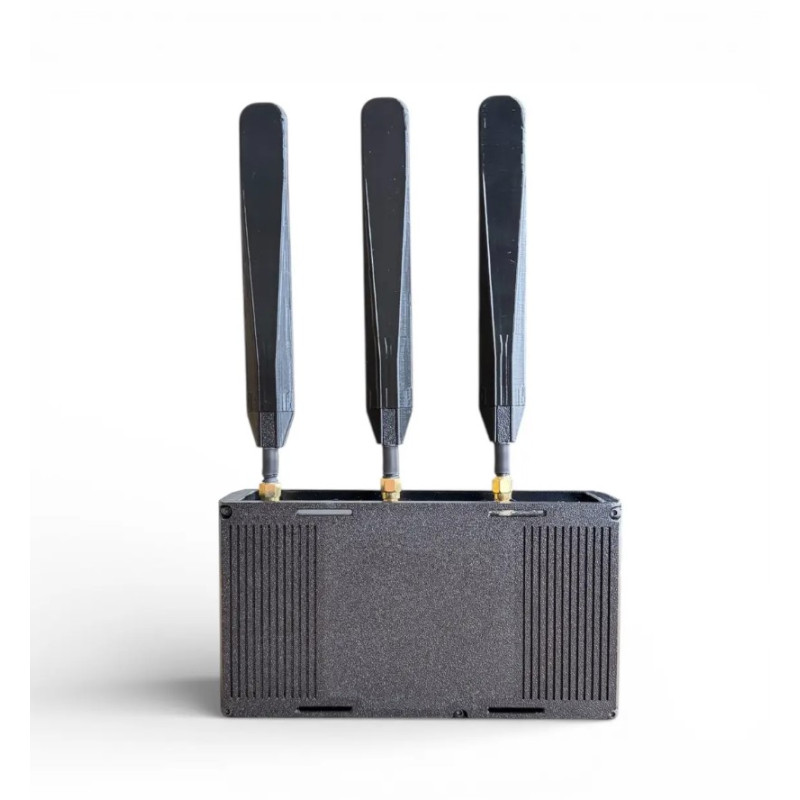
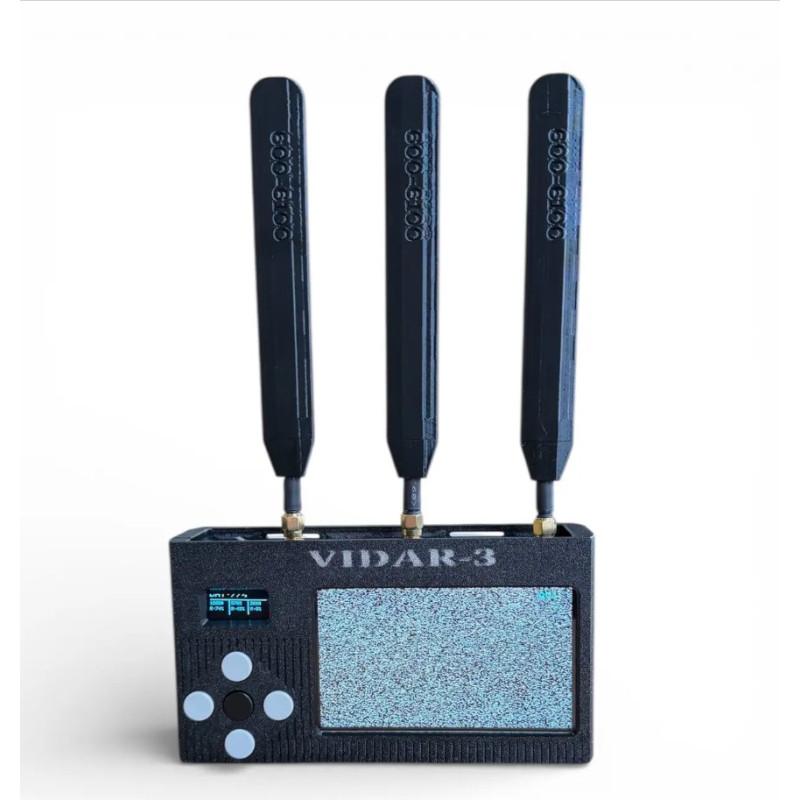

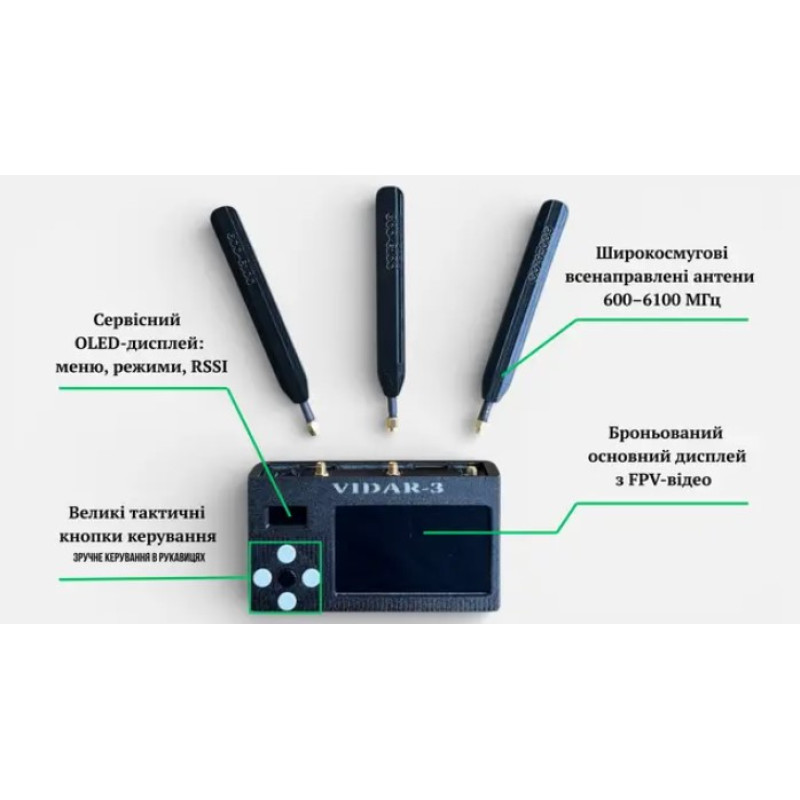






VIDAR-3 – a portable triple-band UAV video detector that scans analog FPV signals in the 1.2, 3.3, and 5.8 GHz bands and displays the same video seen by the drone operator. VIDAR-3 was created taking into account real combat experience and feedback from military personnel. That is why it received armored glass to protect the main display from fragments, large tactile buttons for operation with tactical gloves, well-designed wideband omnidirectional antennas (600–6100 MHz, 360°) for reliable reception, and signal strength indication (RSSI) so that the operator sees not only the picture but also the strength of the FPV threat.
Key advantages
-
Full-fledged wideband 3 combat bands
Receiver operating frequency bands:
– 820–2100 MHz (1.2–1.3 GHz)
– 2730–4050 MHz (3.3 GHz)
– 4830–6030 MHz (5.8 GHz)
These are the main frequencies on which video is transmitted by most FPV drones. -
Protected large screen
The main video monitor is covered with armored glass + protective film. The screen better withstands impacts, scratches, and small fragments. The device is slightly heavier but truly suitable for front-line work. -
Standard VIDAR-3 antennas (600–6100 MHz, 360°)
Wideband omnidirectional antennas of our own production with increased polarization tolerance: they stably receive signals in a circle (360°) and cover the operating range of 600–6100 MHz, and are designed specifically for the architecture of this detector to "not miss" channels.
The antennas are designed to fully cover the receiver's operating bands (and actually work "with a margin" within these ranges). In practice, this provides more stable reception on different channels/frequencies, less "pickiness" regarding the exact position/rotation of the antenna, and better repeatability of results in a real environment (reflections/multipath in a forest, built-up area, dugout, car).
Of course, standard Chinese narrowband FPV antennas ("barrels/pagoda", "dovetail") provide greater range, but usually only in their narrow sub-band and with greater dependence on polarization and orientation. Therefore, the standard VIDAR-3 antennas are the optimal basic kit for reliable detection in all 3 bands; for the task of "maximum range at a specific frequency," other antennas can be selected separately for the scenario. -
Convenient control with gloves
Large tactical buttons are positioned so that they can be operated with tactical gloves, almost by touch – without "fumbling" for small keys. -
RSSI control and sensitivity adjustment
VIDAR-3 displays the RSSI signal level for each band. The sensitivity threshold can be adjusted:-
to filter out weak and background signals;
-
to reduce false triggers from friendly FPV/noise;
-
to orient by signal strength – whether the drone is approaching or moving away (by changing the antenna position and observing where the signal is strongest).
-
-
Auto-scan and manual mode
The device automatically scans three bands, showing frequency, RSSI, and FPV indication. There is a manual mode with precise frequency tuning, the ability to skip harmonics and friendly signals. -
Audio and visual indication
BUZZER ON/OFF audio mode, video monitor operating modes (AUTO / ON / OFF), and three brightness levels help adapt the device for night/day and save battery.
Main characteristics
Reception range: optimally up to 5 km; actual distance may be greater or lesser depending on terrain, transmitter power, and radio interference levels.
-
Receiver frequency bands: 820–2100 / 2730–4050 / 4830–6030 MHz
-
Signal type: analog FPV video signals
-
Screens: information display + main video monitor
-
Battery: built-in 10,000 mAh
-
Operating time: up to 6 hours
-
Charging: USB-C
-
Housing: heat-resistant ABS plastic
-
Package contents: VIDAR-3 scanner, antennas for all bands
Important: VIDAR-3 does not guarantee 100% UAV detection – it is used as an additional source of information in conjunction with other surveillance and EW equipment.
Other products in this category here Drone Detector
There are no reviews for this product, be the first to leave your review.