Exoskeleton technologies have come a long way from a science fiction idea in movies and computer games to real engineering systems integrated into modern military logistics. The active development of exoskeletons began at the end of the 20th century. Back then, they were considered exclusively as a means for medical rehabilitation, but their ability to significantly increase human endurance, strength, and mobility quickly attracted the interest of the military.
Today, exoskeletons are widely used in military logistics and support, where people are forced to carry a huge number of heavy shells, load missile systems, service heavy armored vehicles, or undertake complex long marches with heavy loads. The use of exoskeletons significantly reduces the load on the musculoskeletal system, ensures a stable work pace, and minimizes the risk of injuries.
In this article, we will examine what exoskeletons are, what types of exoskeletons are used in military affairs, how exactly they can help a person on the battlefield, and what prospects for their implementation exist today. The material was developed by the Flash Army team for military artillerymen, logisticians, medics, analysts interested in the technological modernization of armies, as well as for technology enthusiasts and engineers.
What is an exoskeleton and how does it work
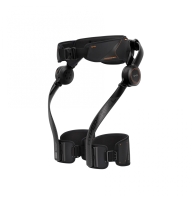
An exoskeleton is an external frame or structure worn on the body that mimics its biomechanics, enhances human physical capabilities and endurance, and, in medicine, restores lost functions of the musculoskeletal system. It is a kind of set of mechanical additional external bones and muscles that take on part of the load, allowing a person to carry more, run further, and tire less.
The main principle of exoskeleton operation is based on redistributing the load vector. That is, when a person lifts a weight, it does not press on the spine, intervertebral discs, pelvis, and knee joints, but is redistributed onto the exoskeleton frame, which is attached to the body and rests directly on the ground. The person inside this frame only performs the function of an operator, and the weight goes into the ground.
Typically, exoskeletons consist of the following key components:
- The load-bearing matrix is a lightweight yet very strong frame made of aircraft-grade aluminum or carbon fiber.
- Articulation nodes are hinges that are placed precisely opposite the anatomical joints of a person and are designed to fully replicate movements without restricting them.
- Power system. This is what makes the structure help the person. Depending on the type of exoskeleton, it can consist of springs, leaf springs, and shock absorbers, or electric servomotors, hydraulic cylinders, or pneumatics.
Active (motorized) models also include a control system and sensors, consisting of accelerometers and gyroscopes that determine the angle of inclination and movement speed, as well as strain gauges that measure the pressure force exerted by the foot or hand on the structure.
Main types of exoskeletons in the military sphere
Military engineering classifies different types of exoskeletons according to criteria such as power type (method of energy generation), localization (which part of the body it enhances), and construction type (rigid or soft). Let's consider the varieties of military exoskeletons in more detail:
- Power type and operating principle
-
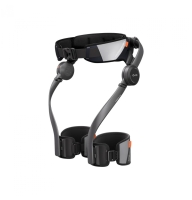
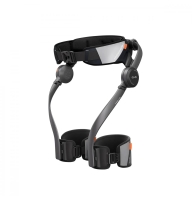
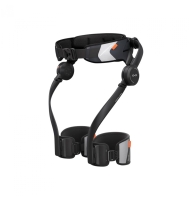
Passive exoskeletons (mechanical) use leverage and mechanical elements to redistribute the load: springs, torsion bars (elastic shafts), and hydraulic shock absorbers. Energy is accumulated when a person bends limbs or leans, and released during straightening. They are lightweight, do not require power, are reliable, and easy to use. Most often, passive exoskeletons are used for foot marches, long patrols, assault operations, and artillery crew work.
-
Active exoskeletons (motorized) are robotic systems equipped with electric motors and hydraulic or pneumatic drives, which require additional power. A computer reads motor commands to perform human micro-movements and muscle work. They are quite heavy, have a complex structure, are sensitive to dirt and moisture, and require constant maintenance, but significantly increase human carrying capacity and endurance. They are used for heavy logistics (carrying aerial bombs or air defense missiles), engineering work, and transporting heavy equipment.
-
- Localization
-
The lower suspension (legs, pelvic girdle, and lower back) is a structure fixed at the waist, hips, and shins. It rests on the sole of the shoe. They help during long walks and marches with heavy loads (40 kg or more), significantly reducing the load on the knees and spine. This type is the most common in most modern military logistics programs.
-
Full-body (universal) exoskeletons combine upper and lower suspension into a single synchronized system. They provide comprehensive support for the arms, legs, and back. They are designed for tasks with the highest load and maximum performance requirements. Full-body exoskeletons are only active because coordinating the mechanics of the entire body without servomotors and a computer is almost impossible. These models are the least common due to their very high cost, weight, and technical complexity of implementation. Most such projects are still only used in a test format.
-
- Construction Type
-
Rigid exoskeletons have a strong frame structure (skeleton) made of titanium, aluminum, or carbon, mimic human anatomy, and transfer loads through mechanical elements. They are capable of carrying extremely heavy loads (70–100 kg), synchronize more easily with human movements, allow for the attachment of additional modules (protection, sensors, weapons), and can serve as additional armor. However, they also have certain disadvantages, such as greater own weight, limitation of natural flexibility, pressure of rigid elements on the skin, and the risk of injury to the person in case of malfunctions.
-
Soft exoskeletons are bandage systems made of durable tactical fabrics, elastic cables, and pneumatic muscles, resembling heavy-duty sportswear or a tight jumpsuit. Unlike rigid models, they have very little weight, do not restrict a soldier's movements at all, and can be worn under a standard uniform and used for general reinforcement and for reducing fatigue in specific muscle groups during long marches, patrols, and when carrying small loads. They are not capable of handling significant weight, unlike rigid options, and require precise calibration due to the flexibility of the materials.
-
Recently, the main trend has been the development of hybrid exoskeletons, which combine various structural features and functionalities: a soft textile base, rigid carbon or titanium inserts in areas of greatest load, and the presence of a smart drive that makes the system active. Hybrid models have small dimensions, allow working with significant loads without restricting movement, as is the case with classic rigid exoskeletons, and special drives are controlled by artificial intelligence.
How Exoskeletons Help Military Personnel in the Field
In combat conditions, exoskeletons are designed to take on a significant part of a soldier's load, maintaining their effectiveness during combat and logistical tasks. On the battlefield, they perform three main functions:
- Load Carrying: The weight of modern equipment ranges from 25–50 kg, or more if ammunition, communication devices, water, and food supplies are carried. An exoskeleton helps significantly reduce this load by transferring it to its own frame and transmitting it through support elements directly to the ground. This allows for an increase in payload by 15–25 kg (and, in the case of active systems, up to 50 kg), using the soldier as an autonomous transport vehicle where heavy equipment cannot reach, and reduces the number of carriers, leaving others in formation to provide cover.
- Fatigue Reduction: During long marches or hours-long stays in position, a person loses reaction speed, shooting accuracy, and the ability to make quick decisions. This is a very important factor that affects not only effectiveness but also soldiers' survival. Exoskeletons can significantly reduce fatigue by providing proper weight distribution and stabilizing joints in the desired position. They also effectively reduce the risk of chronic musculoskeletal diseases.
- Increased Endurance: The exoskeleton accumulates energy with each step (or adds impulse from servomotors) and "pushes" the soldier's leg forward. This allows the body to consume less oxygen and save 25–30% of energy. This allows for increased march distances and movement speed, maintaining physical combat readiness during long operations, and faster recovery after loads.
Advantages of Using Exoskeletons in the Army
Exoskeletons are becoming a promising element of military equipment due to several advantages:
- Endurance — the ability for a soldier to cover greater distances, work longer in difficult conditions, and recover faster after loads. During heavy forced marches, the soldier does not get exhausted and expends 30% less energy.
- Autonomous logistics — the ability to independently carry heavy shells and loads weighing 50–70 kg in conditions where it is impossible or impractical to use machinery.
- Preservation of human resources — prevention and minimization of compression injuries to the spine and joints, which are among the most frequent causes of non-combat personnel losses. In addition, only 1–2 people will be needed to evacuate a wounded person, reducing the time required to provide first aid.
- Accuracy and stability — preventing hand tremors from prolonged holding of heavy weapons, machine guns, and massive anti-drone rifles.
By reducing physical exertion and increasing endurance, the exoskeleton helps military personnel perform tasks more effectively, carry more equipment, get less tired, and maintain combat readiness longer.
Like any modern technology, exoskeletons have their own limitations and challenges. For example, active models face a critical power supply problem: lithium batteries last only a couple of hours of active operation. After discharge, the exoskeleton turns into a heavy cage that renders the soldier helpless. Servos, cables, and AI sensors are very vulnerable to dirt and moisture, which significantly complicates their use on the battlefield.
Electric motors and hydraulics of active systems create noise during operation, capable of unmasking a unit, and rigid frame elements prevent a soldier from quickly reacting to a threat: falling to the ground, rolling into cover, crawling prone, or squeezing into a narrow hatch of armored vehicles. Another problem is the rather high manufacturing cost, which limits mass supply.
Prospects for the Development of Military Exoskeletons
There are several main vectors for the development of exoskeletons where modern military engineering is moving. Among them is the full integration of AI, up to controlling brain impulses via interfaces, which will allow for reacting to human intentions faster than muscles can contract. Solving the power supply problem by switching to solid-state batteries, which can support system autonomy 3–5 times longer, is also relevant.
A real prospect is considered to be the replacement of heavy motors and gearboxes with artificial muscles (elastic polymers that contract and expand under the action of electric current), which will make exoskeletons lighter, quieter, and less restrictive of human movement. An active development is the integration of the exoskeleton with armor protection: a single complex will turn a soldier into a protected yet mobile, effective firing platform.
Conclusion
Military exoskeletons have come a long way from fantastic concepts to real technological assistants on the battlefield. Although active combat suits are still undergoing engineering refinements and laboratory improvements, they have already become real human helpers under extreme loads and have proven their ability to change the face of modern warfare, where endurance has become a symbol not only of effectiveness but also of survival.
Modern exoskeletons can be purchased at the Flash Army online store.