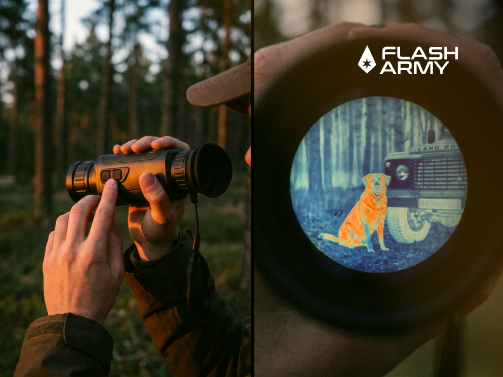
Night-vision devices (NVGs) emerged from a practical need during various operations in the dark. Humans have always been at a disadvantage in darkness, and NVGs became a way to compensate for this limitation. Initially, such devices were used exclusively in the military, but over time, technology became more accessible, and the scope of application significantly expanded.
Today, night-vision devices are used not only by the military. They are essential for security personnel, border guards, rescuers, hunters, and volunteers. Even in civilian life, NVGs can be useful for observation, navigation, or working in low-light conditions. This is why there is growing interest in how these devices work and how they differ from each other.
For the military, night-vision devices have a special value. They allow operations at night without revealing one's position, maintaining orientation, and controlling the situation. It is no coincidence that night-vision devices for military use have significantly higher requirements for reliability, lifespan, and operational stability. Reviewing the solutions offered by Flash Army makes it clear: NVGs are not a single class of devices, but an entire category with different approaches and features.
How NVGs Work
Many believe that NVGs "see in complete darkness." In reality, this is not entirely true. Night-vision devices do not create an image from scratch; they work with the light already present in the environment. They operate on a similar principle to the matrix of modern DSLR cameras—by reflecting the received light. Even at night without flashlights, there is faint light—from the moon, stars, or reflected infrared radiation. This light enters the device onto a photocathode, where it is converted into a stream of electrons. The electrons then pass through an amplification system, where their number is multiplied many times. After this, they hit a phosphor screen, which forms the visible image. It is because of this technology that classic NVGs have a green tint to the image—it is the least fatiguing for the eyes during prolonged use.
It is important to understand another point that is often confused. Night-vision devices are not thermal imagers. They do not see the heat of objects but only amplify light, helping to see objects around. Therefore, in conditions of complete darkness or indoors, infrared illumination is often used. Such solutions are widely used in modern night-vision devices, particularly in models oriented towards practical use during military operations.
Key Characteristics of NVGs
When it comes to choosing NVGs, many only look at the generation. But in practice, this is only part of the picture. The main characteristics directly affect how convenient and effective the device will be in real-world conditions.
One of the key parameters is resolution. It determines whether the user can distinguish fine details, object contours, and movement. In night-vision devices for military use, this is critical, as the clarity of the image affects the speed of decision-making, and often the life of the soldier. Equally important is light sensitivity—it determines how well the NVG performs in minimal lighting conditions.
It is also worth paying attention to the field of view. A wide field of view is more convenient for movement but sometimes reduces detail. Weight, balance, and control placement—all of this becomes important after several hours of use. That is why in professional solutions, ergonomics are often no less important than technical characteristics.
What to usually pay attention to:
- Image clarity and stability—for the ability to see details and movement in the dark.
- Light sensitivity—for operation in minimal lighting.
- Ease of use in real-world conditions.
NVG Generations: From Gen 1 to Digital
Dividing NVGs into generations helps to navigate the level of technology, but does not always give a complete picture.
- Gen 1—these are basic night-vision devices suitable for simple tasks. They require at least minimal illumination and have a limited range. Such models often show distortions at the edges of the image.
- Gen 2 was a significant step forward. The image became clearer, noise decreased, and range increased. It was from this generation that NVGs began to be actively used in the professional sphere. For many tasks, including security, Gen 2 remains an optimal option.
- Gen 3 and Gen 4—these are high-class devices. Such night-vision devices for military use can operate practically without illumination, have a long lifespan, and stable performance in difficult conditions.
Digital NVGs stand apart. They use a matrix and software processing, allow video recording, and can operate during the day, but in extremely dark conditions, they often fall short of classic analog solutions.
Types of Night-Vision Devices
In addition to generation, night-vision devices differ in format. The simplest options are monoculars. This is a compact device that is convenient to carry and use for observation. It does not take up much space and is suitable for short work sessions.
Night-vision binoculars provide a more comfortable image perception and better depth. They are suitable for prolonged observation but are less convenient for active movement. That is why they are more often used in stationary positions or for security.
Night-vision goggles are designed for movement. They can be mounted on a helmet, leaving hands free. This format is most often used as night-vision devices for military personnel. Separately, it is worth mentioning night-vision sights, which integrate with weapons and allow operation in the dark without using visible light. Such formats are widely represented among modern night-vision devices.
Conclusion
Night-vision devices are not a universal tool for every occasion, but a means for specific tasks. Their effectiveness depends not only on the generation but also on characteristics, format, and conditions of use. Understanding the principle of operation helps to avoid inflated expectations and make an informed choice.
For military, security, or special tasks, it is important that NVGs are reliable and predictable. That is why night-vision devices for military use differ significantly from civilian models. If you approach the choice calmly and with understanding, the wide selection of models presented on the Flash Army website allows you to choose night-vision devices that truly work in real conditions, and are not just well-described in product specifications.