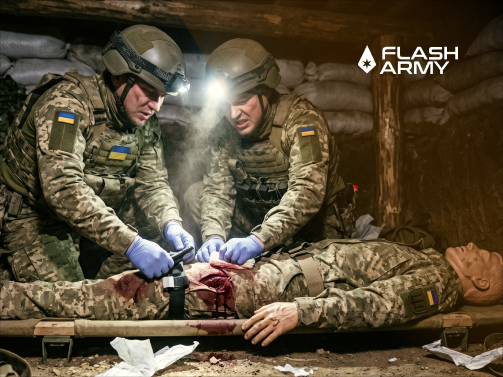
Many automotive, tourist, or tactical first-aid kits contain a thermal blanket, but in practice, not everyone understands what it's for or how to use it correctly. It's often perceived as an additional accessory that "just needs to be there," without a clear understanding of its functions. Because of this, in a critical situation, a thermal blanket is either not used at all or is used incorrectly. Yet, it can genuinely impact a person's condition in the first minutes after an injury or hypothermia.
The emergency thermal blanket is widely used in tactical medicine, rescue services, tourism, and military medicine. Its main task is to preserve body heat and reduce heat loss in conditions of stress, injury, or an unfavorable environment. Even at positive temperatures, the risk of hypothermia remains high, especially if a person has lost blood and the body is under severe stress. In such cases, a thermal blanket is used to prevent the development of hypothermia.
For this tool to truly work, it's important to understand its operating principle, design features, and usage rules.
What is a thermal blanket?
A thermal blanket is a lightweight protective covering designed to preserve human body heat and insulate against environmental influences. It does not generate heat itself but effectively reduces the loss of heat already produced by the body. This helps stabilize the victim's condition faster. This is especially critical in cases of injuries, bleeding, and shock.
Military and medical thermal blankets are standard equipment in first-aid kits in many countries. They are used in both combat and civilian scenarios – from car accidents to mountain hikes. Their compactness and simplicity have made them a universal tool. They require no power, special skills, or additional devices.
What it's made of
The main material of a thermal blanket is a thin polyester film coated with a metallized layer, usually aluminum. This layer is responsible for reflecting thermal radiation back to the body. The material is lightweight but strong enough to withstand deployment in field conditions. It is also windproof and waterproof.
This structure allows for combining several functions at once: thermal protection, a barrier against rain and wind, and partial insulation from cold surfaces. It is important to understand that a thermal blanket does not replace clothing or a sleeping bag but significantly enhances their effect. In tactical medicine, this is of fundamental importance.
Design features
The design of a thermal blanket is as simple as possible yet well-thought-out. It has no seams, fillers, or complex elements that could fail. Most models are double-sided: one side is silver, the other is gold. This allows the blanket to be used in various conditions.
Key design features to highlight separately:
- The thin structure allows the blanket to be folded compactly without losing its properties.
- The metallized coating reflects up to 80-90% of thermal radiation.
- Water resistance reduces the risk of cooling due to contact with moisture.
Thanks to this, the medical thermal blanket is easily integrated into any first-aid kit, including the tactical medicine solutions presented on the Flash Army website.
Main functions of a thermal blanket
Its primary function is to preserve body heat in conditions where the body loses it faster than it can replenish. This is relevant in cases of blood loss, injuries, shock, or prolonged exposure to cold. A thermal blanket is used to prevent a sharp drop in body temperature, which can worsen the victim's condition.
The second important function is protection from external factors. Wind, rain, or cold ground significantly accelerate heat loss. Even brief contact with a cold surface can worsen a person's condition. An emergency thermal blanket creates a simple but effective barrier.
It is also worth noting separately:
- Maintaining a stable condition until medical help arrives.
- Reducing the risk of complications during transport.
- Versatility of use in civilian and military conditions.
That is why the military thermal blanket is part of the standard first-aid kit.
How to properly use a medical thermal blanket
Preparation
Before use, it is important to assess the person's condition and environmental conditions. If possible, the victim should be insulated from cold surfaces using clothing, a backpack, or other improvised means. How to use a medical thermal blanket is not a complex question, but it requires attention. The blanket should be unfolded carefully to avoid damaging the material.
It is also worth determining which side to cover with. In most scenarios, the silver side is placed inward, towards the body, to reflect heat. The gold side can be used outward for additional protection from external factors.
Covering and positioning
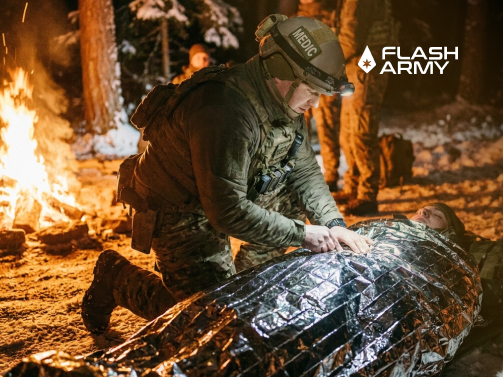
The victim should be covered completely, leaving only the face exposed for normal breathing. Special attention should be paid to the chest and abdomen areas, where most heat is lost. If the person is lying down, the blanket should extend underneath the body, creating maximum insulation.
During transport, the thermal blanket should not be removed unless medically necessary. It does not hinder aid and can remain on the person for a long time. In tactical medicine, this is standard practice.
Precautions
A thermal blanket is not a heat source and does not replace active warming. It should not be used as the sole means in cases of severe hypothermia. It is also important to avoid tightly covering the airways. The material is not air-permeable.
It is also important to remember:
- Do not use near open flames.Do not cut the blanket unnecessarily.
- Do not discard after single use if it is not damaged.
Conclusion
A thermal blanket is a simple but critically important tool in the first-aid system. It requires no special training but can significantly impact a person's condition in the first minutes after an injury. Understanding its operating principle and correct use increases the effectiveness of aid. That is why a thermal blanket should not just be in a first-aid kit, but also in the sight of those responsible for safety and medical support.