Gas cylinders are used not only in everyday life but also in tourism, industrial, and military applications. Gas is not only a convenient and economical energy source but also a potential source of danger. To understand why gas cylinders explode, one must know how they are constructed, how to store gas cylinders, and what mistakes to avoid.
Gas cylinders come in various types: household, camping, and industrial. Regardless of the type, they all operate on the same principle: gas is stored inside under pressure, and if this balance is disrupted, a release or explosion occurs.
Main Causes of Gas Cylinder Explosions
There can be many causes of an explosion, but they all boil down to a few main ones. Let's examine each in detail to understand how to act safely.
Overheating
One of the most common causes of cylinder explosions is overheating. When a gas cylinder is left near an open flame, heaters, or in direct sunlight, the internal pressure rapidly increases. If the temperature exceeds the permissible limit, the valves may not release the excess pressure quickly enough, and the casing simply cannot withstand it.
To avoid this:
- Do not leave gas cylinders in the sun or near fire.
- Do not place a stove directly on or next to the cylinder.
- Store gas in the shade or cover it with insulating material.
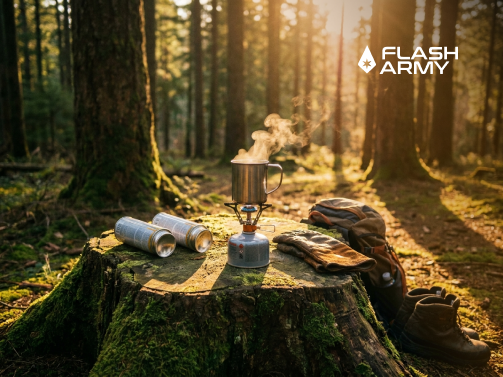
It is also important to understand that even camping cylinders used for portable gas stoves have temperature limitations. In summer, in a car or on the beach, they can heat up to critical values.
Mechanical Damage
Any crack, dent, or scratch on the casing is a potential threat. If a cylinder sustains even minor deformation during transport or a fall, it must be inspected. Such a gas cylinder inspection allows for the detection of dangerous spots that could crack under pressure.
It is worth remembering:
- A cylinder is a metal container, but even metal ages.
- Rust is the main enemy of the casing.
- Do not throw or drag the cylinder on the ground.
At Flash Army, you can find reliable gas cylinders made from quality materials that withstand loads and are tested for strength. But even the best cylinder requires careful and cautious handling.
Improper Storage
How a gas cylinder is stored is crucial. The most common mistakes are storage in enclosed, poorly ventilated areas or in high humidity.
To ensure safety:
- Store cylinders in an upright position.
- Do not keep them near radiators or electrical appliances.
- Ensure the valve is closed.
- Perform a gas cylinder inspection once a year.
This is especially important in summer when pressure increases even without external heating. Violations of storage rules often lead to gradual weakening of the metal or loss of hermeticity.
Gas Leak
Gas is odorless, so manufacturers add special odorants to it. If you smell a strong odor, it's a signal to act immediately. A leak is the most dangerous condition because gas ignites instantly upon contact with a spark or flame.
What to do:
- Close the valve.
- Do not turn on lights or use your phone.
- Open windows and doors.
- Move the cylinder to an open area.
After this, a gas cylinder inspection or replacement is required. Leaks can result from a worn valve, a faulty hose, or a damaged connection.
Overpressure
A certain operating pressure, calculated by the manufacturer, is maintained inside each cylinder. If you fill the cylinder "by eye" or use an unsuitable regulator, the pressure may exceed the norm. The result is an explosion.
To avoid this:
- Fill cylinders only at certified points.
- Do not use unsuitable adapters.
- Always monitor the gas level.
In industrial settings, overpressure can occur due to equipment malfunction, which is why regular technical inspections of cylinders are conducted there.
What Happens During a Leak: Concentration, Ignition, Detonation
The explosion process has three stages. First, gas leaks, then it accumulates in an enclosed space, and only after that does ignition occur.
- Concentration: Gas mixes with air, forming an explosive mixture. For propane or butane, this is approximately 2–9% in the air.
- Ignition: A spark – even static – is enough to ignite the mixture.
- Detonation: The explosion wave spreads instantly, causing destruction and fire.
That is why a gas leak, even in a small volume, is a reason for immediate action. Explosions most often occur in garages, basements, kitchens, or tents, where ventilation is limited.
How to Prevent a Gas Cylinder Explosion
The most effective way to avoid danger is prevention.
Here are some basic rules:
- Regular Inspection. Check valves, hoses, and connections before each use.
- Storage. Follow the manufacturer's instructions on how to store a gas cylinder.
- Usage. Do not heat the cylinder or place it near fire.
- Ventilation. When in use, the cylinder should be outdoors or in a well-ventilated area.
- Inspection. Every few years, the cylinder should be submitted for inspection at a service center.
Camping models are designed with safety in mind – they are lightweight, sealed, and have overpressure relief valves. But even the best equipment won't save you if it's used incorrectly.
Conclusion
There can be many reasons for gas cylinder explosions, but they all boil down to the human factor – negligence, haste, or ignorance. Knowing how to store gas cylinders, how to check their condition, and what to do in case of a leak means protecting yourself and your loved ones.
A gas cylinder explosion is not an accident, but a consequence of violations. Therefore, every user must treat it with respect and caution. If you are looking for reliable gas cylinders, you should pay attention to the assortment at Flash Army – safety, quality, and reliability come first.