The mass adoption of small unmanned aerial vehicles (UAVs) has significantly changed the modern battlefield and the fundamentals of military and critical infrastructure security. Commercial quadcopters and FPV drones have turned into a serious threat that demands an immediate and adequate response. One of the most widespread countermeasures is the handheld anti-drone net launcher. It is a portable device designed to physically intercept drones at close range.
These devices are one of the simplest and safest tools for physically combating drones at short distances. Handheld net launchers are indispensable in situations where using electronic warfare (EW) systems is impossible or impractical. They also carry no risk of harming civilians, unlike firearms, allow the drone to be brought down intact for further study or reuse, and don't require any special skills.
In this article, we'll break down what handheld anti-drone net launchers are and how they work, as well as the top 5 handheld net launcher models and what to look for when choosing one. This material was written by the Flash Army team for military personnel, security specialists, developers of integrated protection systems, and military enthusiasts.
What Are Handheld Anti-Drone Net Launchers and How Do They Work
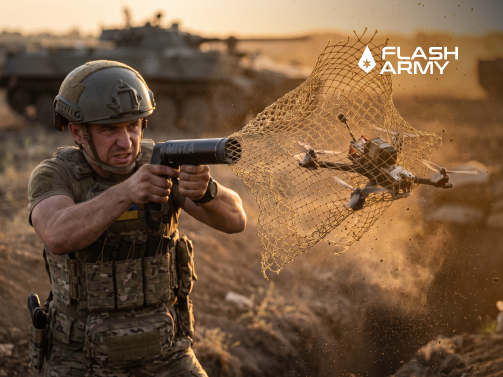
A handheld net launcher is a compact, portable device in a gun-like format (typically pneumatic or pyrotechnic), designed to neutralize drones by firing a sturdy net that deploys in the air and mechanically jams the aircraft's propellers. Unlike EW systems, a net launcher works purely mechanically, making it fully effective even against fully autonomous aerial targets.
A standard net launcher consists of three key structural elements: a grip with a trigger mechanism, an energy source (drive), and a barrel with a cartridge that holds the net itself.
Drive mechanisms come in two types:
- Pneumatic (compressed gas): built around standard CO₂ cartridges (similar to those used in air pistols or soda siphons). They're quiet, safe, and reusable, making them a great fit for civilian security services.
- Pyrotechnic (powder-based): powered by a blank cartridge, providing greater power, range, and net flight speed. They're widely used for intercepting fast military FPV drones.
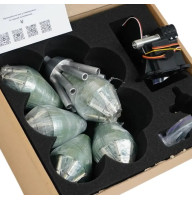
To prevent the net from firing out as a shapeless clump, special cylindrical or round weights are attached to its corners. These are what get propelled outward by the force of the gas or powder charge during firing. In flight, the weights fly outward in different directions, pulling the lines taut and unfolding the net behind them into a proper square or hexagon shape in the air.
The net itself is made from ultra-strong modern fibers: Kevlar, Dyneema, or specialized nylon. These threads have enormous tensile strength relative to their minimal weight, so a drone's propellers can't cut through them.
The operating principle of handheld net launchers works as follows:
- Target detection: the operator visually locates the drone and aims.
- Firing: using compressed gas or a pyrotechnic charge, the net is launched toward the UAV.
- Net deployment: the weights fly outward at an angle to one another, opening up the net and forming a "canopy" with an area of 3 to 9 square meters.
- Contact with the target: the net covers the drone, and the propellers, spinning at enormous speeds (up to 20,000–30,000 RPM), instantly catch and wind the sturdy threads around themselves.
- Fall or controlled descent: depending on the system's design, the drone either falls or (if the model has a parachute) descends to the ground along with the net.
The effectiveness of a net launcher depends heavily on the operator's skill and their ability to judge the correct distance. If fired too early, the net loses speed before reaching the target and hits the drone as a shapeless bundle. If fired too late, it either flies past the target or deploys after passing it.
Top 5 Handheld Net Launcher Models
Today, there's a range of kinetic counter-UAV solutions available, from disposable units carried in a chest rig pocket "just in case" to complex reusable engineered systems and even aerial interceptors. Let's look at 5 of the most popular and relevant handheld net launcher models:
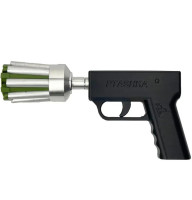
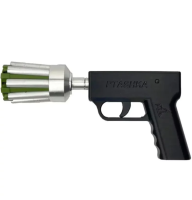
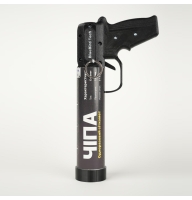
- "Chipa" is a compact, disposable, pistol-style net launcher designed for quickly intercepting FPV drones at close range. It's lightweight, with an ergonomic body, button activation, and built-in safety features. It stands out for ease of use and fast readiness for action.
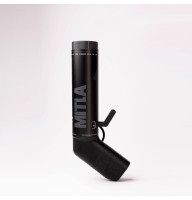
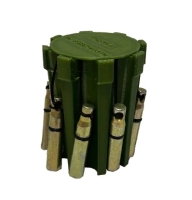
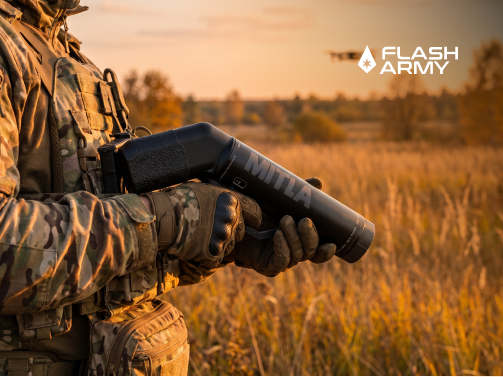
- "Mitla" is an ultralight, disposable, easy-to-use net launcher for infantry and mobile groups, designed for field conditions. It is suitable for operators with minimal training, fully self-contained, requires no maintenance, and is disposed of right after firing.
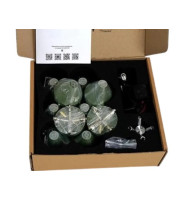
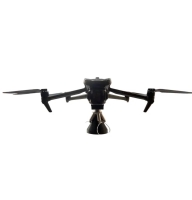
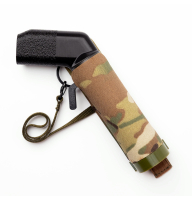
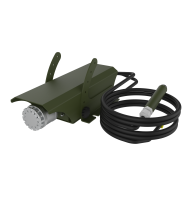
- "Ptashka" is a transformer-style model that serves as a universal handheld module that can also be mounted on an interceptor drone (such as a Mavic 3) for remote release by the drone operator.
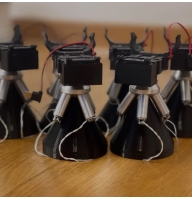
- "Pavuk" is a powerful, reusable handheld system with a double- or multi-layer net resembling a spider web in structure. Notable for its low noise level and quick-reload system.
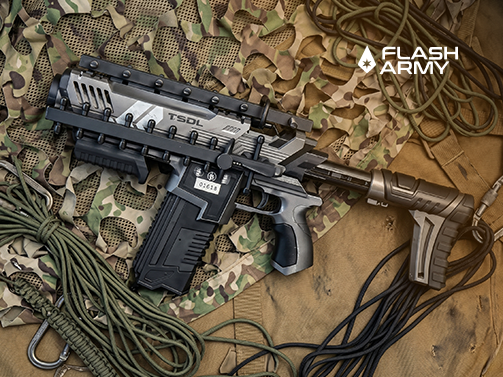
- "Stryzh" is a reusable, carbine-style net launcher with extended range and a full stock, designed for precision interception of high-speed targets.
All five models share the same practical purpose: effectively intercepting enemy drones through mechanical means, but they differ significantly in design.
Features of Each Model and a Brief Comparison
Let's take a detailed look at the features and technical specifications of each model:
Its main feature is a pistol-style ergonomic design with a clear anatomical grip. This device is built for an easy grip and quick response, and is well-balanced for one-handed operation. The sealed factory packaging protects the pyrotechnic cartridge from moisture and dirt in a trench. It serves as a rapid-response tool for when a drone is spotted at the last moment. Its weak point is that it can only be aimed "by eye"; the design doesn't allow for mounting sights.
Technical specifications:
- Usage type: disposable.
- Drive: pyrotechnic (blank cartridge).
- Weight: 500 g.
- Effective range: up to 25 m (net coverage area 3×3 m).
It’s an extremely minimalist disposable device that visually resembles a compact plastic or composite-cardboard tube, without a classic grip or stock. There's no need for any maintenance (cleaning, lubrication, or upkeep). Simply remove the cap, aim, fire, and discard the used device. Firing is triggered by pulling a pin or pressing an integrated button on the end. Its light weight allows it to be carried in a magazine pouch or attached to a chest rig (MOLLE). The main drawback: there's absolutely no possibility of reuse; you only get one chance for an accurate shot.
Technical specifications:
- Usage type: disposable.
- Drive: pyrotechnic (7.62 mm blank cartridge).
- Weight: 365–375 g.
- Effective range: up to 25 m (net coverage area 3.6×3.6 m).
Its main advantage is absolute versatility and a unique transformer concept. This model is capable of hunting both from the ground and from the air. When needed, the launcher unit can be detached and mounted onto the underside of an interceptor quadcopter. The remote trigger connects to the payload release system or lighting control system. However, the operator needs piloting and coordination skills to use the device in flight mode.
Technical specifications:
- Usage type: modular, reusable.
- Drive: pyrotechnic.
- Weight: 600 g.
- Effective range: up to 20 m (in flight mode, range is adjusted by the pilot).
Thanks to its pneumatic drive, the device operates without flame, smoke, or a loud powder-based bang, making it ideal for civilian use to protect critical infrastructure, businesses, and security services. The cartridge-based reload system allows the spent cartridge to be swapped for a new, pre-loaded one in 10 seconds. The universal multi-layer net reliably disables both large commercial-style quadcopters and small homemade drones. The main drawback is its dependence on cartridge gas pressure (in severe cold, the pneumatic system's effectiveness may decrease).
Technical specifications:
- Usage type: reusable.
- Drive: pneumatic.
- Weight: 1.8 kg.
- Effective range: up to 15–20 m.
It is a full-sized, heavy "anti-drone shotgun," but with a mechanical mode of action. Built for maximum range (up to 30 meters) and engaging moving targets. A shoulder stock helps stabilize aiming and absorb recoil from the pyrotechnic charge. There's an option to mount a red dot sight on the top rail. A special tool for manually packing the net is included. Its weak point is its bulky size, which requires a separate carrying strap.
Technical specifications:
- Usage type: reusable.
- Drive: reinforced pyrotechnic cartridge.
- Weight: 2.5 kg.
- Effective range: up to 30 m.
Each model has technical advantages that determine the types of tactical tasks and use cases it's best suited for. The ultralight, disposable "Mitla" and "Chipa" are clear leaders for frontline use, the transformer-style "Ptashka" is an ideal choice for flexible tactical tasks, and the heavy, reusable "Pavuk" and "Stryzh" best cover the needs of rear-area objects and layered defense.
What to Consider When Choosing a Handheld Net Launcher
When choosing a handheld net launcher, it's important to consider a range of characteristics that affect its effectiveness in real-world drone interception:
- Drive type: pyrotechnic versions are more powerful and have greater range, ideal for intercepting fast FPV drones, while pneumatic net launchers are quiet, safe, and a great choice for civilian defense.
- Net characteristics: a larger coverage area significantly increases the chance of catching the target, but bringing down small, maneuverable drones requires a multi-layer net or one with fine mesh that they can't slip through.
- Reload speed: as a "last resort" device in a trench, disposable tubes that require no reloading at all work best, while reusable devices with swappable cartridges are a better choice for complex tactical missions.
- Weight and ergonomics: lightweight models under 500 grams can be carried in a chest rig pouch, while heavier carbines (2 kg and up) require a separate strap and significantly weigh down the operator on the move.
- Presence of a safety: reusable models and pistol-style models typically include one, while compact disposable tubes often forgo it for the sake of faster activation and simpler design, requiring extra caution when carrying them.
It's best to test a net launcher before purchasing, if possible, or at least rely on reviews from users who have already used a specific model in combat conditions.
Conclusion
Handheld anti-drone net launchers are a simple yet effective tool for intercepting drones at close range, proving effective in situations where electronic warfare can't be used. Their mechanical operating principle, ease of use, and variety of models have made them an essential part of modern physical UAV interception systems. Net launchers for various tactical tasks are available for purchase at Flash Army.