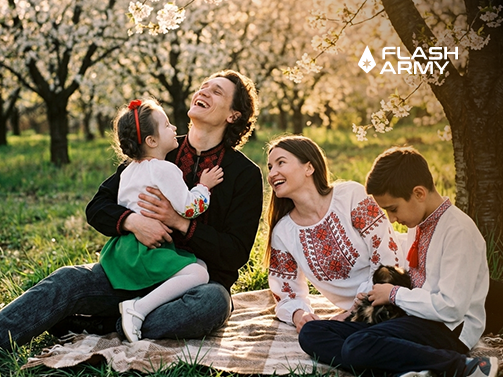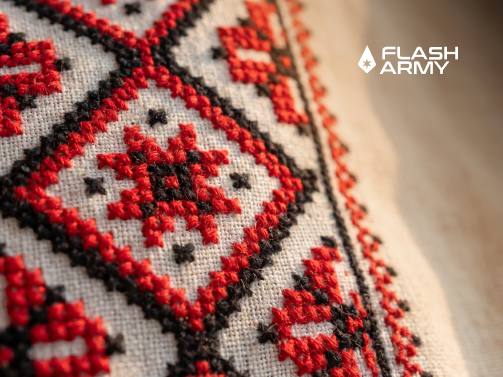
Vyshyvanka is not just an item of clothing, but a carrier of ancient Ukrainian symbolism with centuries of history and invaluable cultural significance. The first images of embroidered clothing in Ukraine can be seen on clay figurines from the Trypillian era, and the first physical evidence dates back to Scythian times.
Traditionally, vyshyvanka has always been considered a talisman, and therefore the symbols depicted on it were not chosen by chance — a deep meaning was embedded in every geometric figure or stitch. The patterns were meant to protect the wearer from misfortune and bring them good luck. It is this profound meaning, shaped by centuries of history, that has made vyshyvanka not just an item of clothing, but a true part of the cultural code.
This material will tell you what the symbols on vyshyvankas mean, which ornaments are traditional for different regions of Ukraine, and why their significance has not lost its relevance even today.
What the Vyshyvanka Ornaments Symbolize
The Ukrainian embroidered shirt has not only aesthetic value — every element here is filled with special meaning and is part of an entire ordered ancient system. The symbols, color, figures, and every stitch of the embroidery carry information about the person's gender, place of origin, lineage, and status.
There is a huge number of ornaments, each carrying a unique deep meaning and cultural memory. Vyshyvankas were sewn for the closest loved ones, and therefore, not only time and skill were invested in them, but also a deep meaning — they were meant to protect the owner, give them vital energy, and bring good fortune.
All ornaments served as a kind of code, intertwining beliefs, love, hopes and aspirations, connection with the surrounding world, family, ancestors, and divine forces. Roughly, three types of ornaments were used in Ukrainian vyshyvankas: geometric, floral, and animal. Let's look in more detail at which symbols are most characteristic of traditional embroidery, what they mean, and why the important meaning of the ornament on vyshyvanka is still preserved.
Geometric Ornaments: Meaning and Examples
Geometric ornaments are the oldest motifs of Ukrainian vyshyvanka and its foundation. They originate from times when people perceived the world, natural phenomena, elements, cosmic objects, family traditions, and agricultural processes through simple, understandable forms. Despite their simplicity, these symbols were endowed with magical meaning and served as a true formula.
Here are the main geometric symbols used:
- Rhombus (or Diamond) — one of the most common symbols, embodying the feminine principle, fertility, and the earth. There were several different variations:
- Rhombus with a dot — a sown field. The dot in this case symbolized a seed, and the element itself was often used as a talisman for brides and pregnant women.
- Rhombus with hooks (or tendrils) — also called a "frog," as this animal symbolized moisture necessary for life; it is also a symbol of the plow, protection, and comfort.
- Square — a symbol of order, stability, harmony, perfection. The square embodied material meaning and the masculine principle; it often symbolized a field, as well as cyclicity (4 cardinal directions, seasons, etc.).
- Triangle — symbolizes the trinity of the world. As an interpretation of time — past, present, and future; of family — father, mother, and son; of spiritual principles — divine, human, and natural forces. With the advent of Christianity, the triangle began to symbolize the Holy Trinity.
- Circle — a symbol of the sun (solar sign), as well as fire and light, which are its continuation, life-giving energy, the victory of light over darkness. It also meant movement and the continuity of life, eternity. Often, a circle with rays was embroidered.
- Cross — the center of the universe, a symbol of balance and harmony, the combination of four elements, as well as the feminine and masculine principles (a straight cross symbolized the masculine principle, and an oblique one — the feminine). It was considered a very strong protective sign.
- Eight-pointed star (Roza or Alatyar) — an eight-pointed cross that combined the feminine and masculine principles with a center where new life is born. It was believed that this symbol could guide a person through life and "illuminate" their path as a simplified image of the Sun.
- Spiral (or Wave) — a symbol of the water element and the feminine principle, eternity, longevity, infinity, the flow of life.
Geometric ornaments were very often combined and repeated many times, turning the embroidery into a kind of code designed to endow the owner with protection from evil, good fortune, and abundance.
Floral Motifs in Vyshyvanka and Their Symbolism
Floral ornaments are the second most important group of symbols in Ukrainian embroidery, which began to be used a little later but added picturesqueness and poeticism to it. Here there is less abstraction, but a strong connection with nature and a reflection of earthly life, beauty, and family ties are clearly traceable. The following symbols were most often used:
- Tree of Life — one of the central, most profound symbols, meaning the Universe: roots (past), trunk (present), and crown (future). It reflects the connection between generations and the unity of the world. Most often depicted as a plant in a pot on wedding rushnyks or women's vyshyvankas.
- Viburnum (Kalyna) — a very widely used motif symbolizing family, maiden beauty, love. It also signifies blood — family and national, shed in the struggle against enemies.
- Oak — embodies masculine strength, protection, longevity, might, resilience, courage. Most often used on men's shirts.
- Grapes — joy, prosperity, fertility, well-being, united family. An ancient agricultural symbol that has firmly taken root in Ukrainian embroidery, actively used in wedding rushnyks.
- Poppy — memory of ancestors and fallen warriors, as well as a powerful talisman against evil and a symbol of the fire of life.
- Periwinkle — a delicate and tender sign of fidelity in love, which will not freeze even under snow, like this flower. Often used in maiden and wedding shirts.
- Hops — has a meaning close to grapes, symbolizing youth, vitality, life energy. Embroidered on men's clothing.
- Rose (Ruzha) — a symbol of love, feminine beauty, and strength. Often used on women's shirts and wedding rushnyks.
- Wheat (Ear) — abundance, fruitfulness, fertility, wealth, vital force.
Ukrainian culture is inextricably linked with agriculture and nature, which is why floral ornaments are a very important part of embroidery, used in men's and women's clothing and having deep cultural significance.
Zoomorphic Symbols: Animals in Embroidered Patterns
Animal symbols in Ukrainian embroidery are more stylized than floral ones, and are often depicted more abstractly, resembling geometric figures. They are less common than geometric or floral ornaments, but have no less interesting and profound meaning. They often reflect the ancient ancestors' ideas about nature, patron spirits, and certain human traits.
The following zoomorphic symbols are found in embroidery:
- Birds: most often symbols of love, fidelity, good news, peace. One of the most important meanings is mediation between heaven and earth. The most common zoomorphic group. The following varieties are most often used:
- Pair of birds (swans or doves) — love, fidelity, harmony, tenderness, family happiness. With viburnum in their beaks — concord and continuation of the lineage. Often embroidered on family rushnyks.
- Rooster — a symbol of the sun, new beginnings, protection from evil, awakening of nature.
- Swallow — good news, the arrival of spring, renewal of life.
- Stork — symbolized the continuation of the lineage, family ties, fidelity, prosperity, native home.
- Dove — a bird of peace, spirituality, purity, and bright hope.
- Firebird (or peacock) — a solar symbol meaning well-being, abundance, flourishing, happiness, luck.
- Insects: not very often depicted due to their small size, but had a deep meaning — tireless work, harmony with nature, the importance of every living creature in the universe. Mostly the following insects were depicted in embroidery:
- Butterfly — lightness, beauty, bright energy, rebirth, souls of ancestors. Most often embroidered on children's clothing.
- Spider — a good symbol meaning home comfort and protection, patience and creation, connection between worlds; often depicted as a spiderweb, symbolizing the pattern of fate.
- Bee — tireless work, connection with the earth and nature, vital energy, wisdom, order.
- Ladybug — a symbol of the sun, goodness, good news, and patronage of higher powers.
- Animals: zoomorphic symbols required considerable skill and attention to detail from the embroiderer, so they can most often be seen on expensive festive attire. The following varieties of animals were widely used:
- Horse — according to Slavic myth, it carried the sun, so it is a solar symbol and a talisman, meaning purposefulness, endurance, vital force.
- Bull — symbolized courage, stubbornness, fertility, the power of the earth.
- Deer — an ancient symbol with Scythian roots, meaning the victory of light over darkness and the connection between the spiritual and earthly worlds. Antlers were often stylized as the tree of life.
- Ram — prosperity, wealth, home comfort, fertility, and the cyclicity of life. Ram horns were often depicted separately.
- Snake — a symbol of wisdom and protection, as well as water, fertility, connection with the underworld.
- Fish — fertility, life, abundance, knowledge, and spirituality. Often only fish scales were depicted as a symbol of protection.
Not infrequently, one can see not only real animals but also mythical creatures on vyshyvankas — such as the Bird-Maiden (a bird with a woman's face), winged animals (most often dogs), or Berehynia (a female figure whose hands transform into flowers and branches). All these symbols had deep roots and served the function of protection and connection with supernatural forces.
How Ornaments Were Chosen in Different Regions of Ukraine
Each region had its characteristic ornaments, related to natural conditions, geography, traditions, daily life, and even the influence of neighboring cultures. Vyshyvanka could serve as a kind of passport, as a person's origin could be determined by its pattern, symbols, and thread color.
- Halychyna — mostly geometric and sometimes stylized animal ornaments in bright colors, characteristic of mountainous areas;
- Bukovyna — this region was characterized by decorative floral patterns with added beads and shiny threads;
- Podillia — zoomorphic elements and complex geometry were widely used; a regional feature is embroidery from the inside out and sleeves completely covered with black threads (Borshchiv embroidery);
- Polissia — for the northern regions, minimalist geometric ornaments with strong protective symbolism and monochromatic red embroidery on white are characteristic;
- Poltavshchyna — here, contrasting or exquisite monochromatic white embroidery, restrained floral and geometric ornaments were widespread;
- Slobozhanshchyna — the central and eastern regions are characterized by colorful or red-and-black volumetric floral embroidery, including satin stitch; embroidered roses or typical Cossack protective symbolism (crosses and stars) can often be seen;
- Southern Ukraine — here, neighboring cultures (Greek, Crimean Tatar, etc.) brought significant influence; floral ornaments are widely used, with typical oriental flowers such as tulips or hyacinths; thin geometric patterns, gold thread, and combinations of contrasting colors are also common.
The ornaments of Ukrainian embroidery always reflected the daily life, traditions, and characteristics of the region. Thus, for mountainous areas, colorful geometry, which was an image of mountain nature, as well as stylistic depictions of domestic animals, were characteristic. In the central part, inextricably linked with agriculture, lush flowers and floral ornaments were most often embroidered, and in the south, yellow and blue — the colors of the sun and the sea — were often combined.
Why Vyshyvanka Symbolism Is Important Today
Vyshyvanka has not only not lost its relevance but has also become a true symbol of identity — cultural, national, and even regional. The symbolism of vyshyvanka preserves knowledge about the beliefs, fears, hopes of our ancestors, and the trials they went through. The belief that a set of embroidered symbols can protect from misfortune, passed down through generations, is alive today. That is why in many families, embroidered shirts are still passed down as a family heirloom.
It is not just an item of clothing, but a living historical memory that unites Ukrainians around the world, serves as a true marker in a globalized modern culture, and reminds of the indomitable spirit and strength of the people, of the struggle against evil, and the will for constant rebirth, embedded by nature itself. Women's and men's vyshyvankas in various designs and techniques can be purchased at the FlashArmy online store.